
Big Hairy Armadillo
Chaetophractus villosus
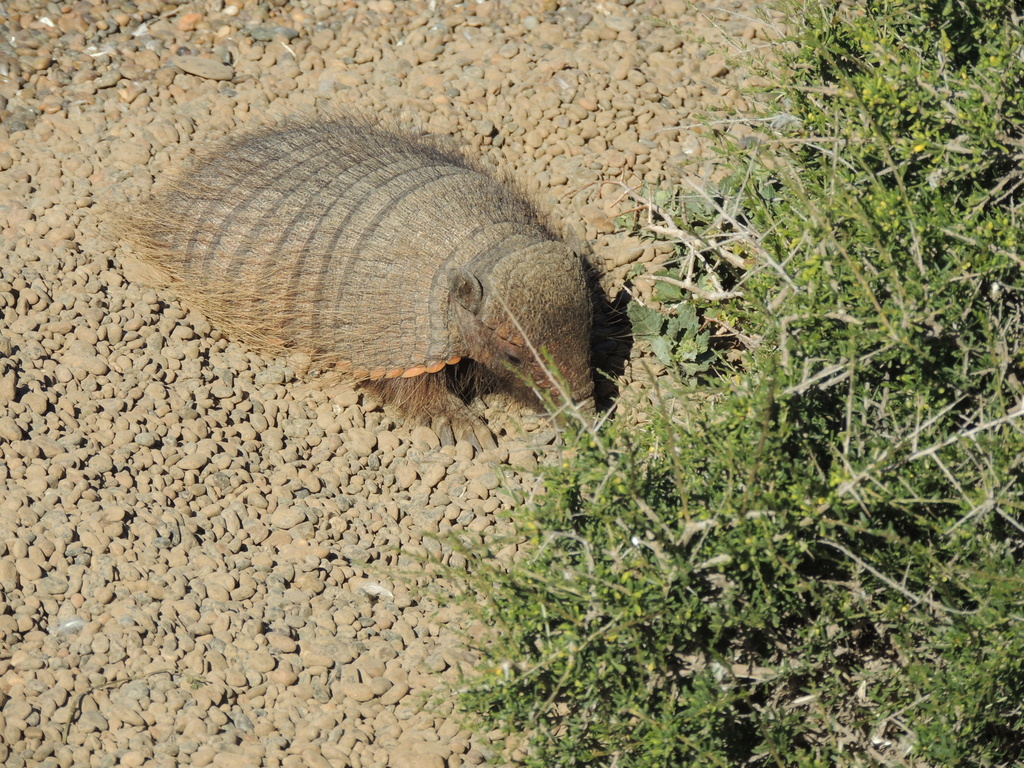
The big (or large) hairy armadillo (Chaetophractus villosus) is one of the largest and most numerous armadillos in South America.
- Kingdom
- Animalia
- Phylum
- Chordata
- Class
- Mammalia
- Order
- Cingulata
- Family
- Dasypodidae
- Genus
- Chaetophractus
- Species
- Chaetophractus villosus
Description
The big (or large) hairy armadillo (Chaetophractus villosus) is one of the largest and most numerous armadillos in South America. It lives from sea level to altitudes of up to 1,300 meters across the southern portion of South America, and can be found in grasslands, forests, and savannahs, and has even started claiming agricultural areas as its home. It is an accomplished digger and spends most of its time below ground. It makes both temporary and long-term burrows, depending on its food source. In Spanish it is colloquially known as peludo. Armadillos are protected from predators by a series of thin, bony plates along the head and back. They reach sexual maturity at around 9 months and have been known to live over 30 years in captivity. Though this animal is routinely harvested for its meat and its shell, or simply killed by farmers, it has shown resiliency, and populations seem to be handling this exploitation well. Currently, no protective practices are in place for this armadillo, but it does live in many protected areas. This species of armadillo is a preferred research animal due to its adaptability to laboratory settings, and relative hardiness in situations of stress.
Gallery
Ajouter des photos
Partagez vos photos de cette espèce (jusqu'à 20 à la fois) : elles sont vérifiées automatiquement, puis publiées.
Répartition
Occurrences observées (données GBIF). Les zones hors aire d'origine peuvent indiquer une présence introduite ou invasive.
Sources et crédits
Informations provenant de plusieurs sources vérifiées. Dernière mise à jour : .
Crédits photos (6)
- Photo : @defnis · CC BY-NC 4.0 · via iNaturalist
- Photo : Andrés Pautasso (@andrespautasso) · CC BY-NC 4.0 · via iNaturalist
- Photo : Jim Moore (Maryland) (@jimmoore) · CC BY 4.0 · via iNaturalist
- Photo : Philipp Pavelka (@philpav) · CC BY 4.0 · via iNaturalist
- Photo : Gonzalo Roget (@gonsaro) · CC BY 4.0 · via iNaturalist
- Photo : Ivan L. F. Magalhaes (@ivanlfm) · CC BY-NC 4.0 · via iNaturalist
Mentions de licence
Texte disponible sous licence CC BY-SA 4.0. Il adapte notamment Chaetophractus villosus, Wikipedia (CC BY-SA) : Big hairy armadillo (Wikipédia, auteurs dans l’historique de l’article).
- Taxonomie : GBIF Backbone Taxonomy (CC BY 4.0)
- Carte : occurrences GBIF, fond © contributeurs OpenStreetMap (ODbL)
- Statut de conservation : Liste rouge de l'UICN, via Wikidata (CC0)
Détail : Sources et licences.
Discussion (0)
Aucun message pour l’instant. Lancez la discussion sur cette fiche (sources, précisions, débats éditoriaux).
Connectez-vous pour participer à la discussion.