
Golden jackal
Canis aureus
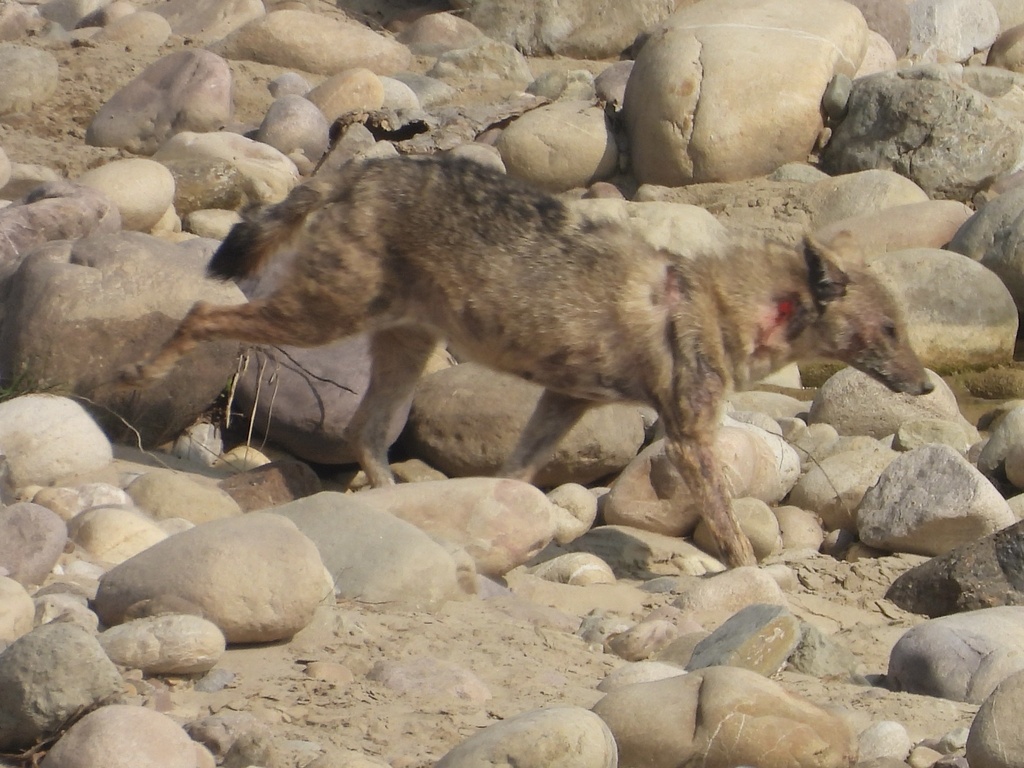
The golden jackal (Canis aureus), also called the common jackal, is a wolf-like canid that is native to Eurasia.
- Kingdom
- Animalia
- Phylum
- Chordata
- Class
- Mammalia
- Order
- Carnivora
- Family
- Canidae
- Genus
- Canis
- Species
- Canis aureus
Description
The golden jackal (Canis aureus), also called the common jackal, is a wolf-like canid that is native to Eurasia. The golden jackal's coat varies in color from a pale creamy yellow in summer to a dark tawny beige in winter. It is smaller and has shorter legs, a shorter tail, a more elongated torso, a less-prominent forehead, and a narrower and more pointed muzzle than the Arabian wolf. It is listed as Least Concern on the IUCN Red List due to its widespread distribution and high density in areas with plenty of available food and optimum shelter. Despite its name, the golden jackal is not closely related to the African black-backed jackal or the side-striped jackal, which are part of the genus Lupulella. It is instead closer to wolves and coyotes. The ancestor of the golden jackal is believed to be the extinct Arno river dog that lived in southern Europe 1.9 million years ago. It is described as having been a small, jackal-like canine. Genetic studies indicate that the golden jackal expanded from India around 20,000 years ago, towards the end of the last Last Glacial Maximum. The oldest golden jackal fossil, found at the Ksar Akil rock shelter near Beirut, Lebanon, is 7,600 years old. The oldest golden jackal fossils in Europe were found in Greece and are 7,000 years old. There are six subspecies of the golden jackal. It is capable of producing fertile hybrids with both the gray wolf and the African wolf. Jackal–dog hybrids called Sulimov dogs are in service at the Sheremetyevo Airport near Moscow, where they are deployed by the Russian airline Aeroflot for scent-detection. The golden jackal is abundant in valleys and beside rivers and their tributaries, canals, lakes, and seashores; however, the species is rare in foothills and low mountains. It is a social species, the basic social unit of which consists of a breeding pair and any young offspring. It is very adaptable, with the ability to exploit food ranging from fruit and insects to small ungulates. It attacks domestic fowl and domestic mammals up to the size of domestic water buffalo calves. Its competitors are the red fox, steppe wolf, jungle cat, Caucasian wildcat, the raccoon in the Caucasus and in Central Asia, and the Asiatic wildcat. It is expanding beyond its native grounds in from Southeast Europe into Central Europe as far as France, and Northeast Europe into areas where there are few or no wolves.
Gallery
Ajouter des photos
Partagez vos photos de cette espèce (jusqu'à 20 à la fois) : elles sont vérifiées automatiquement, puis publiées.
Répartition
Occurrences observées (données GBIF). Les zones hors aire d'origine peuvent indiquer une présence introduite ou invasive.
Sources et crédits
Informations provenant de plusieurs sources vérifiées. Dernière mise à jour : .
Crédits photos (4)
- Photo : @mochabonsai · CC BY-NC 4.0 · via iNaturalist
- Photo : Ilgın Ertan Gürol (@ilgingurol) · CC BY-NC 4.0 · via iNaturalist
- Photo : @cholzapfel · CC BY-NC 4.0 · via iNaturalist
- Photo : James (@outwestman) · CC BY-NC 4.0 · via iNaturalist
Mentions de licence
Texte disponible sous licence CC BY-SA 4.0. Il adapte notamment Wikipedia (CC BY-SA) : Golden jackal (Wikipédia, auteurs dans l’historique de l’article).
- Taxonomie : GBIF Backbone Taxonomy (CC BY 4.0)
- Carte : occurrences GBIF, fond © contributeurs OpenStreetMap (ODbL)
- Statut de conservation : Liste rouge de l'UICN, via Wikidata (CC0)
Détail : Sources et licences.
Discussion (0)
Aucun message pour l’instant. Lancez la discussion sur cette fiche (sources, précisions, débats éditoriaux).
Connectez-vous pour participer à la discussion.