
Père David's Deer
Elaphurus davidianus
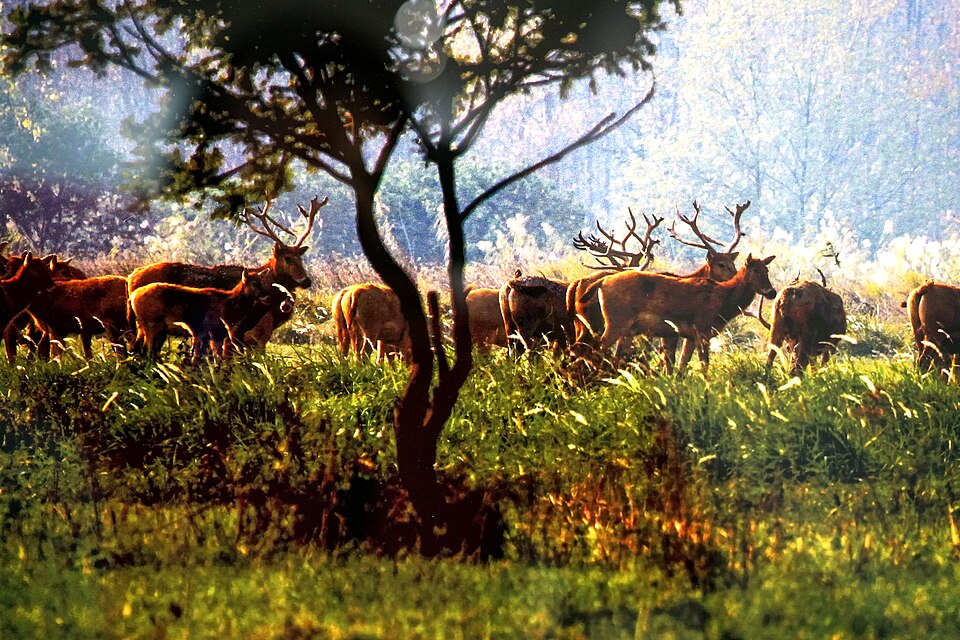
Père David's deer (Elaphurus davidianus), also known as the milu (Chinese: 麋鹿; pinyin: mílù) or elaphure, is a species of deer native to the subtropical river valleys of China.
- Kingdom
- Animalia
- Phylum
- Chordata
- Class
- Mammalia
- Order
- Artiodactyla
- Family
- Cervidae
- Genus
- Elaphurus
- Species
- Elaphurus davidianus
Description
Père David's deer (Elaphurus davidianus), also known as the milu (Chinese: 麋鹿; pinyin: mílù) or elaphure, is a species of deer native to the subtropical river valleys of China. It grazes mainly on grass and aquatic plants. It is the only extant member of the genus Elaphurus. Some experts suggest demoting Elaphurus to a subgenus of Cervus. Based on genetic comparisons, Père David's deer is closely related to Eld's deer. Père David's deer were hunted almost to extinction in their native China by the late 19th century, but a number were taken to zoos in France and Germany and the deer was bred successfully in captivity. In the early 20th century, the British nobleman and politician Herbrand Russell, 11th Duke of Bedford, acquired a few Père David's deer from the Berlin Zoo and built up a large herd on his estate at Woburn Abbey. In the 1980s, the duke's great-grandson Robin Russell, 14th Duke of Bedford, donated several dozen deer to the Chinese government for reintroducing the species to the wild. In 2020, the wild population in China was estimated at 2,825 individuals, with a further 7,380 in various nature reserves in China. All Père David's deer alive today descend from Herbrand Russell's original herd.
Gallery
Ajouter des photos
Partagez vos photos de cette espèce (jusqu'à 20 à la fois) : elles sont vérifiées automatiquement, puis publiées.
Répartition
Occurrences observées (données GBIF). Les zones hors aire d'origine peuvent indiquer une présence introduite ou invasive.
Sources et crédits
Informations provenant de plusieurs sources vérifiées. Dernière mise à jour : .
Crédits photos (7)
- Photo : 白色瑰宝 · CC BY-SA 4.0
- Photo : 白色瑰宝 · CC BY-SA 4.0
- Photo : @xhttttttt · CC BY-NC 4.0 · via iNaturalist
- Photo : @wzwqoo · CC BY-NC 4.0 · via iNaturalist
- Photo : @jiuwan2018 · CC BY-NC 4.0 · via iNaturalist
- Photo : @yihan_chen_ss · CC BY-NC 4.0 · via iNaturalist
- Photo : @legom · CC BY-NC 4.0 · via iNaturalist
Mentions de licence
Texte disponible sous licence CC BY-SA 4.0. Il adapte notamment Wikipedia (CC BY-SA) : Père David's deer (Wikipédia, auteurs dans l’historique de l’article).
- Taxonomie : GBIF Backbone Taxonomy (CC BY 4.0)
- Carte : occurrences GBIF, fond © contributeurs OpenStreetMap (ODbL)
- Statut de conservation : Liste rouge de l'UICN, via Wikidata (CC0)
Détail : Sources et licences.
Discussion (0)
Aucun message pour l’instant. Lancez la discussion sur cette fiche (sources, précisions, débats éditoriaux).
Connectez-vous pour participer à la discussion.