
Greater spot-nosed Monkey
Cercopithecus nictitans
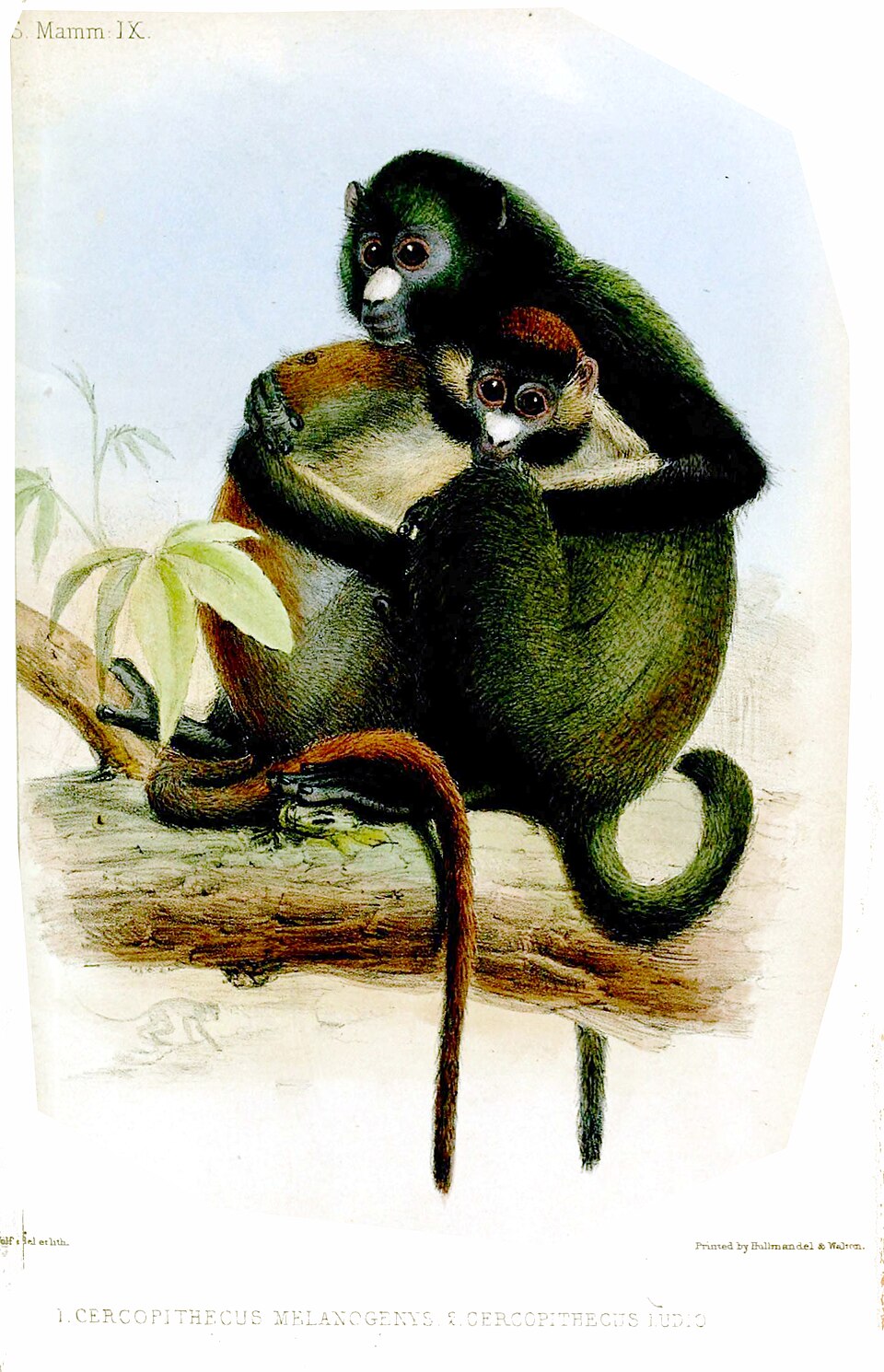
The greater spot-nosed monkey or putty-nosed monkey (Cercopithecus nictitans) is one of the smallest Old World monkeys.
- Kingdom
- Animalia
- Phylum
- Chordata
- Class
- Mammalia
- Order
- Primates
- Family
- Cercopithecidae
- Genus
- Cercopithecus
- Species
- Cercopithecus nictitans
Description
The greater spot-nosed monkey or putty-nosed monkey (Cercopithecus nictitans) is one of the smallest Old World monkeys. It is a guenon of the C. mitis group, native to West Africa and living to some extent in rain forests, but more often in the transition zone between rain forest and savannah. It is primarily arboreal and often associates with monkeys of other species. Both their common names come from the monkeys' prominent white nose. The greater spot-nosed monkey lives in groups consisting of one adult male, a number of adult females, and their dependent offspring. Little recent research has been conducted into its behaviour, and most has concentrated on its auditory communication. Males use three call types which have been described as 'booms', 'pyows', and 'hacks'. These are used in a number of contexts including as alarm calls. As in some other species of monkeys, the acoustical structure of greater spot-nosed monkey alarm calls it has been argued to vary according to the kind of predator spotted. The monkey reportedly combines different sounds into a sequence, which has an entirely different meaning from the sounds out of which it is made.
Gallery
Ajouter des photos
Partagez vos photos de cette espèce (jusqu'à 20 à la fois) : elles sont vérifiées automatiquement, puis publiées.
Répartition
Occurrences observées (données GBIF). Les zones hors aire d'origine peuvent indiquer une présence introduite ou invasive.
Sources et crédits
Informations provenant de plusieurs sources vérifiées. Dernière mise à jour : .
Crédits photos (7)
- Photo : Joseph Wolf · Domaine public
- Photo : R.I.Pocock (text) · Domaine public
- Photo : @pgtz · CC BY-NC 4.0 · via iNaturalist
- Photo : Mayukh Dey (@mayukh_dey) · CC BY-NC 4.0 · via iNaturalist
- Photo : Dérozier Violette (@violettederozier) · CC BY-NC 4.0 · via iNaturalist
- Photo : Matt Muir (@muir) · CC BY 4.0 · via iNaturalist
- Photo : Dérozier Violette (@violettederozier) · CC BY-NC 4.0 · via iNaturalist
Mentions de licence
Texte disponible sous licence CC BY-SA 4.0. Il adapte notamment Wikipedia (CC BY-SA) : Greater spot-nosed monkey (Wikipédia, auteurs dans l’historique de l’article).
- Taxonomie : GBIF Backbone Taxonomy (CC BY 4.0)
- Carte : occurrences GBIF, fond © contributeurs OpenStreetMap (ODbL)
- Statut de conservation : Liste rouge de l'UICN, via Wikidata (CC0)
Détail : Sources et licences.
Discussion (0)
Aucun message pour l’instant. Lancez la discussion sur cette fiche (sources, précisions, débats éditoriaux).
Connectez-vous pour participer à la discussion.