
Black Duiker
Cephalophus niger
The black duiker (Cephalophus niger), also known as tuba in Dyula, is a forest-dwelling duiker found in the southern parts of Sierra Leone, Liberia, Côte d'Ivoire, Ghana, Benin, and Nigeria.
- Kingdom
- Animalia
- Phylum
- Chordata
- Class
- Mammalia
- Order
- Artiodactyla
- Family
- Bovidae
- Genus
- Cephalophus
- Species
- Cephalophus niger
Description
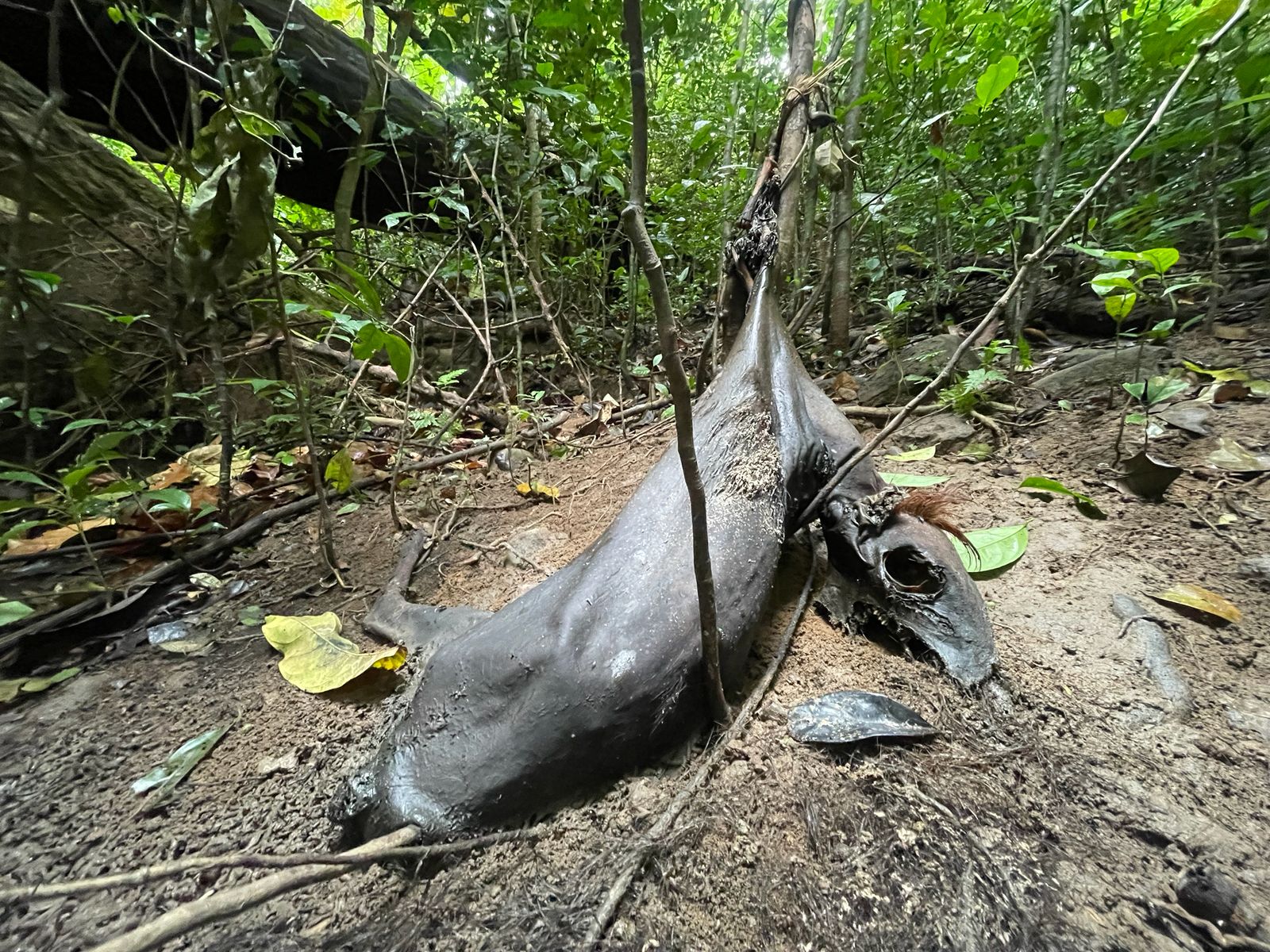
The black duiker (Cephalophus niger), also known as tuba in Dyula, is a forest-dwelling duiker found in the southern parts of Sierra Leone, Liberia, Côte d'Ivoire, Ghana, Benin, and Nigeria. Black duikers stand around 500 mm (20 in) tall at the shoulder and weigh 15 to 20 kg (33 to 44 lb). They have, not surprisingly, black coats. The head is a rust colour with a large red crest between the ears. Black duikers have long, thin horns of 80 to 170 mm (3.1 to 6.7 in), but the horns of females reach only 30 mm (1.2 in). Black duikers live mainly in lowland rainforest, where they eat fruit, flowers, and leaves which have fallen from the canopy. They are probably diurnal, though this is surmised only from captive specimens. Black duiker are reported to be solitary, territorial animals. The mating season of the black duikers is year round, but more offspring are born from November to January. The gestation period lasts 126 days, and is thus comparably short, usually only one young is born. Its average weight is 1.94 kg (4.3 lb); it is weaned around 90 days of age. The birth interval is seven and a half months. In captivity, the black duiker lives up to 14 years. An estimated 100,000 black duikers are left in the world; they are threatened by hunting and are considered to be in decline across their range.
Gallery
Ajouter des photos
Partagez vos photos de cette espèce (jusqu'à 20 à la fois) : elles sont vérifiées automatiquement, puis publiées.
Répartition
Occurrences observées (données GBIF). Les zones hors aire d'origine peuvent indiquer une présence introduite ou invasive.
Sources et crédits
Informations provenant de plusieurs sources vérifiées. Dernière mise à jour : .
Crédits photos (10)
- Photo : Daniel Alempijevic · CC BY-NC 4.0 · via GBIF
- Photo : Max Schmitt · CC BY-NC 4.0 · via GBIF
- Photo : ChimpAndSee · CC BY-NC 4.0 · via GBIF
- Photo : ChimpAndSee · CC BY-NC 4.0 · via GBIF
- Photo : ChimpAndSee · CC BY-NC 4.0 · via GBIF
- Photo : ChimpAndSee · CC BY-NC 4.0 · via GBIF
- Photo : ChimpAndSee · CC BY-NC 4.0 · via GBIF
- Photo : ChimpAndSee · CC BY-NC 4.0 · via GBIF
- Photo : ChimpAndSee · CC BY-NC 4.0 · via GBIF
- Photo : ChimpAndSee · CC BY-NC 4.0 · via GBIF
Mentions de licence
Texte disponible sous licence CC BY-SA 4.0. Il adapte notamment Cephalophus niger, Wikipedia (CC BY-SA) : Black duiker (Wikipédia, auteurs dans l’historique de l’article).
- Taxonomie : GBIF Backbone Taxonomy (CC BY 4.0)
- Carte : occurrences GBIF, fond © contributeurs OpenStreetMap (ODbL)
- Statut de conservation : Liste rouge de l'UICN, via Wikidata (CC0)
Détail : Sources et licences.
Discussion (0)
Aucun message pour l’instant. Lancez la discussion sur cette fiche (sources, précisions, débats éditoriaux).
Connectez-vous pour participer à la discussion.