
Jentink's Duiker
Cephalophus jentinki
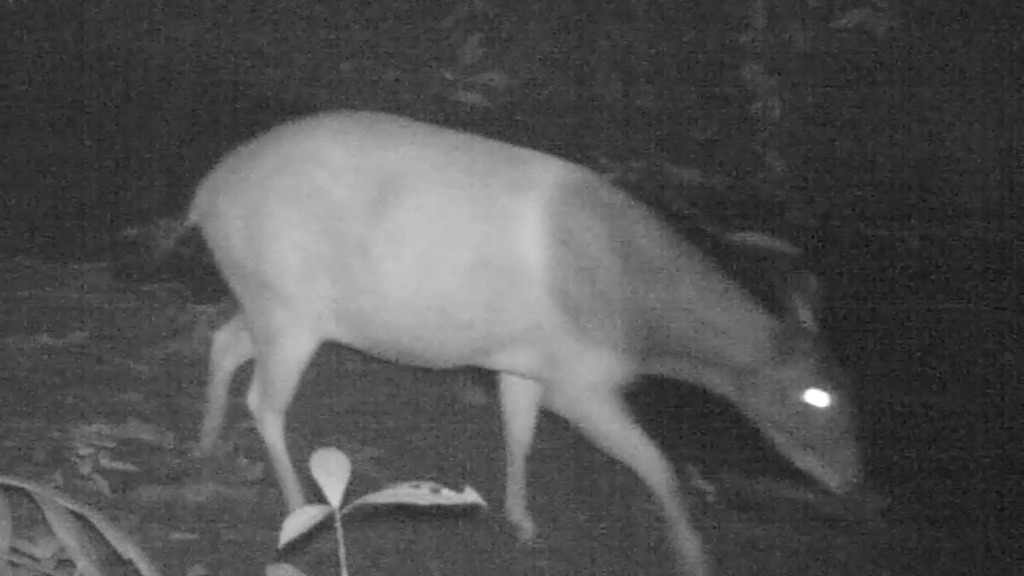
Jentink's duiker (Cephalophus jentinki), also known as gidi-gidi in Krio and kaikulowulei in Mende, is a forest-dwelling duiker found in the southern parts of Liberia, southwestern Côte d'Ivoire, and scattered enclaves in Sierra Leone.
- Kingdom
- Animalia
- Phylum
- Chordata
- Class
- Mammalia
- Order
- Artiodactyla
- Family
- Bovidae
- Genus
- Cephalophus
- Species
- Cephalophus jentinki
Description
Jentink's duiker (Cephalophus jentinki), also known as gidi-gidi in Krio and kaikulowulei in Mende, is a forest-dwelling duiker found in the southern parts of Liberia, southwestern Côte d'Ivoire, and scattered enclaves in Sierra Leone. It is named in honor of Fredericus Anna Jentink. Jentink's duikers stand around 80 cm (31 in) tall at the shoulder and weigh about 70 kg (150 lb), making them the largest species of the duikers. They are gray from the shoulders back and dark black from the shoulders forward. A white band goes over the shoulders, between the two colours and joining the white undersides. Jentink's duikers have long, thin horns, which curl back a little at the ends, and reach between 14 and 21 cm (5.5 and 8.3 in). Jentink's duikers live mainly in very thick rainforest, where they eat fruit, flowers, and leaves which have fallen from the canopy, as well as stems of seedlings, roots, and, to the annoyance of local farmers, palm nuts, mangos, and cocoa pods. They are nocturnal and shelter during the day in dense thickets, or buttress roots, apparently in pairs. Jentink's duikers are reported to be territorial animals, and when frightened, will run very quickly, but wear themselves out easily. The species was first recognized as a new species in 1884, though it was not described until 1892. The species then vanished until a skull was found in Liberia in 1948. Sightings have occurred in its habitat since the 1960s. In 1971, the species was successfully bred in the Gladys Porter Zoo. Recent population numbers are not available. In 1999 it was estimated that around 3,500 Jentink's duikers remained in the wild, but the following year others suggested less than 2,000 were likely to remain. They are threatened primarily by habitat destruction and commercial bushmeat hunters.
Gallery
Ajouter des photos
Partagez vos photos de cette espèce (jusqu'à 20 à la fois) : elles sont vérifiées automatiquement, puis publiées.
Répartition
Occurrences observées (données GBIF). Les zones hors aire d'origine peuvent indiquer une présence introduite ou invasive.
Sources et crédits
Informations provenant de plusieurs sources vérifiées. Dernière mise à jour : .
Crédits photos (4)
- Photo : ChimpAndSee (@chimpandsee) · CC BY-NC 4.0 · via iNaturalist
- Photo : ChimpAndSee (@chimpandsee) · CC BY-NC 4.0 · via iNaturalist
- Photo : ChimpAndSee (@chimpandsee) · CC BY-NC 4.0 · via iNaturalist
- Photo : ChimpAndSee (@chimpandsee) · CC BY-NC 4.0 · via iNaturalist
Mentions de licence
Texte disponible sous licence CC BY-SA 4.0. Il adapte notamment Cephalophus jentinki, Wikipedia (CC BY-SA) : Jentink's duiker (Wikipédia, auteurs dans l’historique de l’article).
- Taxonomie : GBIF Backbone Taxonomy (CC BY 4.0)
- Carte : occurrences GBIF, fond © contributeurs OpenStreetMap (ODbL)
Détail : Sources et licences.
Discussion (0)
Aucun message pour l’instant. Lancez la discussion sur cette fiche (sources, précisions, débats éditoriaux).
Connectez-vous pour participer à la discussion.