
Bay duiker
Cephalophus dorsalis
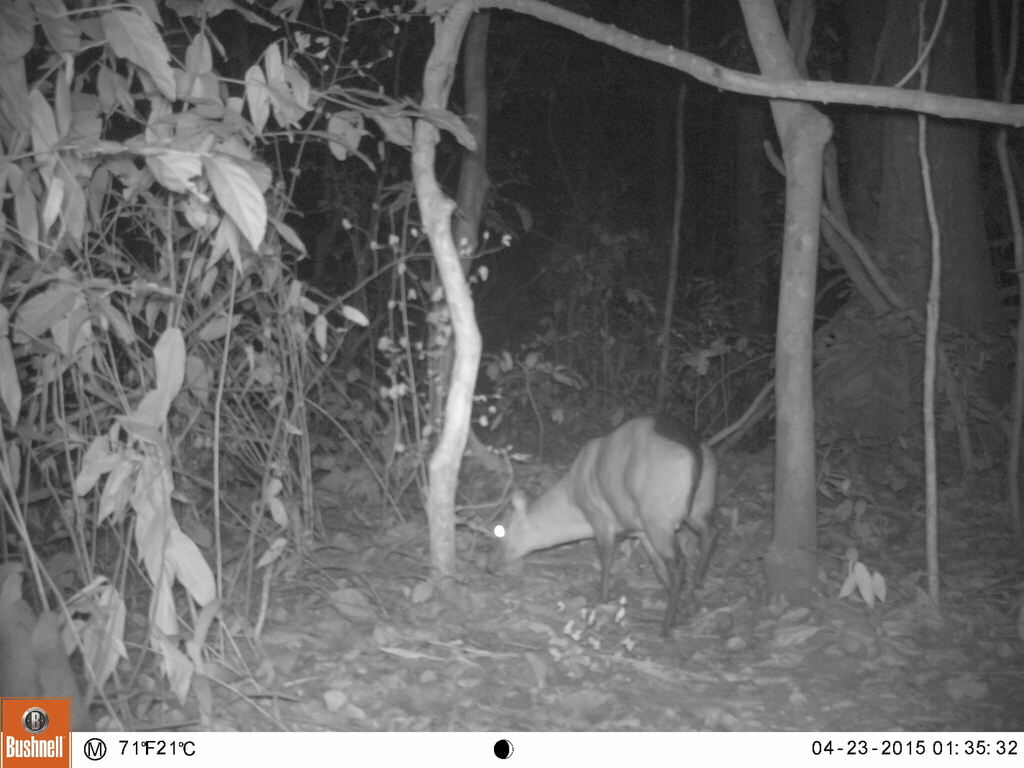
The bay duiker (Cephalophus dorsalis), also known as the black-striped duiker and the black-backed duiker, is a forest-dwelling duiker native to western and southern Africa.
- Kingdom
- Animalia
- Phylum
- Chordata
- Class
- Mammalia
- Order
- Artiodactyla
- Family
- Bovidae
- Genus
- Cephalophus
- Species
- Cephalophus dorsalis
Description
The bay duiker (Cephalophus dorsalis), also known as the black-striped duiker and the black-backed duiker, is a forest-dwelling duiker native to western and southern Africa. It was first described by British zoologist John Edward Gray in 1846. Two subspecies are identified. The bay duiker is reddish-brown and has a moderate size. Both sexes reach 44–49 cm (17–19 in) at the shoulder. The sexes do not vary considerably in their weights, either; the typical weight range for this duiker is 18–23 kg (40–51 lb). Both sexes have a pair of spiky horns, measuring 5–8 cm (2.0–3.1 in). A notable feature of this duiker is the well-pronounced solid stripe of black extending from the back of the head to the tail. The bay duiker is a nocturnal animal. It tends to remain solitary, but pairs can also be observed. The leopard is the main predator of this duiker. It mainly prefers fruits, but may also feed on animal matter such as bird eggs. Females may conceive by the age of 18 months. Breeding occurs throughout the year. Gestation lasts about 240 days, following which generally a single offspring is born. The lifespan of the bay duiker is typically 17 to 18 years. The bay duiker prefers old-growth or primary forests. It has been historically overhunted across its range for bushmeat. The survival of the bay duiker is also threatened by human settlement and agricultural expansion due to this duiker's preference for old-growth forests, and habitat degradation. The bay duiker is, however, still a common duiker species, and is classified as near threatened by the International Union for Conservation of Nature and Natural Resources.
Gallery
Ajouter des photos
Partagez vos photos de cette espèce (jusqu'à 20 à la fois) : elles sont vérifiées automatiquement, puis publiées.
Répartition
Occurrences observées (données GBIF). Les zones hors aire d'origine peuvent indiquer une présence introduite ou invasive.
Sources et crédits
Informations provenant de plusieurs sources vérifiées. Dernière mise à jour : .
Crédits photos (7)
- Photo : @thierry_aebischer_chinko · CC BY-NC 4.0 · via iNaturalist
- Photo : @marioherre · CC BY-NC 4.0 · via iNaturalist
- Photo : Rod Cassidy (@sanghalodge) · CC BY-NC 4.0 · via iNaturalist
- Photo : ChimpAndSee (@chimpandsee) · CC BY-NC 4.0 · via iNaturalist
- Photo : @thierry_aebischer_chinko · CC BY-NC 4.0 · via iNaturalist
- Photo : @thierry_aebischer_chinko · CC BY-NC 4.0 · via iNaturalist
- Photo : @thierry_aebischer_chinko · CC BY-NC 4.0 · via iNaturalist
Mentions de licence
Texte disponible sous licence CC BY-SA 4.0. Il adapte notamment Cephalophus dorsalis, Wikipedia (CC BY-SA) : Bay duiker (Wikipédia, auteurs dans l’historique de l’article).
- Taxonomie : GBIF Backbone Taxonomy (CC BY 4.0)
- Carte : occurrences GBIF, fond © contributeurs OpenStreetMap (ODbL)
- Statut de conservation : Liste rouge de l'UICN, via Wikidata (CC0)
Détail : Sources et licences.
Discussion (0)
Aucun message pour l’instant. Lancez la discussion sur cette fiche (sources, précisions, débats éditoriaux).
Connectez-vous pour participer à la discussion.