
Desert Lynx
Caracal caracal
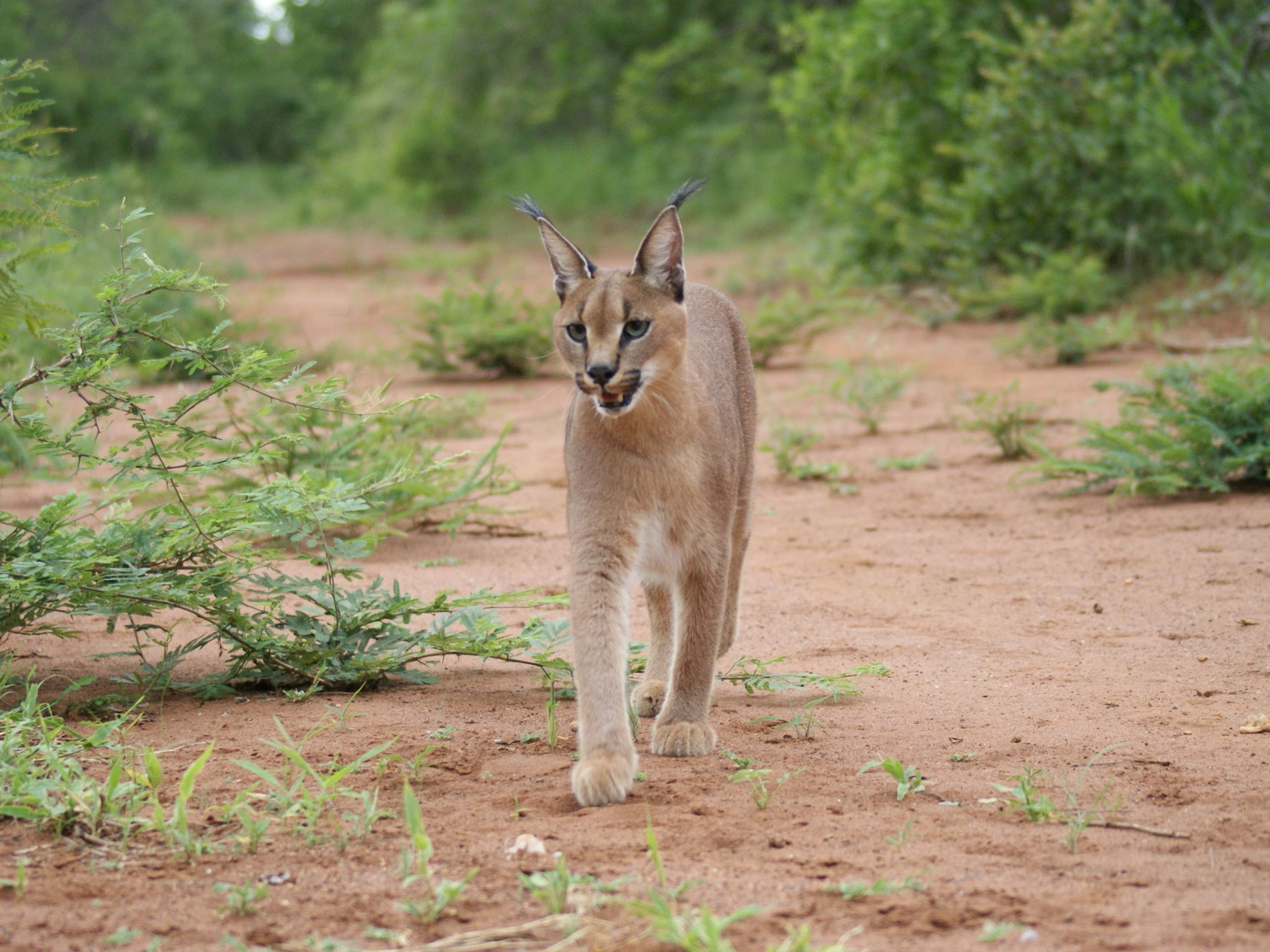
The caracal (Caracal caracal) is a wild cat native to Africa, the Middle East, Central Asia, and arid areas of Pakistan and northwestern India.
- Kingdom
- Animalia
- Phylum
- Chordata
- Class
- Mammalia
- Order
- Carnivora
- Family
- Felidae
- Genus
- Caracal
- Species
- Caracal caracal
Description
The caracal (Caracal caracal) is a wild cat native to Africa, the Middle East, Central Asia, and arid areas of Pakistan and northwestern India. It is characterised by a robust build, long legs, a short face, long tufted ears, relatively short tail, and long canine teeth. Its coat is uniformly reddish tan or sandy, while the ventral parts are lighter with small reddish markings. It reaches 40–50 cm (16–20 in) at the shoulder and weighs 8–19 kg (18–42 lb). It was first scientifically described by German naturalist Johann Christian Daniel von Schreber in 1776. Three subspecies are recognised. Typically nocturnal, the caracal is highly secretive and difficult to observe. It is territorial, and lives mainly alone or in pairs. The caracal is a carnivore that typically preys upon birds, rodents, and other small mammals. It can leap higher than 3.0 m (9.8 ft) and catch birds in midair. It stalks its prey until it is within 5 m (16 ft) of it, after which it runs it down and kills it with a bite to the throat or to the back of the neck. Both sexes become sexually mature by the time they are one year old and breed throughout the year. Gestation lasts between two and three months, resulting in a litter of one to six kittens. Juveniles leave their mothers at the age of nine to ten months, though a few females stay back with their mothers. The average lifespan of captive caracals is nearly 16 years.
Gallery
Ajouter des photos
Partagez vos photos de cette espèce (jusqu'à 20 à la fois) : elles sont vérifiées automatiquement, puis publiées.
Répartition
Occurrences observées (données GBIF). Les zones hors aire d'origine peuvent indiquer une présence introduite ou invasive.
Sources et crédits
Informations provenant de plusieurs sources vérifiées. Dernière mise à jour : .
Crédits photos (6)
- Photo : Louise Joubert · CC BY-SA 3.0
- Photo : Dennis Jergovs · CC BY-SA 4.0
- Photo : Henry de Lange (@henrydelange) · CC BY 4.0 · via iNaturalist
- Photo : @jdabs · CC BY-NC 4.0 · via iNaturalist
- Photo : Dirk Froebel (@dirk_froebel) · CC BY 4.0 · via iNaturalist
- Photo : Octávio Mateus (@omateus) · CC BY-NC 4.0 · via iNaturalist
Mentions de licence
Texte disponible sous licence CC BY-SA 4.0. Il adapte notamment Wikipedia (CC BY-SA) : Caracal (Wikipédia, auteurs dans l’historique de l’article).
- Taxonomie : GBIF Backbone Taxonomy (CC BY 4.0)
- Carte : occurrences GBIF, fond © contributeurs OpenStreetMap (ODbL)
- Statut de conservation : Liste rouge de l'UICN, via Wikidata (CC0)
Détail : Sources et licences.
Discussion (0)
Aucun message pour l’instant. Lancez la discussion sur cette fiche (sources, précisions, débats éditoriaux).
Connectez-vous pour participer à la discussion.