
Japanese Serow
Capricornis crispus
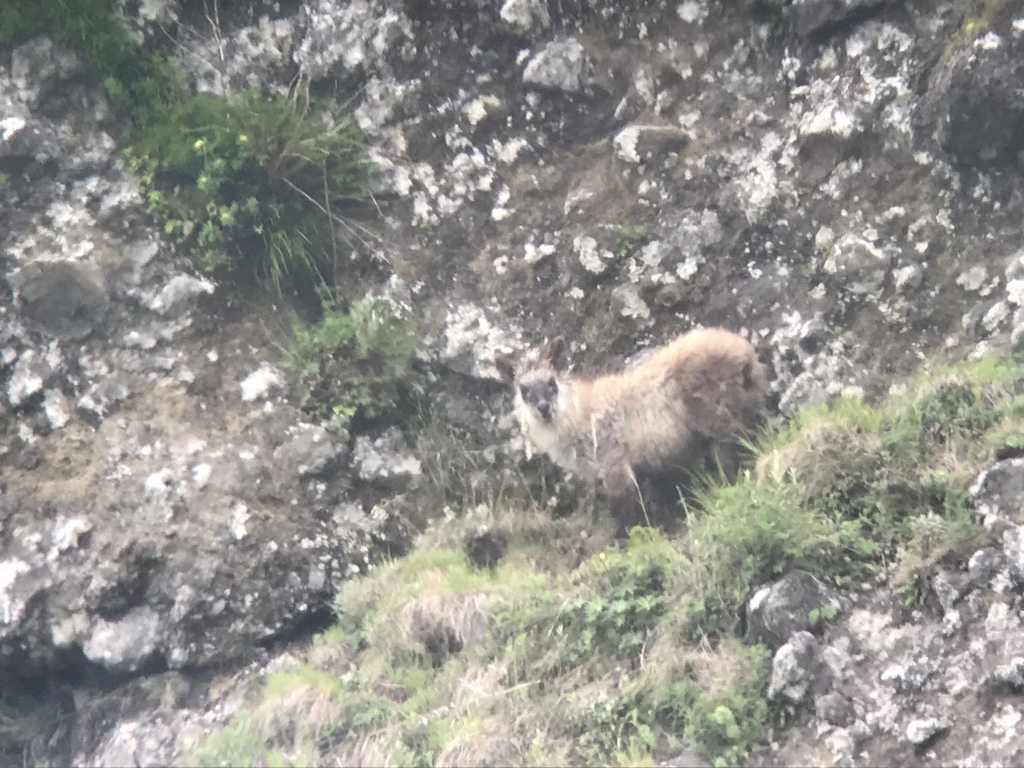
The Japanese serow (氈鹿, kamoshika; lit. "coarse pelt deer") (Capricornis crispus) (羚羊) is a Japanese goat-antelope, an even-toed ungulate.
- Kingdom
- Animalia
- Phylum
- Chordata
- Class
- Mammalia
- Order
- Artiodactyla
- Family
- Bovidae
- Genus
- Capricornis
- Species
- Capricornis crispus
Description
The Japanese serow (氈鹿, kamoshika; lit. "coarse pelt deer") (Capricornis crispus) (羚羊) is a Japanese goat-antelope, an even-toed ungulate. It is found in dense woodland in Japan, primarily in northern and central Honshu. The serow is seen as a national symbol of Japan, and is subject to protection in conservation areas. Adult Japanese serow stand about 81 centimetres (32 in) tall and weigh 30–45 kg (66–99 lb). They are black to whitish, and colouring lightens in summer. The fur is very bushy, especially the tail. Both sexes have short, backwards-curving horns, and are difficult to distinguish by sight. Japanese serow are found in dense mountain forests where they eat leaves, shoots, and acorns. They are diurnal and feed in early mornings and late afternoons. Serows are solitary, or gather in couples or small family groups. The animal marks its territory with sweet-and-sour-smelling preorbital gland secretions, and males and females have separate territories that may overlap. In the mid-20th century, the Japanese serow was hunted to near-extinction. In 1955, the Japanese government passed a law designating it a "Special National Monument" to protect it from poachers. Populations have since grown so greatly that the IUCN Red List of Threatened Animals ranks it "least concern". In 1979, complaints from foresters and farmers led to the repeal of the 1955 law. Since then, the serow has had protected status in 13 designated protected areas over 23 prefectures, and has been subject to culling as a pest outside conservation areas. Conservationists have labelled it a "living national treasure of the forest".
Gallery
Ajouter des photos
Partagez vos photos de cette espèce (jusqu'à 20 à la fois) : elles sont vérifiées automatiquement, puis publiées.
Répartition
Occurrences observées (données GBIF). Les zones hors aire d'origine peuvent indiquer une présence introduite ou invasive.
Sources et crédits
Informations provenant de plusieurs sources vérifiées. Dernière mise à jour : .
Crédits photos (8)
- Photo : Reiko Okano (@suzu) · CC BY-NC 4.0 · via iNaturalist
- Photo : @circle-a · CC BY-NC 4.0 · via iNaturalist
- Photo : Carlos Bernal (@carber) · CC BY-NC 4.0 · via iNaturalist
- Photo : Timur Kalininsky (@timur_kalininsky) · CC BY 4.0 · via iNaturalist
- Photo : Christian Doedt (@chrisjp) · CC BY-NC 4.0 · via iNaturalist
- Photo : Isy VD (@isyvd) · CC BY 4.0 · via iNaturalist
- Photo : @heybrows · CC BY-NC 4.0 · via iNaturalist
- Photo : @togari · CC BY-NC 4.0 · via iNaturalist
Mentions de licence
Texte disponible sous licence CC BY-SA 4.0. Il adapte notamment Capricornis crispus, Wikipedia (CC BY-SA) : Japanese serow (Wikipédia, auteurs dans l’historique de l’article).
- Taxonomie : GBIF Backbone Taxonomy (CC BY 4.0)
- Carte : occurrences GBIF, fond © contributeurs OpenStreetMap (ODbL)
- Statut de conservation : Liste rouge de l'UICN, via Wikidata (CC0)
Détail : Sources et licences.
Discussion (0)
Aucun message pour l’instant. Lancez la discussion sur cette fiche (sources, précisions, débats éditoriaux).
Connectez-vous pour participer à la discussion.