
Camel
Camelus
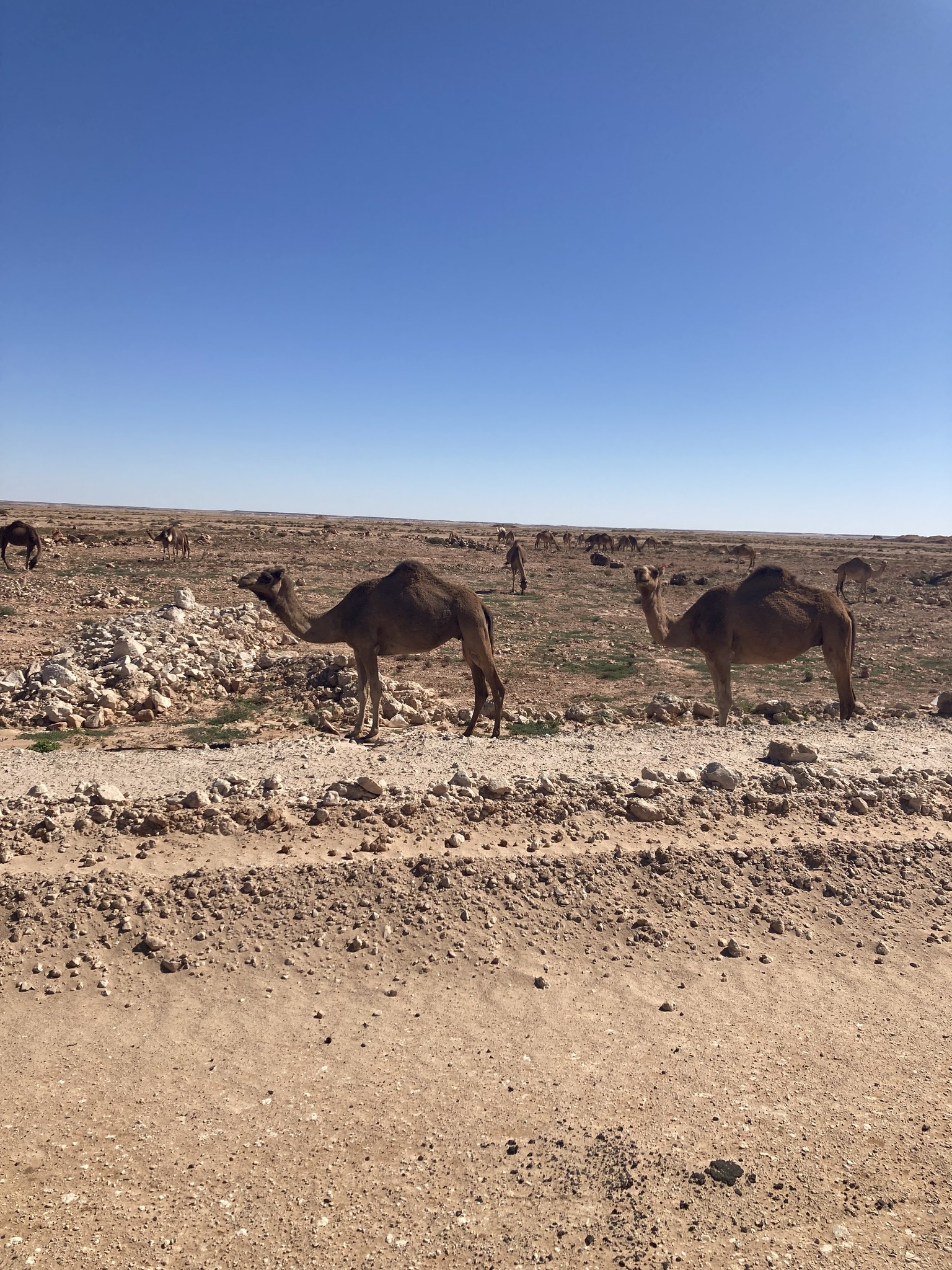
A camel (from Latin: camelus and Ancient Greek: κάμηλος (kamēlos) from Ancient Semitic: gāmāl) is an even-toed ungulate in the genus Camelus that bears distinctive fatty deposits known as "humps" on its back.
- Kingdom
- Animalia
- Phylum
- Chordata
- Class
- Mammalia
- Order
- Artiodactyla
- Family
- Camelidae
- Genus
- Camelus
- Species
- Camelus
Description
A camel (from Latin: camelus and Ancient Greek: κάμηλος (kamēlos) from Ancient Semitic: gāmāl) is an even-toed ungulate in the genus Camelus that bears distinctive fatty deposits known as "humps" on its back. Camels have long been domesticated and, as livestock, they provide food (camel milk and meat) and textiles (fiber and felt from camel hair). Camels are working animals especially suited to their desert habitat and are a vital means of transport for passengers and cargo. There are three surviving species of camel. The one-humped dromedary makes up 94% of the world's camel population, and the two-humped Bactrian camel makes up 6%. The wild Bactrian camel is a distinct species that is not ancestral to the domestic Bactrian camel, and is now endangered, with around 1,000 individuals and a continuing decline. The word camel is also used informally in a wider sense, where the more correct term is "camelid", to include all seven species of the family Camelidae: the true camels (the above three species), along with the "New World" camelids: the llama, the alpaca, the guanaco, and the vicuña, which belong to the separate tribe Lamini. Camelids originated in North America during the Eocene, with the ancestor of modern camels, Paracamelus, migrating across the Bering land bridge into Asia during the late Miocene, around 6 million years ago.
Ajouter des photos
Partagez vos photos de cette espèce (jusqu'à 20 à la fois) : elles sont vérifiées automatiquement, puis publiées.
Répartition
Occurrences observées (données GBIF). Les zones hors aire d'origine peuvent indiquer une présence introduite ou invasive.
Sources et crédits
Informations provenant de plusieurs sources vérifiées. Dernière mise à jour : .
Crédits photos (1)
- Photo : Bilal Achmel · CC BY-NC 4.0 · via GBIF
Mentions de licence
Texte disponible sous licence CC BY-SA 4.0. Il adapte notamment Wikipedia (CC BY-SA) : Camel (Wikipédia, auteurs dans l’historique de l’article).
- Taxonomie : GBIF Backbone Taxonomy (CC BY 4.0)
- Carte : occurrences GBIF, fond © contributeurs OpenStreetMap (ODbL)
Détail : Sources et licences.
Discussion (0)
Aucun message pour l’instant. Lancez la discussion sur cette fiche (sources, précisions, débats éditoriaux).
Connectez-vous pour participer à la discussion.