
Dwarf sperm whale
Kogia sima
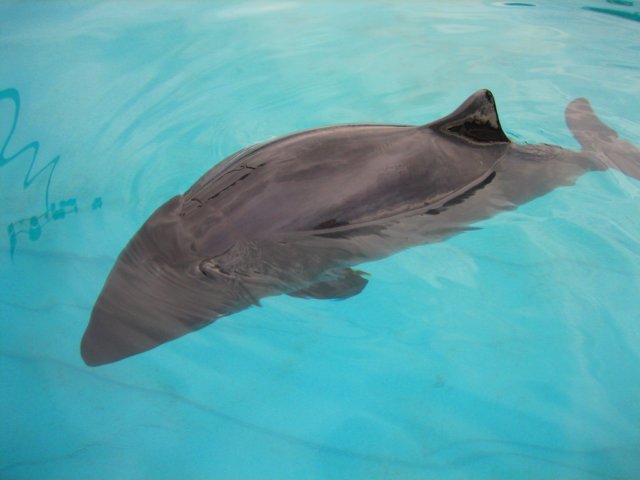
The dwarf sperm whale (Kogia sima) is a sperm whale that inhabits temperate and tropical oceans worldwide, in particular continental shelves and slopes.
- Kingdom
- Animalia
- Phylum
- Chordata
- Class
- Mammalia
- Order
- Cetacea
- Family
- Kogiidae
- Genus
- Kogia
- Species
- Kogia sima
Description
The dwarf sperm whale (Kogia sima) is a sperm whale that inhabits temperate and tropical oceans worldwide, in particular continental shelves and slopes. It was first described by biologist Richard Owen in 1866, based on illustrations by naturalist Sir Walter Elliot. The species was considered to be synonymous with the pygmy sperm whale (Kogia breviceps) from 1878 until 1998. The dwarf sperm whale is a small whale, 2 to 2.7 m (6 ft 7 in to 8 ft 10 in) and 136 to 272 kg (300 to 600 lb), that has a grey coloration, square head, small jaw, and robust body. Its appearance is very similar to the pygmy sperm whale, distinguished mainly by the position of the dorsal fin on the body–nearer the middle in the dwarf sperm whale and nearer the tail in the other. The dwarf sperm whale is a suction feeder that mainly eats squid, and does this in small pods of typically one to four members. It is preyed upon by the orca (Orcinus orca) and large sharks such as the great white shark (Carcharodon carcharius). When startled, the whale can eject a cloud of red-brown fluid. Most of what is known of the whale comes from beached individuals, as sightings in the ocean are rare. Many of these stranded whales died from parasitic infestations or heart failure. The dwarf sperm whale is hunted in small numbers around Asia. It is most threatened by ingesting, or getting entangled by marine debris. No global population estimate has been made, and so its conservation status by the International Union for Conservation of Nature (IUCN) is least concern.
Gallery
Ajouter des photos
Partagez vos photos de cette espèce (jusqu'à 20 à la fois) : elles sont vérifiées automatiquement, puis publiées.
Répartition
Occurrences observées (données GBIF). Les zones hors aire d'origine peuvent indiquer une présence introduite ou invasive.
Sources et crédits
Informations provenant de plusieurs sources vérifiées. Dernière mise à jour : .
Crédits photos (5)
- Photo : www.MetaphoricalPlatypus.com · CC BY 3.0
- Photo : Sergio Martínez (@sergiomtz) · CC BY-NC 4.0 · via iNaturalist
- Photo : James Eaton (@james_birdtourasia) · CC0 (domaine public) · via iNaturalist
- Photo : Alexandre Grave (@alexandregrave) · CC BY-NC 4.0 · via iNaturalist
- Photo : @patrickobrien3 · CC BY-NC 4.0 · via iNaturalist
Mentions de licence
Texte disponible sous licence CC BY-SA 4.0. Il adapte notamment Wikipedia (CC BY-SA) : Dwarf sperm whale (Wikipédia, auteurs dans l’historique de l’article).
- Taxonomie : GBIF Backbone Taxonomy (CC BY 4.0)
- Carte : occurrences GBIF, fond © contributeurs OpenStreetMap (ODbL)
- Statut de conservation : Liste rouge de l'UICN, via Wikidata (CC0)
Détail : Sources et licences.
Discussion (0)
Aucun message pour l’instant. Lancez la discussion sur cette fiche (sources, précisions, débats éditoriaux).
Connectez-vous pour participer à la discussion.