
Riverine Rabbit
Bunolagus monticularis
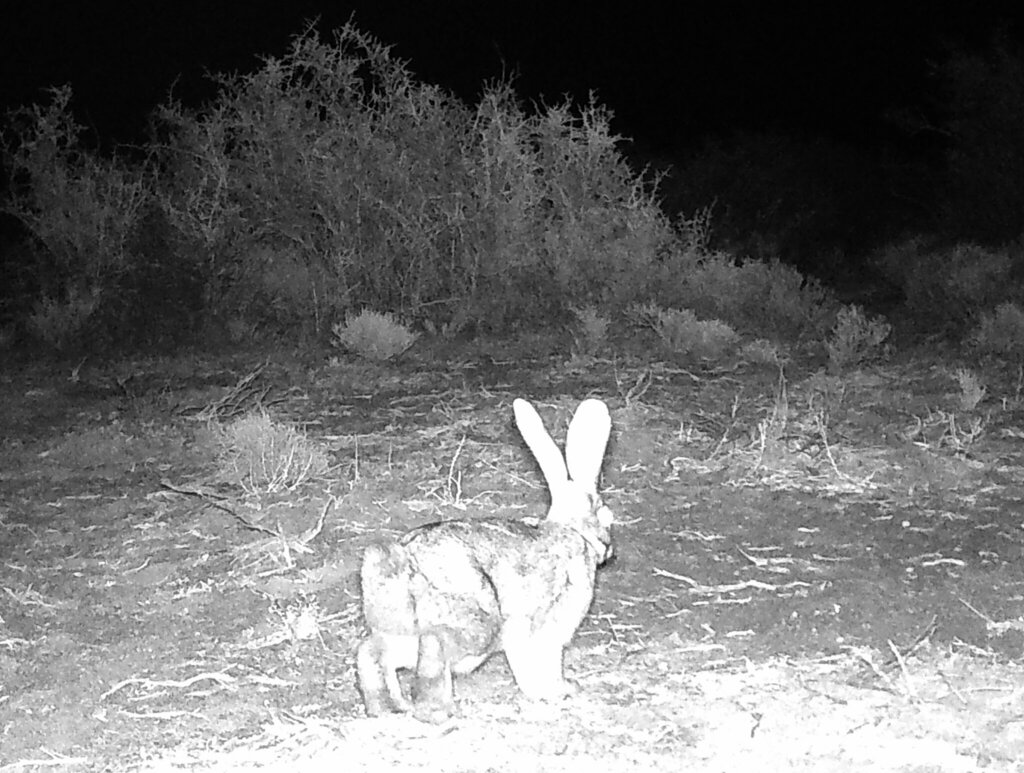
The riverine rabbit (Bunolagus monticularis), also known as the bushman rabbit or bushman hare, is a species of rabbit that lives among patches of thick vegetation in the Karoo of South Africa's Western and Northern Cape provinces.
- Kingdom
- Animalia
- Phylum
- Chordata
- Class
- Mammalia
- Order
- Lagomorpha
- Family
- Leporidae
- Genus
- Bunolagus
- Species
- Bunolagus monticularis
Description
The riverine rabbit (Bunolagus monticularis), also known as the bushman rabbit or bushman hare, is a species of rabbit that lives among patches of thick vegetation in the Karoo of South Africa's Western and Northern Cape provinces. It is the only member of the genus Bunolagus. It is classified a critically endangered species by the International Union for Conservation of Nature (IUCN); the most recent estimates of the species' population range from 157 to 207 mature individuals, and 224 to 380 total. First identified in 1903 as a member of the hares, the riverine rabbit is a medium-sized rabbit, about 33.7 to 47.0 centimetres (13.3 to 18.5 in) long. Its fur has a unique dark brown stripe from the edge of its mouth to the base of its ears, and a white to grey ring around each eye. It is nocturnal and herbivorous, and its diet consists of grasses, flowers and leaves, most of which are dicotyledons. The riverine rabbit digs burrows in the soft alluvial soils of its habitat near seasonal rivers for protection from the heat and for females to nest and protect the young. It is the only African rabbit known to dig its own burrows. Riverine rabbits are polygamous, and live alone throughout the year. Unlike most rabbits, female riverine rabbits produce only one to two young per year. This contributes to its status as critically endangered, along with habitat loss from agricultural development, soil erosion, and predators. Human impacts on the environment have a significant impact on the species' continued survivability. Currently, there are conservation plans being enacted to stabilise its population and protect its habitat.
Gallery
Ajouter des photos
Partagez vos photos de cette espèce (jusqu'à 20 à la fois) : elles sont vérifiées automatiquement, puis publiées.
Répartition
Occurrences observées (données GBIF). Les zones hors aire d'origine peuvent indiquer une présence introduite ou invasive.
Sources et crédits
Informations provenant de plusieurs sources vérifiées. Dernière mise à jour : .
Crédits photos (6)
- Photo : @_3foxes · CC BY-NC 4.0 · via iNaturalist
- Photo : @kevinjolliffe · CC BY-NC 4.0 · via iNaturalist
- Photo : Owen Davies (@ordavies) · CC0 (domaine public) · via iNaturalist
- Photo : Wynand (@wynandvlok) · CC BY-NC 4.0 · via iNaturalist
- Photo : Paul Carter (@pacapix) · CC BY-NC 4.0 · via iNaturalist
- Photo : Justin Ponder (@justin_p) · CC BY 4.0 · via iNaturalist
Mentions de licence
Texte disponible sous licence CC BY-SA 4.0. Il adapte notamment Bunolagus monticularis, Wikipedia (CC BY-SA) : Riverine rabbit (Wikipédia, auteurs dans l’historique de l’article).
- Taxonomie : GBIF Backbone Taxonomy (CC BY 4.0)
- Carte : occurrences GBIF, fond © contributeurs OpenStreetMap (ODbL)
- Statut de conservation : Liste rouge de l'UICN, via Wikidata (CC0)
Détail : Sources et licences.
Discussion (0)
Aucun message pour l’instant. Lancez la discussion sur cette fiche (sources, précisions, débats éditoriaux).
Connectez-vous pour participer à la discussion.