
African buffalo
Syncerus caffer
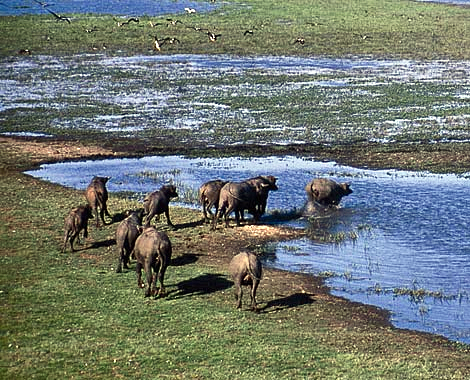
The African buffalo (Syncerus caffer) is a large species of true buffalo native to Sub-Saharan Africa, where it is found in a number of disconnected ranges stretching from south-eastern Senegal through West and Central Africa to South…
- Kingdom
- Animalia
- Phylum
- Chordata
- Class
- Mammalia
- Order
- Artiodactyla
- Family
- Bovidae
- Genus
- Syncerus
- Species
- Syncerus caffer
Description
The African buffalo (Syncerus caffer) is a large species of true buffalo native to Sub-Saharan Africa, where it is found in a number of disconnected ranges stretching from south-eastern Senegal through West and Central Africa to South Africa. The adult African buffalo's horns are its characteristic feature: they have fused bases that form a continuous bone shield, referred to as a "boss", across the top of the head. The African buffalo is more closely related to Asian buffalo (Bubalus) species than it is to other bovids such as American bison or domestic cattle. Its unpredictable temperament may be part of the reason that the African buffalo has never been domesticated and has no domesticated descendants, unlike the wild yak and wild water buffalo, which are the ancestors of the domestic yak and water buffalo, respectively. Natural predators of adult African buffaloes include lions, African wild dogs, spotted hyenas, and Nile crocodiles. As one of the Big Five game animals, the Cape buffalo (Syncerus caffer caffer), the largest subspecies native to eastern and southern Africa, is a sought-after trophy in hunting.
Gallery
Ajouter des photos
Partagez vos photos de cette espèce (jusqu'à 20 à la fois) : elles sont vérifiées automatiquement, puis publiées.
Répartition
Occurrences observées (données GBIF). Les zones hors aire d'origine peuvent indiquer une présence introduite ou invasive.
Sources et crédits
Informations provenant de plusieurs sources vérifiées. Dernière mise à jour : .
Crédits photos (7)
- Photo : Tourism NT · CC BY
- Photo : Beastandbirdafrica · CC BY-SA 4.0
- Photo : Eric Leeuwerck (@eleeuw) · CC BY-NC 4.0 · via iNaturalist
- Photo : @congonaturalist · CC BY-NC 4.0 · via iNaturalist
- Photo : Rebecca Chan (@raobaykah) · CC BY-NC 4.0 · via iNaturalist
- Photo : @mfbrett · CC BY-NC 4.0 · via iNaturalist
- Photo : ONG OeBenin (@oebenin) · CC BY-NC 4.0 · via iNaturalist
Mentions de licence
Texte disponible sous licence CC BY-SA 4.0. Il adapte notamment Wikipedia (CC BY-SA) : African buffalo (Wikipédia, auteurs dans l’historique de l’article).
- Taxonomie : GBIF Backbone Taxonomy (CC BY 4.0)
- Carte : occurrences GBIF, fond © contributeurs OpenStreetMap (ODbL)
- Statut de conservation : Liste rouge de l'UICN, via Wikidata (CC0)
Détail : Sources et licences.
Discussion (0)
Aucun message pour l’instant. Lancez la discussion sur cette fiche (sources, précisions, débats éditoriaux).
Connectez-vous pour participer à la discussion.