
Banteng
Bos javanicus
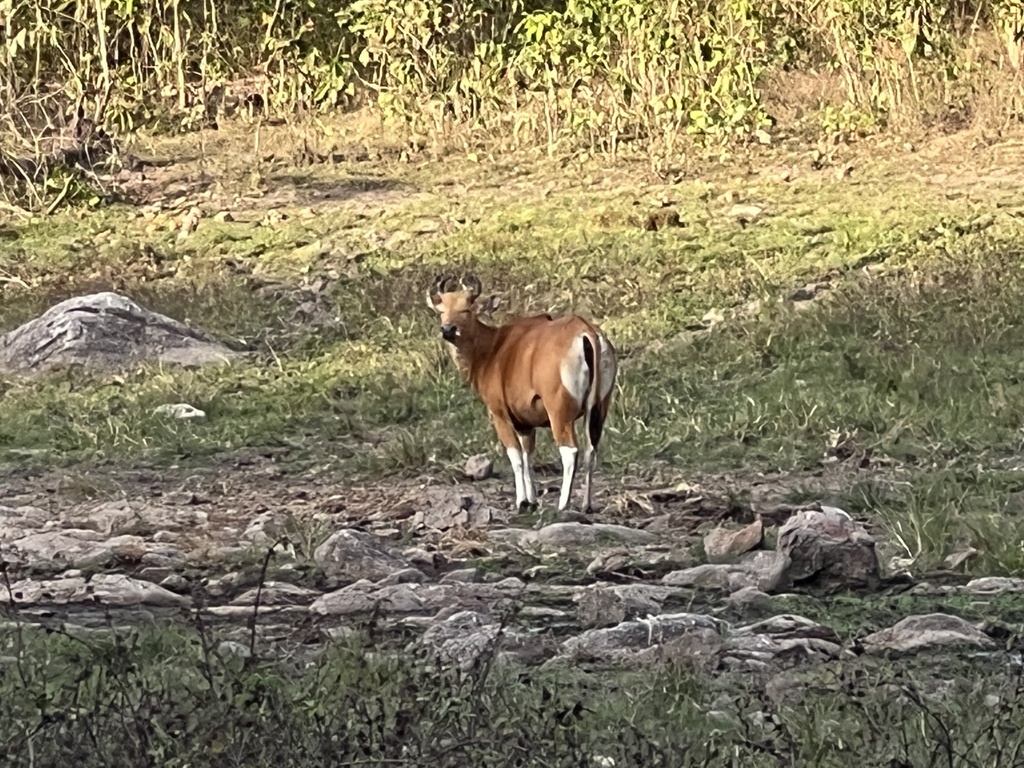
The banteng (Bos javanicus; ), also known as the tembadau, is a species of wild bovine found in Southeast Asia, with domestic-wild hybrids present in parts of Northern Australia.
- Kingdom
- Animalia
- Phylum
- Chordata
- Class
- Mammalia
- Order
- Artiodactyla
- Family
- Bovidae
- Genus
- Bos
- Species
- Bos javanicus
Description
The banteng (Bos javanicus; ), also known as the tembadau, is a species of wild bovine found in Southeast Asia, with domestic-wild hybrids present in parts of Northern Australia. The head-and-body length is between 1.9 and 3.68 m (6.2 and 12.1 ft). Wild banteng are typically larger and heavier than their domesticated counterparts, but are otherwise similar in appearance. The banteng shows extensive sexual dimorphism; adult bulls are generally dark brown to black, larger and more sturdily built than adult cows, which are thinner and usually pale brown or chestnut red. There is a big white patch on the rump. Horns are present on both sexes, and are typically 60 to 95 cm (24 to 37 in) long. Three subspecies are generally recognised. Banteng are active during the day as well as at night, though activity at night is more in areas frequented by humans. Herds comprise two to forty individuals, and generally a single bull. Being herbivorous, banteng feed on vegetation such as grasses, sedges, shoots, leaves, flowers, and fruits. Banteng can survive without water for long stretches during droughts, but drink regularly if possible, especially from standing water. Not much is known about the reproductive physiology of banteng, but it might be similar to that observed in taurine cattle. After a gestation of nearly 285 days (nine to ten months), a week longer than that typically observed in taurine cattle, a single calf is born. Banteng occur in a variety of habitats throughout their range, including open deciduous forests, semi-evergreen forests, lower montane forests, grasslands, and abandoned farms. The largest populations of wild banteng occur in Java, Cambodia, and possibly in Kalimantan (particularly East Kalimantan and North Kalimantan) and Thailand. Domesticated banteng occur in Bali and many eastern Indonesian islands (such as Sulawesi, Sumbawa, and Sumba), Australia, Malaysia, and New Guinea. Feral populations are found in Sabah and the Northern Territory of Australia. Domesticated populations are primarily used for their highly demanded meat, and are used as draught animals to a lesser extent. The wild banteng is classified as Critically Endangered on the IUCN Red List, and populations have decreased by more than 50% in the past few decades. Rampant poaching (for food, game, traditional medicine and horns), habitat loss and fragmentation and susceptibility to disease are major threats throughout its range. Wild banteng are legally protected in all countries in their range, and are largely restricted to protected areas (possibly barring Cambodia). The banteng is the second endangered species to be successfully cloned, and the first clone to survive beyond infancy.
Gallery
Ajouter des photos
Partagez vos photos de cette espèce (jusqu'à 20 à la fois) : elles sont vérifiées automatiquement, puis publiées.
Répartition
Occurrences observées (données GBIF). Les zones hors aire d'origine peuvent indiquer une présence introduite ou invasive.
Sources et crédits
Informations provenant de plusieurs sources vérifiées. Dernière mise à jour : .
Crédits photos (8)
- Photo : Chanon Chirachitmichai (@chanon_chirachitmichai) · CC BY-NC 4.0 · via iNaturalist
- Photo : ภูมิภิวัตน์ ศรีพรหม (@myidplasmid) · CC BY-NC 4.0 · via iNaturalist
- Photo : Hafizh Aulia Khairy Rakananda (@khhafizh) · CC BY-NC 4.0 · via iNaturalist
- Photo : Feijoa Sellowiana (@feijoa_sellowiana) · CC BY-NC 4.0 · via iNaturalist
- Photo : Allison Xiong (@glebglub) · CC BY-NC 4.0 · via iNaturalist
- Photo : @crocattackdatabase · CC BY-NC 4.0 · via iNaturalist
- Photo : Vatcharavee Sriprasertsil (@vatcharavee) · CC BY-NC 4.0 · via iNaturalist
- Photo : Lorenzo Cecchi (https://orcid.org/0000-0001-9706-0947) (@tasmacetus) · CC BY-NC 4.0 · via iNaturalist
Mentions de licence
Texte disponible sous licence CC BY-SA 4.0. Il adapte notamment Banteng, Wikipedia (CC BY-SA) : Banteng (Wikipédia, auteurs dans l’historique de l’article).
- Taxonomie : GBIF Backbone Taxonomy (CC BY 4.0)
- Carte : occurrences GBIF, fond © contributeurs OpenStreetMap (ODbL)
- Statut de conservation : Liste rouge de l'UICN, via Wikidata (CC0)
Détail : Sources et licences.
Discussion (0)
Aucun message pour l’instant. Lancez la discussion sur cette fiche (sources, précisions, débats éditoriaux).
Connectez-vous pour participer à la discussion.