
Guinea baboon
Papio papio
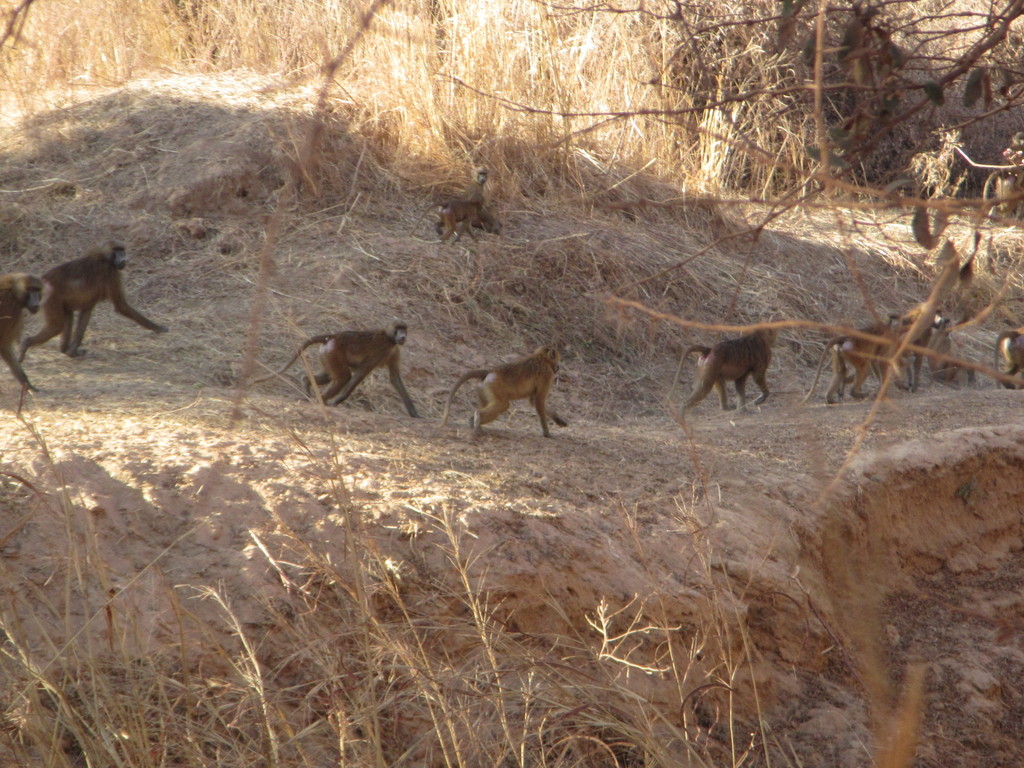
The Guinea baboon (Papio papio) is a baboon from the Old World monkey family.
- Kingdom
- Animalia
- Phylum
- Chordata
- Class
- Mammalia
- Order
- Primates
- Family
- Cercopithecidae
- Genus
- Papio
- Species
- Papio papio
Description
The Guinea baboon (Papio papio) is a baboon from the Old World monkey family. Some (older) classifications list only two species in the genus Papio, this one and the hamadryas baboon. In those classifications, all other Papio species are considered subspecies of P. papio and the species is called the savanna baboon. The Guinea baboon inhabits a small area in western Africa. Its range includes Guinea, Senegal, Gambia, southern Mauritania and western Mali. Its habitat includes dry forests, gallery forests, and adjoining bush savannas or steppes. It has reddish-brown hair, a hairless, dark-violet or black face with the typical dog-like muzzle, which is surrounded by a small mane, and a tail carried in a round arc. It also has limb modifications that allow it to walk long distances on the ground. The Guinea baboon is one of the smallest baboon species, weighing between 13 and 26 kg (28.6–57 lbs). Their life spans are generally between 20 and 50 years. It is a diurnal and terrestrial animal, but sleeps in trees or high rocks at night, away from predators. The number of suitable sleeping trees limits the group size and the range. It lives in troops of up to 200 individuals, each with a set place in a hierarchy. Group living provides protection from predators such as the lion and various hyena species. Like all baboons, it is an omnivorous highly opportunistic feeder, eating fruits, buds, roots, bark, grasses, greens, seeds, tubers, leaves, nuts, cereals, insects, worms, birds and small mammals. Because it will eat practically anything available, the Guinea baboon is able to occupy areas with limited resources or harsh conditions. Its presence may help improve habitats because it digs for water and spreads seeds in its waste, encouraging plant growth. The Guinea baboon is a highly communicative animal. It communicates by using a variety of vocalizations and physical interactions. In addition to vocalizations to each other, this animal has vocal communications apparently intended to be received and interpreted by predators. Due to its small range and the loss of its habitat, the Guinea baboon is classified as "near threatened" by the IUCN.
Gallery
Ajouter des photos
Partagez vos photos de cette espèce (jusqu'à 20 à la fois) : elles sont vérifiées automatiquement, puis publiées.
Répartition
Occurrences observées (données GBIF). Les zones hors aire d'origine peuvent indiquer une présence introduite ou invasive.
Sources et crédits
Informations provenant de plusieurs sources vérifiées. Dernière mise à jour : .
Crédits photos (6)
- Photo : Lucy Keith-Diagne (@lucykeith-diagne) · CC BY 4.0 · via iNaturalist
- Photo : Russ Hedley (@russhedley) · CC BY-NC 4.0 · via iNaturalist
- Photo : Ricardo Rodero Henández (@ricardo-anapri) · CC BY-NC 4.0 · via iNaturalist
- Photo : David Howdon (@davidhowdon) · CC BY-NC 4.0 · via iNaturalist
- Photo : Richard Schnürmacher (@schnurmacher_richard) · CC BY-NC 4.0 · via iNaturalist
- Photo : Luc Claes (@lucclaes) · CC BY-NC 4.0 · via iNaturalist
Mentions de licence
Texte disponible sous licence CC BY-SA 4.0. Il adapte notamment Babouin de Guinée, Wikipedia (CC BY-SA) : Guinea baboon (Wikipédia, auteurs dans l’historique de l’article).
- Taxonomie : GBIF Backbone Taxonomy (CC BY 4.0)
- Carte : occurrences GBIF, fond © contributeurs OpenStreetMap (ODbL)
- Statut de conservation : Liste rouge de l'UICN, via Wikidata (CC0)
Détail : Sources et licences.
Discussion (0)
Aucun message pour l’instant. Lancez la discussion sur cette fiche (sources, précisions, débats éditoriaux).
Connectez-vous pour participer à la discussion.