
Fraternal Fruit-eating Bat
Artibeus fraterculus
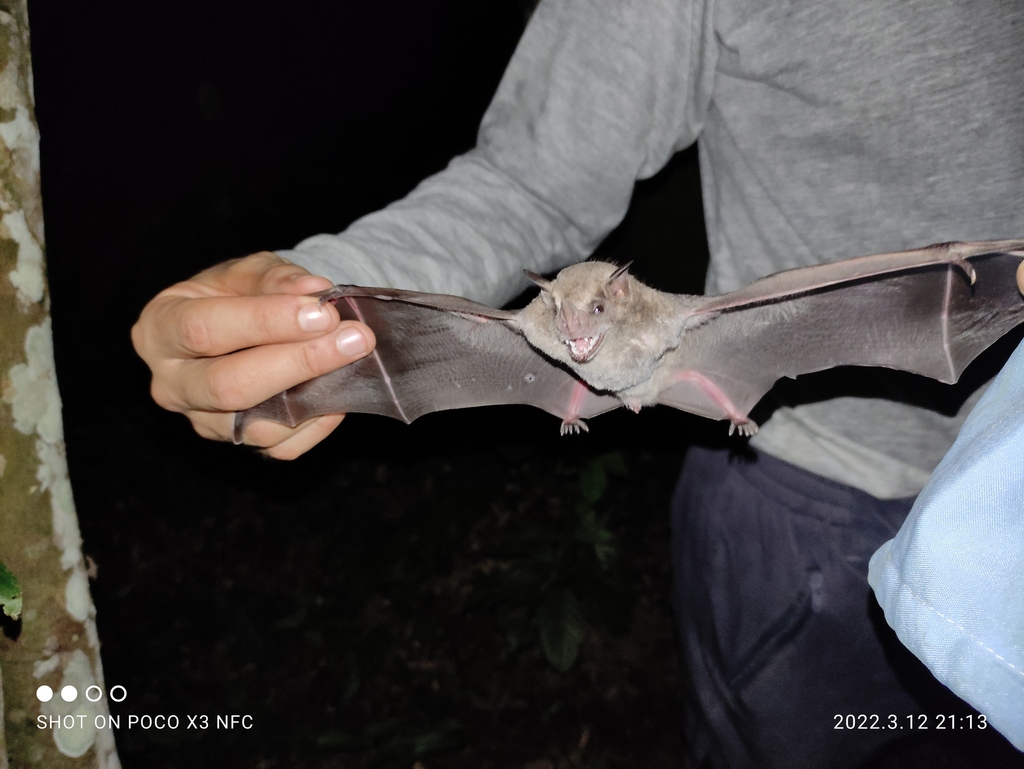
The fraternal fruit-eating bat (Artibeus fraterculus) is a species of bat in the family Phyllostomidae that is found in drier habitats in Ecuador and Peru.
- Kingdom
- Animalia
- Phylum
- Chordata
- Class
- Mammalia
- Order
- Chiroptera
- Family
- Phyllostomidae
- Genus
- Artibeus
- Species
- Artibeus fraterculus
Description
The fraternal fruit-eating bat (Artibeus fraterculus) is a species of bat in the family Phyllostomidae that is found in drier habitats in Ecuador and Peru. It was formerly considered to be a subspecies of the Jamaican fruit bat, but was raised to species level in 1978. The smallest species in the group of large Artibeus (a group that also includes the Jamaican fruit bat, flat-faced fruit-eating bat, and great fruit-eating bat), it has a forearm length of 52–59 mm (2.0–2.3 in), a total length of 64–76 mm (2.5–3.0 in), and a weight of 30–55 g (1.1–1.9 oz). It is a generalist frugivore, feeding on a variety of fruit and supplementing its diet with insects. It breeds in both the wet and dry season, with parturition (birth of young) peaking in February and May. The only known predator is the barn owl, although it may also be hunted by other birds of prey and the spectral bat. It is parasitized by species of streblid bat flies, mites, and protozoans. The fraternal fruit-eating bat is listed as being a species of least concern by the International Union for Conservation of Nature (IUCN) on the IUCN Red List due to its commonness, large range, and lack of significant population declines. However, it may be threatened by heavy metal poisoning in some areas.
Gallery
Ajouter des photos
Partagez vos photos de cette espèce (jusqu'à 20 à la fois) : elles sont vérifiées automatiquement, puis publiées.
Répartition
Occurrences observées (données GBIF). Les zones hors aire d'origine peuvent indiquer une présence introduite ou invasive.
Sources et crédits
Informations provenant de plusieurs sources vérifiées. Dernière mise à jour : .
Crédits photos (7)
- Photo : @edal10 · CC BY-NC 4.0 · via iNaturalist
- Photo : Leonardo Alava (@leoalava) · CC BY-NC 4.0 · via iNaturalist
- Photo : Jaime Salas (@salaszjaime) · CC BY-NC 4.0 · via iNaturalist
- Photo : Daniel Velasco C. (@davelascoc) · CC BY-NC 4.0 · via iNaturalist
- Photo : Roger G. Barboza Castro (@rogerbarbz) · CC BY-NC 4.0 · via iNaturalist
- Photo : @jorgebrito · CC BY-NC 4.0 · via iNaturalist
- Photo : Ricardo Escobedo (@blchasme) · CC BY-NC 4.0 · via iNaturalist
Mentions de licence
Texte disponible sous licence CC BY-SA 4.0. Il adapte notamment Wikipedia (CC BY-SA) : Fraternal fruit-eating bat (Wikipédia, auteurs dans l’historique de l’article).
- Taxonomie : GBIF Backbone Taxonomy (CC BY 4.0)
- Carte : occurrences GBIF, fond © contributeurs OpenStreetMap (ODbL)
- Statut de conservation : Liste rouge de l'UICN, via Wikidata (CC0)
Détail : Sources et licences.
Discussion (0)
Aucun message pour l’instant. Lancez la discussion sur cette fiche (sources, précisions, débats éditoriaux).
Connectez-vous pour participer à la discussion.