
Blackbuck
Antilope cervicapra
The blackbuck (Antilope cervicapra), also known as the Indian antelope, is a medium-sized antelope native to India and Nepal.
- Kingdom
- Animalia
- Phylum
- Chordata
- Class
- Mammalia
- Order
- Artiodactyla
- Family
- Bovidae
- Genus
- Antilope
- Species
- Antilope cervicapra
Description
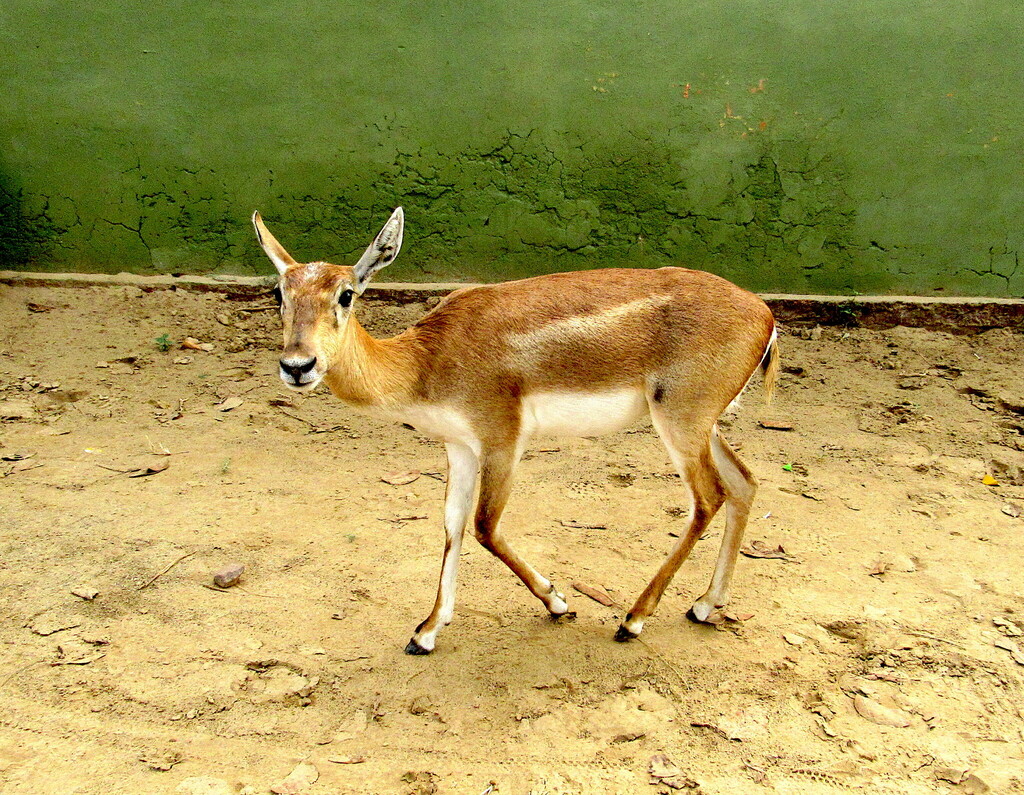
The blackbuck (Antilope cervicapra), also known as the Indian antelope, is a medium-sized antelope native to India and Nepal. It inhabits grassy plains and lightly forested areas with perennial water sources. It stands up to 74 to 84 cm (29 to 33 in) high at the shoulder. Males weigh 20–57 kg (44–126 lb), with an average of 38 kg (84 lb). Females are lighter, weighing 20–33 kg (44–73 lb) or 27 kg (60 lb) on average. Males have 35–75 cm (14–30 in) long corkscrew horns, and females occasionally develop horns, as well. The white fur on the chin and around the eyes is in sharp contrast with the black stripes on the face. Both sexes' coats feature a two-tone colouration; in males, the majority of the body is dark brown to black, with white circles around the eyes, white ears and tail, and the belly, lower jaw, and inner legs also white. Females and juveniles are yellowish-fawn to tan and display the same white areas, only with more of a beige tone than the males. Females also feature a more pronounced horizontal white side-stripe, starting around the shoulder and ending at the rump. The blackbuck is the sole living member of the genus Antilope and was described by Carl Linnaeus in 1758. Two subspecies are recognized. The blackbuck is active mainly during the day. It forms three types of small groups: female, male, and young bachelor herds. Males often adopt lekking as a strategy to garner females for mating. While other males are not allowed into these territories, females often visit these places to forage. The male can thus attempt mating with her. The blackbuck is an herbivore and grazes on low grasses, occasionally browsing as well. Females become sexually mature at the age of eight months, but mate no earlier than two years of age. Males mature later, at 1.5 years. Mating takes place throughout the year. Gestation is typically six months long, after which a single calf is born. The lifespan is typically 10 to 15 years. The antelope is native to and occurs mainly in India, while it is locally extinct in Pakistan and Bangladesh. It was formerly widespread; today small and scattered herds are largely confined to protected areas. During the 20th century, blackbuck numbers declined sharply due to excessive hunting, deforestation, and habitat destruction. The blackbuck has been introduced in Argentina, Australia and the United States, primarily on hunting ranches. In Argentina, the population is surviving well. In India, hunting of blackbuck is prohibited under Schedule I of the Wildlife Protection Act of 1972. The blackbuck has significance in Hinduism; Indian and Nepali villagers do not harm the antelope.
Gallery
Ajouter des photos
Partagez vos photos de cette espèce (jusqu'à 20 à la fois) : elles sont vérifiées automatiquement, puis publiées.
Répartition
Occurrences observées (données GBIF). Les zones hors aire d'origine peuvent indiquer une présence introduite ou invasive.
Sources et crédits
Informations provenant de plusieurs sources vérifiées. Dernière mise à jour : .
Crédits photos (8)
- Photo : Brian Long (@brian35) · CC BY-NC 4.0 · via iNaturalist
- Photo : @makarandsaraf · CC BY-NC 4.0 · via iNaturalist
- Photo : Ashwin Viswanathan (@ashwinv) · CC BY 4.0 · via iNaturalist
- Photo : Prashanth (@prashanthmb) · CC BY-NC 4.0 · via iNaturalist
- Photo : @doulatraje790 · CC BY-NC 4.0 · via iNaturalist
- Photo : Padma Priya (@vedanthi26) · CC BY-NC 4.0 · via iNaturalist
- Photo : @munishgowdah · CC BY-NC 4.0 · via iNaturalist
- Photo : Ansil B.R. (@ansilbr) · CC BY 4.0 · via iNaturalist
Mentions de licence
Texte disponible sous licence CC BY-SA 4.0. Il adapte notamment Antilope cervicapre, Wikipedia (CC BY-SA) : Blackbuck (Wikipédia, auteurs dans l’historique de l’article).
- Taxonomie : GBIF Backbone Taxonomy (CC BY 4.0)
- Carte : occurrences GBIF, fond © contributeurs OpenStreetMap (ODbL)
- Statut de conservation : Liste rouge de l'UICN, via Wikidata (CC0)
Détail : Sources et licences.
Discussion (0)
Aucun message pour l’instant. Lancez la discussion sur cette fiche (sources, précisions, débats éditoriaux).
Connectez-vous pour participer à la discussion.