
Oak hook-tip
Watsonalla binaria
The oak hook-tip (Watsonalla binaria) is a moth of the family Drepanidae.
- Kingdom
- Animalia
- Phylum
- Arthropoda
- Class
- Insecta
- Order
- Lepidoptera
- Family
- Drepanidae
- Genus
- Watsonalla
- Species
- Watsonalla binaria
Description
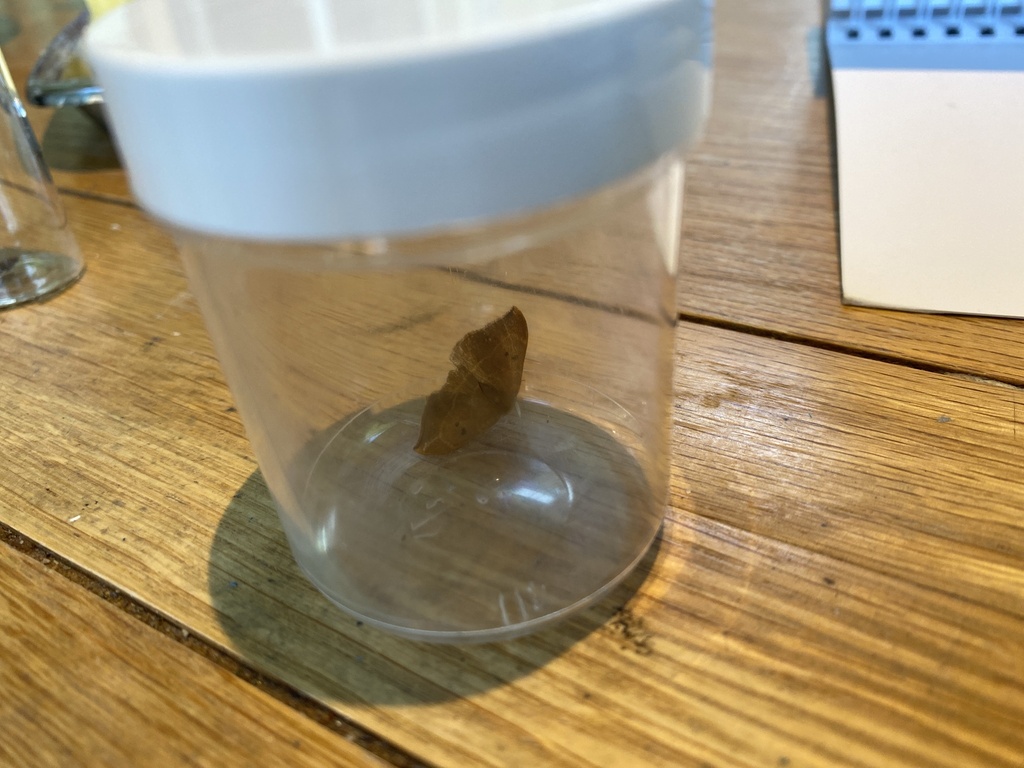
The oak hook-tip (Watsonalla binaria) is a moth of the family Drepanidae. It is found in most of Europe except the far north. It is quite common in England and Wales, but not found in Scotland and only recently in Ireland. The species was first described by Johann Siegfried Hufnagel in 1767. The sexes differ in size (male wingspan about 30 mm, female about 35 mm), but are similar in colour. The fore wings are orange-brown with three narrow yellow fascia (the outer one being faint and sometimes absent) with two dark discal spots between the inner two fascia. Sometimes, these occur, but weaker, on the rear wings. The apex of the fore wings is hook shaped, giving the species its name. The hind wings are lighter orange, again with three yellow fascia. Usually two broods are produced each year, the adults flying in May and June and again in August [1]. Second-generation moths are much smaller and slightly lighter coloured than those of the first. They are very similar to Watsonalla cultraria which also has a yellowish-brown colour. Two black twin points on the front wings are the clearest differentiator. The species sometimes flies during the day, but usually flies at night and is attracted to light. The larva is brown with yellow markings and shows the typical drepanid shape with a tapered tail. It usually feeds on oak, but has also been recorded on alder, beech, and birch. The species overwinters as pupae. ^The flight season refers to the British Isles. This may vary in other parts of the range.
Gallery
Ajouter des photos
Partagez vos photos de cette espèce (jusqu'à 20 à la fois) : elles sont vérifiées automatiquement, puis publiées.
Répartition
Occurrences observées (données GBIF). Les zones hors aire d'origine peuvent indiquer une présence introduite ou invasive.
Sources et crédits
Informations provenant de plusieurs sources vérifiées. Dernière mise à jour : .
Crédits photos (8)
- Photo : @jenjen1989 · CC BY-NC 4.0 · via iNaturalist
- Photo : Manuel Raab (@mani_raab) · CC BY-NC 4.0 · via iNaturalist
- Photo : John D Reynolds (@johndreynolds) · CC BY-NC 4.0 · via iNaturalist
- Photo : @adinie · CC BY-NC 4.0 · via iNaturalist
- Photo : John P (@astrapia) · CC BY-NC 4.0 · via iNaturalist
- Photo : @leo_mrn · CC BY-NC 4.0 · via iNaturalist
- Photo : Frederik Rothe (@mrrunshak) · CC BY-NC 4.0 · via iNaturalist
- Photo : Émilien Vadam (@emilien_vadam) · CC BY-NC 4.0 · via iNaturalist
Mentions de licence
Texte disponible sous licence CC BY-SA 4.0. Il adapte notamment Wikipedia (CC BY-SA) : Oak hook-tip (Wikipédia, auteurs dans l’historique de l’article).
- Taxonomie : GBIF Backbone Taxonomy (CC BY 4.0)
- Carte : occurrences GBIF, fond © contributeurs OpenStreetMap (ODbL)
Détail : Sources et licences.
Discussion (0)
Aucun message pour l’instant. Lancez la discussion sur cette fiche (sources, précisions, débats éditoriaux).
Connectez-vous pour participer à la discussion.