
Urocerus gigas
Urocerus gigas
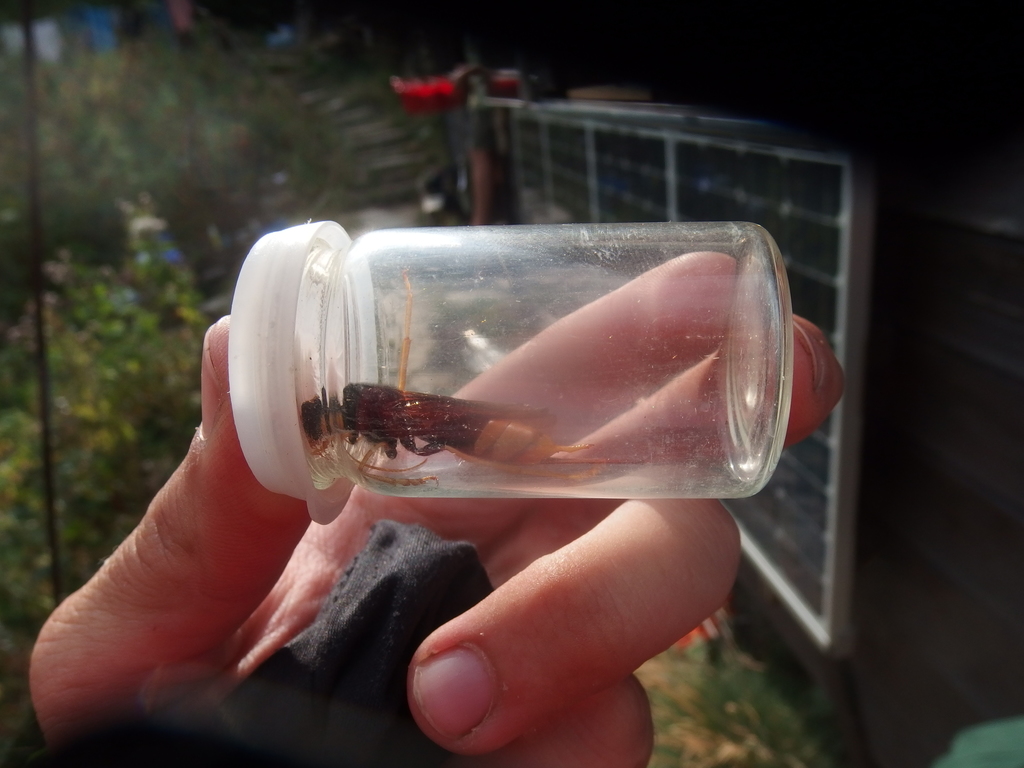
Urocerus gigas, the giant woodwasp, banded horntail, or greater horntail, is a species of sawfly native to the Palearctic realm and North Africa but also reside in North America since 2004 Though they are not wasps, their appearance…
- Kingdom
- Animalia
- Phylum
- Arthropoda
- Class
- Insecta
- Order
- Hymenoptera
- Family
- Siricidae
- Genus
- Urocerus
- Species
- Urocerus gigas
Description
Urocerus gigas, the giant woodwasp, banded horntail, or greater horntail, is a species of sawfly native to the Palearctic realm and North Africa but also reside in North America since 2004 Though they are not wasps, their appearance resembles one due to mimicry. Adults are usually between 10 and 40 millimetres (1⁄2 and 1+1⁄2 inches) in length. Subspecies: Urocerus gigas gigas Urocerus gigas taiganus Urocerus gigas is a wood-boring insect that attacks softwoods of freshly felled logs/unhealthy trees. The species lives in discrete tunnels, frequently filled with hard-packed coarse fibrous frass, hard to dig out from tunnels. The tunnels are large, round and discrete, between 6 and 7 mm (1⁄4 and 9⁄32 in) in diameter. Both sexes have a chitinous spike emerging from the abdomen, derived from the last segment, which is found in all woodwasps. However, unlike in true wasps, the projection is harmless and the insect cannot sting. The second, longer and lower projection in females only is the ovipositor. The ovipositor has saw-like teeth which she uses to drill a hole, and then deposit her eggs, into wood. Urocerus flavicornis was once considered a subspecies of gigas but is now known to be a separate species.
Gallery
Ajouter des photos
Partagez vos photos de cette espèce (jusqu'à 20 à la fois) : elles sont vérifiées automatiquement, puis publiées.
Répartition
Occurrences observées (données GBIF). Les zones hors aire d'origine peuvent indiquer une présence introduite ou invasive.
Sources et crédits
Informations provenant de plusieurs sources vérifiées. Dernière mise à jour : .
Crédits photos (7)
- Photo : Valentin Moser (@vmoser) · CC BY 4.0 · via iNaturalist
- Photo : @kw4dr4t · CC BY-NC 4.0 · via iNaturalist
- Photo : Fedrico (@federicospaghetti) · CC BY-NC 4.0 · via iNaturalist
- Photo : @leeeo · CC BY-NC 4.0 · via iNaturalist
- Photo : Fundación Dodo Colombia (@dodo_colombia) · CC BY-NC 4.0 · via iNaturalist
- Photo : Max (@kurzmann) · CC BY-NC 4.0 · via iNaturalist
- Photo : Jessica Carter (@jessicamhgc) · CC BY-NC 4.0 · via iNaturalist
Mentions de licence
Texte disponible sous licence CC BY-SA 4.0. Il adapte notamment Wikipedia (CC BY-SA) : Urocerus gigas (Wikipédia, auteurs dans l’historique de l’article).
- Taxonomie : GBIF Backbone Taxonomy (CC BY 4.0)
- Carte : occurrences GBIF, fond © contributeurs OpenStreetMap (ODbL)
Détail : Sources et licences.
Discussion (0)
Aucun message pour l’instant. Lancez la discussion sur cette fiche (sources, précisions, débats éditoriaux).
Connectez-vous pour participer à la discussion.