
Teleogryllus oceanicus
Teleogryllus oceanicus
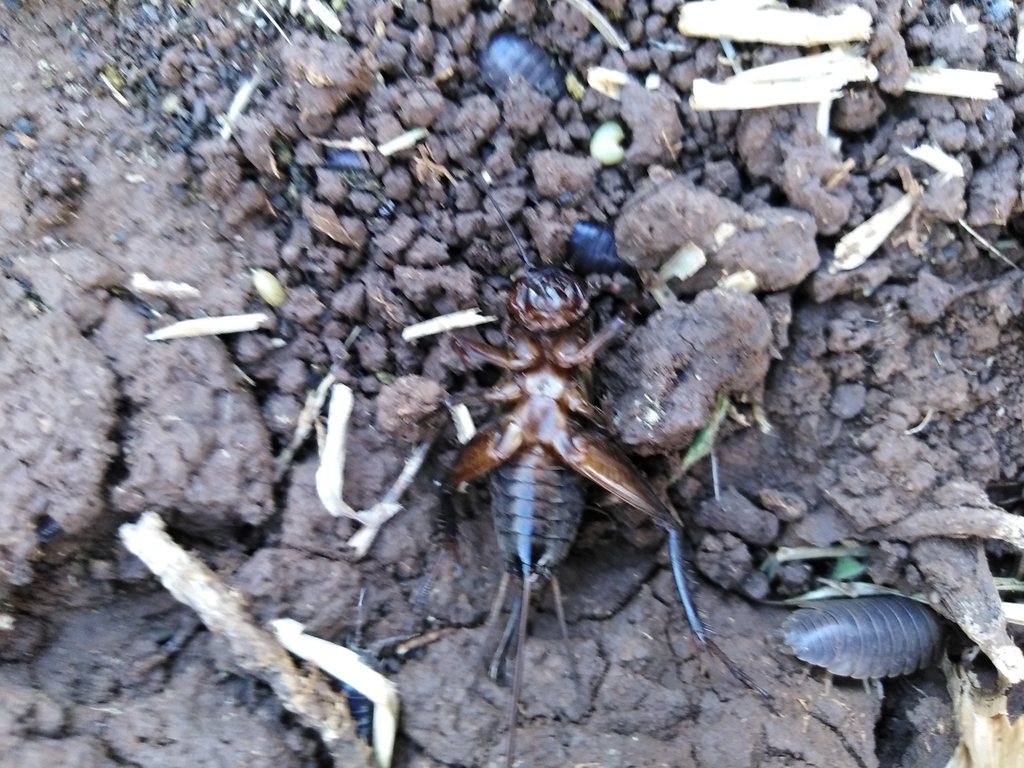
Teleogryllus oceanicus, commonly known as the Australian, Pacific or oceanic field cricket, is a cricket found across Oceania and in coastal Australia from Carnarvon in Western Australia and Rockhampton in north-east Queensland T.…
- Kingdom
- Animalia
- Phylum
- Arthropoda
- Class
- Insecta
- Order
- Orthoptera
- Family
- Gryllidae
- Genus
- Teleogryllus
- Species
- Teleogryllus oceanicus
Description
Teleogryllus oceanicus, commonly known as the Australian, Pacific or oceanic field cricket, is a cricket found across Oceania and in coastal Australia from Carnarvon in Western Australia and Rockhampton in north-east Queensland T. oceanicus populations in Hawaii arose through human-assisted introduction. It is currently unknown whether T. oceanicus was introduced to Hawaii in 1877 by area trade ships, or 1500 years ago with the original Polynesian settlers. Microsatellite comparisons support the idea that the Hawaiian T. oceanicus colonization originated in the Western islands and then spread East. T. oceanicus crickets are black to dark brown in coloration with longitudinal stripes on the back of the head. Males average between 28 and 35 mm in length, and the females are typically longer due to the ovipositor with an average of 33–42 mm. These crickets are typically found on soil ground hiding in fissures or holes in the terrain, and are typically only found in high numbers in landscapes that provide a good deal of cover. T. oceanicus may also be referred to as the black field cricket, a common name it shares with Teleogryllus commodus. The two species are nearly morphologically indistinguishable, the exception being that T. oceanicus males have a greater number of file teeth on their wings. T. oceanicus was originally regarded taxonomically as a geographic race of T. commodus, but was later recognized as a distinct species as growing evidence of reproductive isolation and differences in calling sound were reported. The two species' geographic ranges remain mostly separate with the exception of small overlap zones in Eastern Australia. There have been no reports of hybridization between the species in this overlap zone, thought to be due to differences in calling song acting as a pre-zygotic barrier. No character displacement has been observed in either species in this overlap region. Unlike T. commodus which lays eggs only a single time per season, T. oceanicus crickets breed year round.
Gallery
Ajouter des photos
Partagez vos photos de cette espèce (jusqu'à 20 à la fois) : elles sont vérifiées automatiquement, puis publiées.
Répartition
Occurrences observées (données GBIF). Les zones hors aire d'origine peuvent indiquer une présence introduite ou invasive.
Sources et crédits
Informations provenant de plusieurs sources vérifiées. Dernière mise à jour : .
Crédits photos (8)
- Photo : Javier Sellanes Lopez (@javier106) · CC BY-NC 4.0 · via iNaturalist
- Photo : Thomas Mesaglio (@thebeachcomber) · CC BY 4.0 · via iNaturalist
- Photo : Matthew Connors (@matthew_connors) · CC BY-NC 4.0 · via iNaturalist
- Photo : James Bailey (@silversea_starsong) · CC BY-NC 4.0 · via iNaturalist
- Photo : @juju98 · CC BY-NC 4.0 · via iNaturalist
- Photo : @happymountainnz · CC BY-NC 4.0 · via iNaturalist
- Photo : Adrien Cantat (@tahiticrabs) · CC BY-NC 4.0 · via iNaturalist
- Photo : Addie (@bugtype) · CC BY 4.0 · via iNaturalist
Mentions de licence
Texte disponible sous licence CC BY-SA 4.0. Il adapte notamment Wikipedia (CC BY-SA) : Teleogryllus oceanicus (Wikipédia, auteurs dans l’historique de l’article).
- Taxonomie : GBIF Backbone Taxonomy (CC BY 4.0)
- Carte : occurrences GBIF, fond © contributeurs OpenStreetMap (ODbL)
Détail : Sources et licences.
Discussion (0)
Aucun message pour l’instant. Lancez la discussion sur cette fiche (sources, précisions, débats éditoriaux).
Connectez-vous pour participer à la discussion.