
Red palm weevil
Rhynchophorus ferrugineus
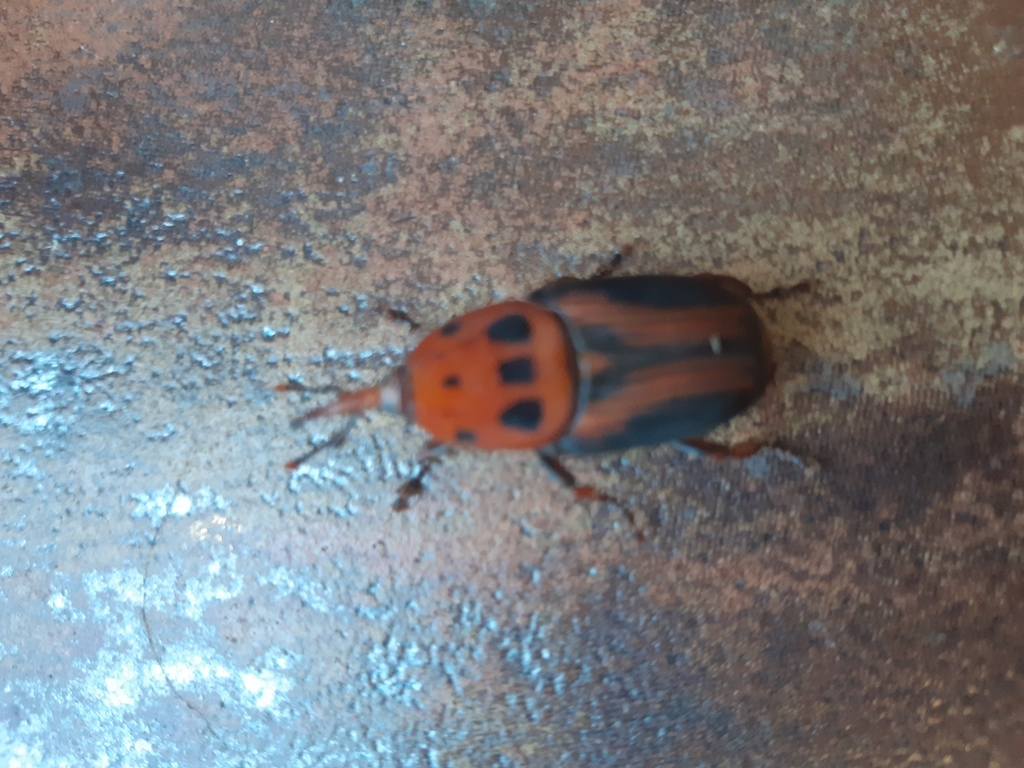
The palm weevil Rhynchophorus ferrugineus is one of two species of snout beetle known as the red palm weevil, Asian palm weevil or sago palm weevil.
- Kingdom
- Animalia
- Phylum
- Arthropoda
- Class
- Insecta
- Order
- Coleoptera
- Family
- Dryophthoridae
- Genus
- Rhynchophorus
- Species
- Rhynchophorus ferrugineus
Description
The palm weevil Rhynchophorus ferrugineus is one of two species of snout beetle known as the red palm weevil, Asian palm weevil or sago palm weevil. The adult beetles are relatively large, ranging between 2 and 4 centimetres (1 and 1+1⁄2 inches) long, and are usually a rusty red colour-but many colour variants exist and have often been classified as different species (e.g., R. vulneratus). Weevil larvae can excavate holes in the trunks of palm trees up to 1 metre (3.3 ft) long, thereby weakening and eventually killing the host plant. As a result, the weevil is considered a major pest in palm plantations, including the coconut palm, date palm and oil palm. Originally from tropical Asia, the red palm weevil has spread to Africa and Europe, reaching the Mediterranean in the 1980s. It was first recorded in Spain in 1994, and in France in 2006. Additional infestations have been located in Malta, Italy (Tuscany, Sicily, Campania, Sardinia, Lazio, Marche, Puglia and Liguria), Croatia and Montenegro. It is also well established throughout most of Portugal, especially in the South. It also has established in Morocco, Tunisia, and other North African countries. The weevil was first reported in the Americas on Curaçao in January 2009 and sighted the same year in Aruba. It was reported in the United States at Laguna Beach, California late in 2010 but this was a misidentification of the closely related species, R. vulneratus, and it did not become established.It was reported in Uruguay in March 2022, and has since spread to many parts of the country. Larvae of Rhynchophorus ferrugineus are considered a delicacy in Southeast Asian cuisine. In some regions, however, larvae farming is strictly prohibited to prevent the potential devastation of plantation crops.
Gallery
Ajouter des photos
Partagez vos photos de cette espèce (jusqu'à 20 à la fois) : elles sont vérifiées automatiquement, puis publiées.
Répartition
Occurrences observées (données GBIF). Les zones hors aire d'origine peuvent indiquer une présence introduite ou invasive.
Sources et crédits
Informations provenant de plusieurs sources vérifiées. Dernière mise à jour : .
Crédits photos (8)
- Photo : Sandra Seabra (@sandraseabra) · CC BY-NC 4.0 · via iNaturalist
- Photo : @jegnaturalust · CC BY-NC 4.0 · via iNaturalist
- Photo : João Esteves (@jesteves) · CC BY-NC 4.0 · via iNaturalist
- Photo : Ruben Ciantia (@rubenciantia) · CC BY 4.0 · via iNaturalist
- Photo : Duarte Frade (@duarte) · CC BY 4.0 · via iNaturalist
- Photo : @manu-klein · CC BY-NC 4.0 · via iNaturalist
- Photo : @bj66 · CC BY-NC 4.0 · via iNaturalist
- Photo : Marek Koszorek (@marekkoszorek) · CC BY-NC 4.0 · via iNaturalist
Mentions de licence
Texte disponible sous licence CC BY-SA 4.0. Il adapte notamment Wikipedia (CC BY-SA) : Rhynchophorus ferrugineus (Wikipédia, auteurs dans l’historique de l’article).
- Taxonomie : GBIF Backbone Taxonomy (CC BY 4.0)
- Carte : occurrences GBIF, fond © contributeurs OpenStreetMap (ODbL)
Détail : Sources et licences.
Discussion (0)
Aucun message pour l’instant. Lancez la discussion sur cette fiche (sources, précisions, débats éditoriaux).
Connectez-vous pour participer à la discussion.