
Pretty pinion
Perizoma blandiata
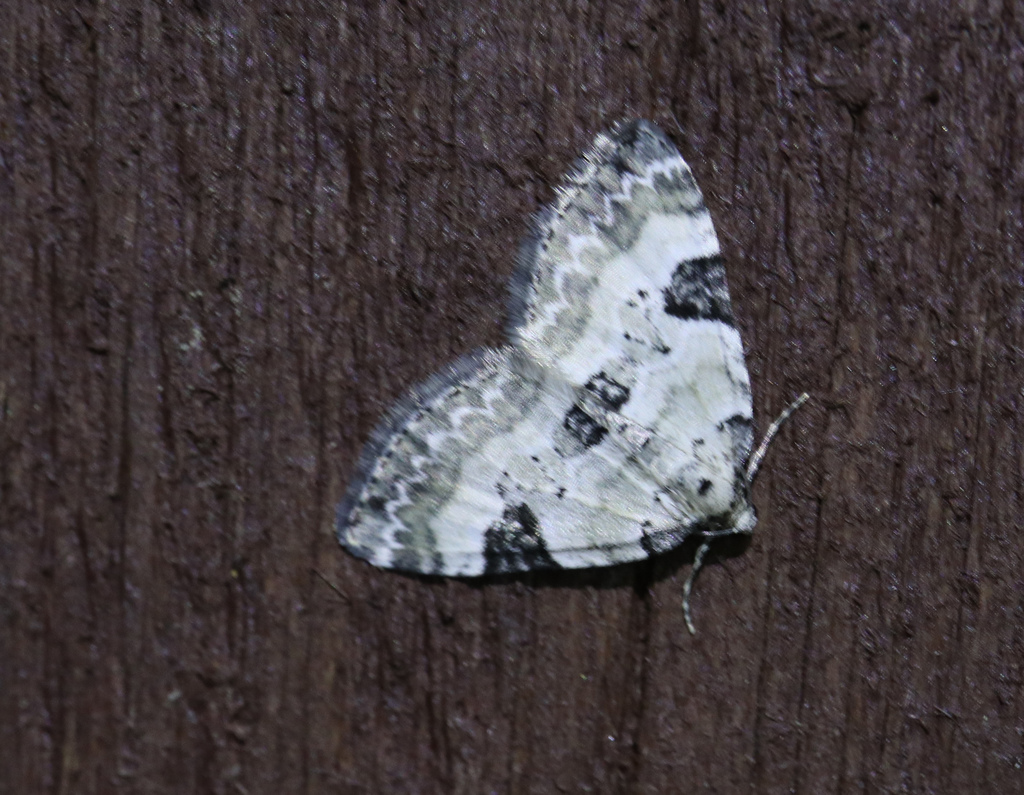
Perizoma blandiata, the pretty pinion, is a moth of the family Geometridae.
- Kingdom
- Animalia
- Phylum
- Arthropoda
- Class
- Insecta
- Order
- Lepidoptera
- Family
- Geometridae
- Genus
- Perizoma
- Species
- Perizoma blandiata
Description
Perizoma blandiata, the pretty pinion, is a moth of the family Geometridae. The species was first described by Michael Denis and Ignaz Schiffermüller in 1775. It is found from most of central and northern Europe to central Asia as far as the Khangai Mountains. The wingspan is 19–23 mm. It is related to P. minorata but with the band between the basal and median obsolete or very shadowy (extremely pale brown) the median band very dark anteriorly but pale in the middle, except on the veins, the hindwing rather more strongly marked. : ab. coarctata Prout has the median band narrowed to a mere thread. : perfasciata form. nov [Prout]. has the median band dark throughout and appears to form a constant local race in the Hebrides. The larva is short and powerful with short bristles and pale green with a wide red longitudinal stripe on each side of the back.This colour combination represents an excellent camouflage and can be interpreted as an imitation of the reddish stem of the Euphrasia on which it feeds. The species is found on moors and other open places. There is one generation per year with adults on wing from the end of July to August. The larvae feed on Euphrasia species. The eggs are deposited on or near the flower buds. The larvae can be found from July to September. It overwinters as a pupa.
Gallery
Ajouter des photos
Partagez vos photos de cette espèce (jusqu'à 20 à la fois) : elles sont vérifiées automatiquement, puis publiées.
Répartition
Occurrences observées (données GBIF). Les zones hors aire d'origine peuvent indiquer une présence introduite ou invasive.
Sources et crédits
Informations provenant de plusieurs sources vérifiées. Dernière mise à jour : .
Crédits photos (7)
- Photo : Tero Linjama (@terolinjama) · CC0 (domaine public) · via iNaturalist
- Photo : Maks Syratt (@makss) · CC BY-NC 4.0 · via iNaturalist
- Photo : Jaro Schacht (@jaroschacht) · CC BY-NC 4.0 · via iNaturalist
- Photo : Menotti Passarella (@italianbirder) · CC BY-NC 4.0 · via iNaturalist
- Photo : Christian Anich (@chranich) · CC BY-NC 4.0 · via iNaturalist
- Photo : Felix Riegel (@felix_riegel) · CC BY-NC 4.0 · via iNaturalist
- Photo : Manuel Raab (@mani_raab) · CC BY-NC 4.0 · via iNaturalist
Mentions de licence
Texte disponible sous licence CC BY-SA 4.0. Il adapte notamment Wikipedia (CC BY-SA) : Perizoma blandiata (Wikipédia, auteurs dans l’historique de l’article).
- Taxonomie : GBIF Backbone Taxonomy (CC BY 4.0)
- Carte : occurrences GBIF, fond © contributeurs OpenStreetMap (ODbL)
Détail : Sources et licences.
Discussion (0)
Aucun message pour l’instant. Lancez la discussion sur cette fiche (sources, précisions, débats éditoriaux).
Connectez-vous pour participer à la discussion.