
Rhinoceros Beetle
Oryctes monoceros
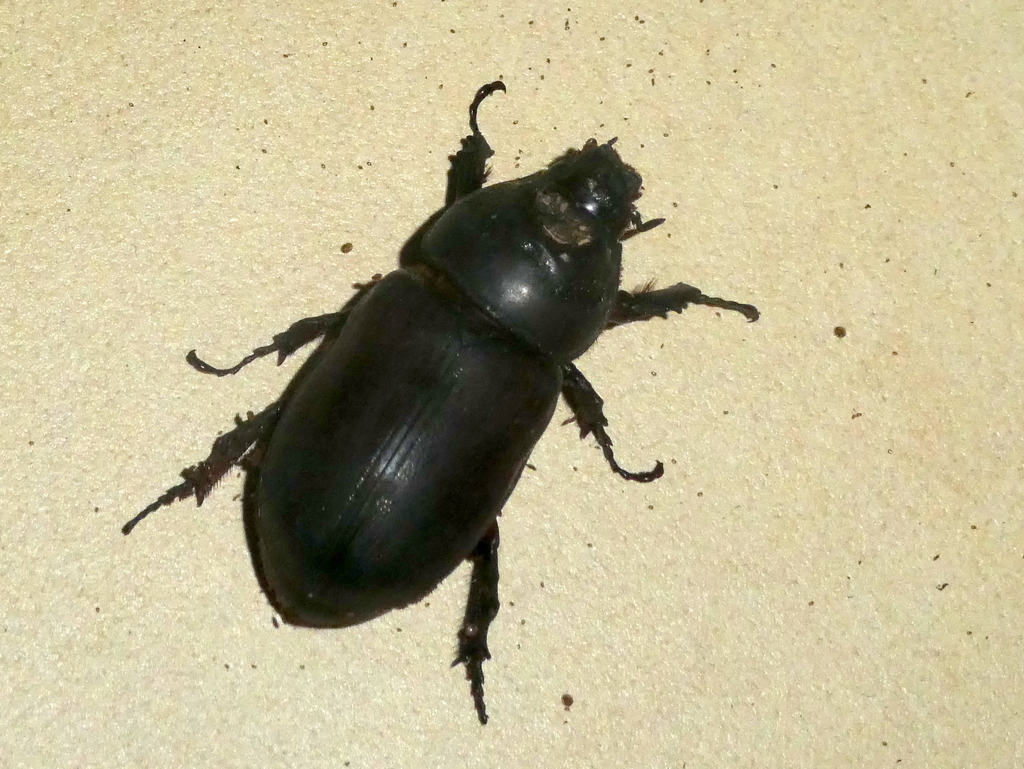
Oryctes monoceros, commonly known as African rhinoceros beetle, is a species of rhinoceros beetles from the subfamily Dynastinae (family: Scarabaeidae) which is common in sub-Saharan Africa.
- Kingdom
- Animalia
- Phylum
- Arthropoda
- Class
- Insecta
- Order
- Coleoptera
- Family
- Scarabaeidae
- Genus
- Oryctes
- Species
- Oryctes monoceros
Description
Oryctes monoceros, commonly known as African rhinoceros beetle, is a species of rhinoceros beetles from the subfamily Dynastinae (family: Scarabaeidae) which is common in sub-Saharan Africa. Its distribution extends from Senegal and Chad in the North to South Africa in the South and includes the islands of Madagascar, Seychelles and Réunion in the East. O. monoceros is similar in size (~ 4 cm long) and biology to O. rhinoceros found in tropical parts of Asia and the Pacific. Both species are serious pests of coconut and oil palms and attack these by boring into the crown of the palms and feeding on the young developing fronds. Taxonomically, O. monoceros and O. rhinoceros belong to different subgenera of Oryctes, the main differences between both species are: Oryctes monoceros (subgenus Rykanoryctes) has 3 immovable spikes at the tip of the hindtibia and on average males have a shorter horn than O. rhinoceros which is more strongly curved backwards. Oryctes rhinoceros (subgenus Rykanes) has 2 immovable spikes at the tip of the hindtibia and on average males have a longer horn than in O. monoceros which is only slightly curved backwards.
Gallery
Ajouter des photos
Partagez vos photos de cette espèce (jusqu'à 20 à la fois) : elles sont vérifiées automatiquement, puis publiées.
Répartition
Occurrences observées (données GBIF). Les zones hors aire d'origine peuvent indiquer une présence introduite ou invasive.
Sources et crédits
Informations provenant de plusieurs sources vérifiées. Dernière mise à jour : .
Crédits photos (8)
- Photo : Rob C. H. M. Oudejans (@oudejans) · CC BY-NC 4.0 · via iNaturalist
- Photo : AW Klopper (@visvanger) · CC BY-NC 4.0 · via iNaturalist
- Photo : Peter Vos (@bushboy) · CC BY-NC 4.0 · via iNaturalist
- Photo : Sally Adam (@sallyslak) · CC BY-NC 4.0 · via iNaturalist
- Photo : Jessica D Roberts (@dottyjess) · CC BY-NC 4.0 · via iNaturalist
- Photo : Georgia Born-Schmidt (@gborn) · CC BY-NC 4.0 · via iNaturalist
- Photo : @mmous · CC BY-NC 4.0 · via iNaturalist
- Photo : @oguzfromally · CC BY-NC 4.0 · via iNaturalist
Mentions de licence
Texte disponible sous licence CC BY-SA 4.0. Il adapte notamment Wikipedia (CC BY-SA) : Oryctes monoceros (Wikipédia, auteurs dans l’historique de l’article).
- Taxonomie : GBIF Backbone Taxonomy (CC BY 4.0)
- Carte : occurrences GBIF, fond © contributeurs OpenStreetMap (ODbL)
Détail : Sources et licences.
Discussion (0)
Aucun message pour l’instant. Lancez la discussion sur cette fiche (sources, précisions, débats éditoriaux).
Connectez-vous pour participer à la discussion.