
Onymacris unguicularis
Onymacris unguicularis
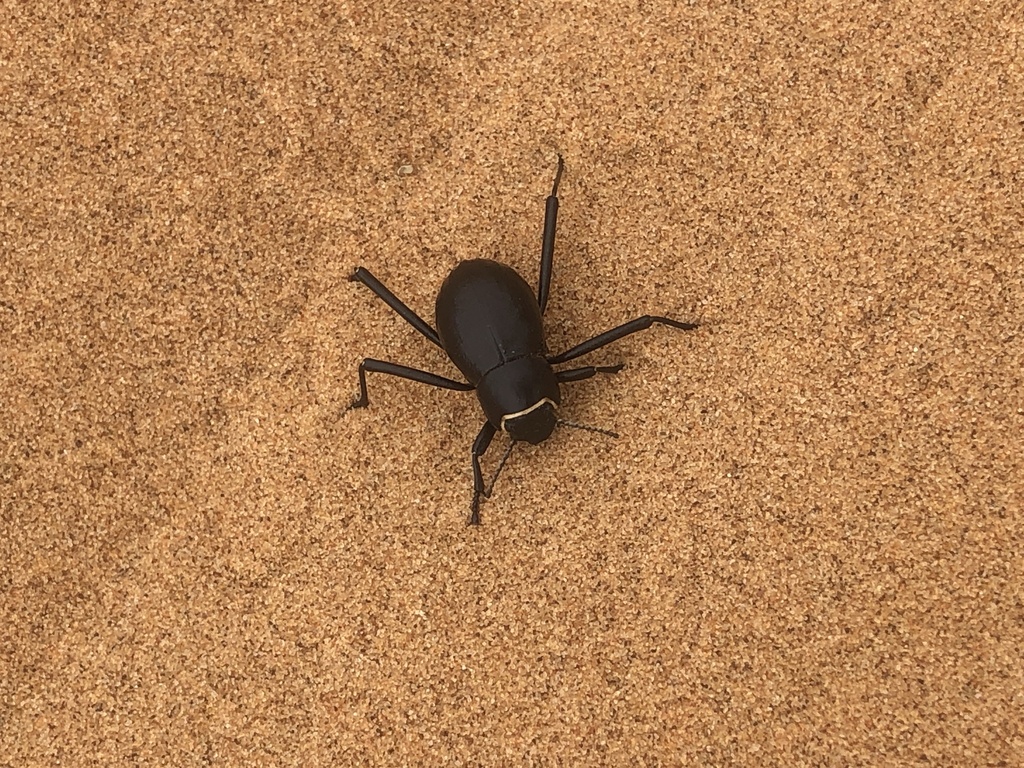
Onymacris unguicularis, also known commonly as the fog-basking beetle, head-stander beetle, or the Toktokkies, is a species of darkling beetle that is native to the Namib Desert of southwestern Africa.
- Kingdom
- Animalia
- Phylum
- Arthropoda
- Class
- Insecta
- Order
- Coleoptera
- Family
- Tenebrionidae
- Genus
- Onymacris
- Species
- Onymacris unguicularis
Description
Onymacris unguicularis, also known commonly as the fog-basking beetle, head-stander beetle, or the Toktokkies, is a species of darkling beetle that is native to the Namib Desert of southwestern Africa. At night, during foggy weather, these beetles climb sand dunes and stand on their forelegs in order to capture water droplets as they run down their vertical bodies and into their mouths The behaviour is called "fog-basking" and is unique to Onymacris unguicularis and Onymacris bicolor. Fog basking was first observed in the O. unguicularis in 1976. The mechanism for this ability is still being discovered, but current research points towards the beetle's elytra containing some hydrophobic component that can catch water droplets being blown in the wind. The idea of harvesting atmospheric moisture from early morning dew using special materials has been widely utilized in many parts of the world. This species has very often been confused with Stenocara gracilipes, another species of darkling beetle in the Namib Desert, due to their similar coloration and water capturing behaviour.
Gallery
Ajouter des photos
Partagez vos photos de cette espèce (jusqu'à 20 à la fois) : elles sont vérifiées automatiquement, puis publiées.
Répartition
Occurrences observées (données GBIF). Les zones hors aire d'origine peuvent indiquer une présence introduite ou invasive.
Sources et crédits
Informations provenant de plusieurs sources vérifiées. Dernière mise à jour : .
Crédits photos (8)
- Photo : Timo M. (@timo27) · CC BY-NC 4.0 · via iNaturalist
- Photo : @ingrid-emeline · CC BY-NC 4.0 · via iNaturalist
- Photo : Peter Erb (@peter_erb) · CC BY-NC 4.0 · via iNaturalist
- Photo : Aleh Sinchuk (@formica) · CC BY-NC 4.0 · via iNaturalist
- Photo : Tom Field (@tomfeild) · CC BY 4.0 · via iNaturalist
- Photo : Royle Safaris (@roylesafaris) · CC BY-NC 4.0 · via iNaturalist
- Photo : @suchihfen · CC BY-NC 4.0 · via iNaturalist
- Photo : Kristopher Brand (@kristopher48468) · CC0 (domaine public) · via iNaturalist
Mentions de licence
Texte disponible sous licence CC BY-SA 4.0. Il adapte notamment Wikipedia (CC BY-SA) : Onymacris unguicularis (Wikipédia, auteurs dans l’historique de l’article).
- Taxonomie : GBIF Backbone Taxonomy (CC BY 4.0)
- Carte : occurrences GBIF, fond © contributeurs OpenStreetMap (ODbL)
Détail : Sources et licences.
Discussion (0)
Aucun message pour l’instant. Lancez la discussion sur cette fiche (sources, précisions, débats éditoriaux).
Connectez-vous pour participer à la discussion.