
Black Cherry Aphid
Myzus cerasi
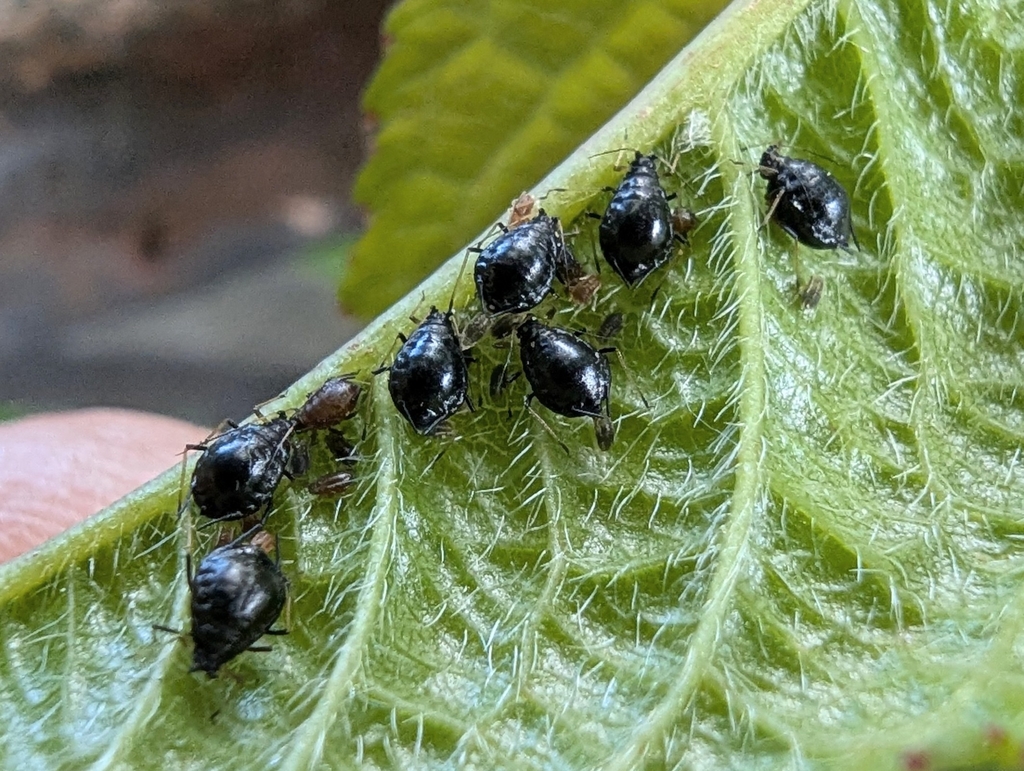
Myzus cerasi, the black cherry aphid or cherry blackfly, is an aphid in order Hemiptera.
- Kingdom
- Animalia
- Phylum
- Arthropoda
- Class
- Insecta
- Order
- Hemiptera
- Family
- Aphididae
- Genus
- Myzus
- Species
- Myzus cerasi
Description
Myzus cerasi, the black cherry aphid or cherry blackfly, is an aphid in order Hemiptera. It is a true bug and sucks sap from plants. Morphology: "Myzus cerasi is a small to medium-sized aphid. Adults are shiny, very dark brown to black, with a sclerotized dorsum. Siphunculi and cauda are entirely black. The legs and antennae are yellow and black. Apterous summer virginoparae have a shiny black body, siphunculi and antennae. Cauda dusky to black, and tibiae yellow except tips. Ecology: The Myzus cerasi breeding habitat is found at growing top shoots of Prunus spp., Prunus cerasus and Prunus avium. Forming large colonies that cause leaf curling and damage to newly forming leaves. Myzus cerasi is also considered to be a cosmopolitan species, ranging across Europe and parts of Asia. The species wide range and differing host species allows for breeding programs to make use of possible natural deterrents that may be more effective than previous pesticides. While research has shown correlation to damage caused by cherry aphids and half-line hosts, there is also evidence for host population resistance. Biopesticides: Bacillus thuringiensis and Bacillus thuringiensis, where found effective in both lab and field studies at reducing aphid population size. While environmental conditions reduce effectiveness of biopesticides this can be attributed to aphid populations experiencing reduced exposure to FDP-41. While only 10 ng/μL of FDP-41 is needed to reach 70% mortality rate within 72 hours , under lab conditions, further studies are needed to increase the viability
Gallery
Ajouter des photos
Partagez vos photos de cette espèce (jusqu'à 20 à la fois) : elles sont vérifiées automatiquement, puis publiées.
Répartition
Occurrences observées (données GBIF). Les zones hors aire d'origine peuvent indiquer une présence introduite ou invasive.
Sources et crédits
Informations provenant de plusieurs sources vérifiées. Dernière mise à jour : .
Crédits photos (8)
- Photo : Letizia Weichgrebe (@letiziaw) · CC BY 4.0 · via iNaturalist
- Photo : Susan Marley (@susan_marley) · CC BY 4.0 · via iNaturalist
- Photo : Susan Marley (@susan_marley) · CC BY 4.0 · via iNaturalist
- Photo : @urenzal · CC BY-NC 4.0 · via iNaturalist
- Photo : Kurt Nadler (@nadler) · CC BY-NC 4.0 · via iNaturalist
- Photo : Kalle Rainio (@karainio) · CC BY-NC 4.0 · via iNaturalist
- Photo : Quentin Groom (@qgroom) · CC0 (domaine public) · via iNaturalist
- Photo : Pavel Šinkyřík (@pavelsink) · CC BY-NC 4.0 · via iNaturalist
Mentions de licence
Texte disponible sous licence CC BY-SA 4.0. Il adapte notamment Wikipedia (CC BY-SA) : Myzus cerasi (Wikipédia, auteurs dans l’historique de l’article).
- Taxonomie : GBIF Backbone Taxonomy (CC BY 4.0)
- Carte : occurrences GBIF, fond © contributeurs OpenStreetMap (ODbL)
Détail : Sources et licences.
Discussion (0)
Aucun message pour l’instant. Lancez la discussion sur cette fiche (sources, précisions, débats éditoriaux).
Connectez-vous pour participer à la discussion.