
House fly
Musca domestica
The housefly (Musca domestica) is a fly of the suborder Cyclorrhapha.
- Kingdom
- Animalia
- Phylum
- Arthropoda
- Class
- Insecta
- Order
- Diptera
- Family
- Muscidae
- Genus
- Musca
- Species
- Musca domestica
Description
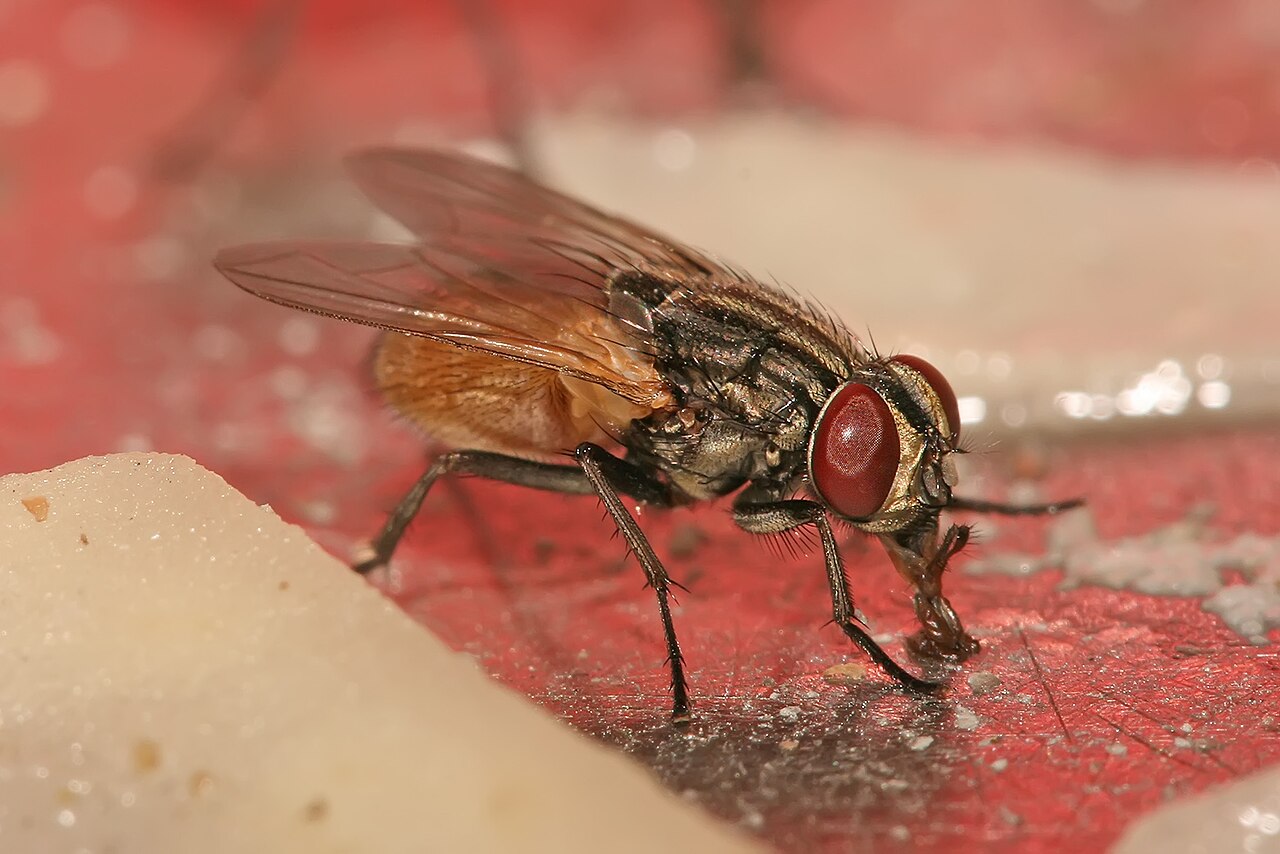
The housefly (Musca domestica) is a fly of the suborder Cyclorrhapha. From its place of origin, perhaps in the Middle East, it has spread around the world as a commensal of humans. Adults are gray to black, with four dark, longitudinal lines on the thorax, slightly hairy bodies, and a single pair of membranous wings. They have red compound eyes, set farther apart in the slightly larger female. The female housefly usually mates only once and stores the sperm for later use. It lays batches of about 100 eggs on decaying organic matter such as food waste, carrion, or feces. These soon hatch into legless white larvae, known as maggots. After two to five days of development, these metamorphose into reddish-brown pupae, about 8 millimetres (3⁄8 inch) long. Adult flies normally live for two to four weeks, but can hibernate during the winter. The adults feed on a variety of liquid or semi-liquid substances, as well as solid materials which have been softened by their saliva. They can carry pathogens on their bodies and in their feces, contaminate food, and contribute to the transfer of food-borne illnesses, while, in numbers, they can be physically annoying. For these reasons, they are considered pests. Houseflies, with short life cycles and ease with which they can be maintained, have been found useful for laboratory research into aging and sex determination. Houseflies appear in literature from Ancient Greek myth and Aesop's "The Impertinent Insect" onwards. Authors sometimes choose the housefly to speak of the brevity of life, as in William Blake's 1794 poem "The Fly", which deals with mortality subject to uncontrollable circumstances.
Gallery
Ajouter des photos
Partagez vos photos de cette espèce (jusqu'à 20 à la fois) : elles sont vérifiées automatiquement, puis publiées.
Répartition
Occurrences observées (données GBIF). Les zones hors aire d'origine peuvent indiquer une présence introduite ou invasive.
Sources et crédits
Informations provenant de plusieurs sources vérifiées. Dernière mise à jour : .
Crédits photos (6)
- Photo : Muhammad Mahdi Karim · GFDL
- Photo : Ana Gatica Colima (@agatica) · CC BY-NC 4.0 · via iNaturalist
- Photo : @jensen6ed · CC BY-NC 4.0 · via iNaturalist
- Photo : jhon william yace tomaylla (@williamyacetomaylla) · CC BY-NC 4.0 · via iNaturalist
- Photo : Lina Goldman (@lina_aachen) · CC BY-NC 4.0 · via iNaturalist
- Photo : @mothdragon · CC BY-NC 4.0 · via iNaturalist
Mentions de licence
Texte disponible sous licence CC BY-SA 4.0. Il adapte notamment Wikipedia (CC BY-SA) : Housefly (Wikipédia, auteurs dans l’historique de l’article).
- Taxonomie : GBIF Backbone Taxonomy (CC BY 4.0)
- Carte : occurrences GBIF, fond © contributeurs OpenStreetMap (ODbL)
Détail : Sources et licences.
Discussion (0)
Aucun message pour l’instant. Lancez la discussion sur cette fiche (sources, précisions, débats éditoriaux).
Connectez-vous pour participer à la discussion.