
Glanville fritellary
Melitaea cinxia
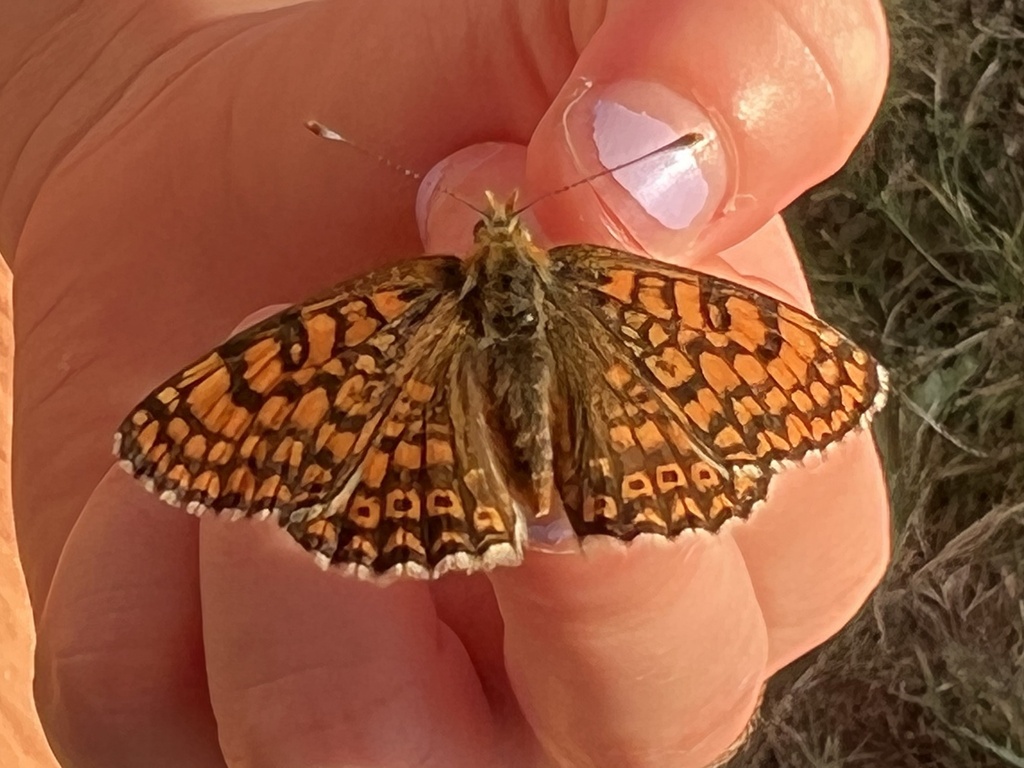
The Glanville fritillary (Melitaea cinxia) is a butterfly of the family Nymphalidae.
- Kingdom
- Animalia
- Phylum
- Arthropoda
- Class
- Insecta
- Order
- Lepidoptera
- Family
- Nymphalidae
- Genus
- Melitaea
- Species
- Melitaea cinxia
Description
The Glanville fritillary (Melitaea cinxia) is a butterfly of the family Nymphalidae. It is named for Eleanor Glanville, the naturalist who discovered it, and the checkerboard pattern on its wings. These butterflies live in almost all of Europe, especially Finland, and in parts of northwest Africa. They are absent from the far north of Europe and parts of the Iberian Peninsula. To the east they are found across the Palearctic (in Turkey, Russia, northern Kazakhstan, and Mongolia). It has been discovered that this butterfly only mates one time in June or July and lays its eggs. It does not provide any protection to these eggs or care for the offspring. As adults, the Glanville fritillaries are short-lived; they spend most of their lives as caterpillars. As caterpillars, Glanville fritillaries enter a stage of diapause, which is a period of suspended development, during the winter time. The spiked speedwell and ribwort plantain are the Glanville fritillary's preferred plants to lay eggs and to eat as larvae. Female butterflies will show a preference for one plant species over the other when deciding where to lay their eggs, but the caterpillars have no preference once they hatch. After entering the adult phase the fritillaries feed on nectar of the spiked speedwell and ribwort plantain, among others. This species of butterfly is at risk of population decline because it is not a migratory species. Though widespread, populations in Finland are at risk because they are not able to travel great distances as easily as other species, such as monarchs, if their environment should suddenly become unsuitable.
Gallery
Ajouter des photos
Partagez vos photos de cette espèce (jusqu'à 20 à la fois) : elles sont vérifiées automatiquement, puis publiées.
Répartition
Occurrences observées (données GBIF). Les zones hors aire d'origine peuvent indiquer une présence introduite ou invasive.
Sources et crédits
Informations provenant de plusieurs sources vérifiées. Dernière mise à jour : .
Crédits photos (7)
- Photo : @fonzy1979 · CC BY-NC 4.0 · via iNaturalist
- Photo : András Schmotzer (@schmotzer_a) · CC BY-NC 4.0 · via iNaturalist
- Photo : Yves Bas (@yvesbas) · CC BY 4.0 · via iNaturalist
- Photo : Joey Bom (@joeybom) · CC BY 4.0 · via iNaturalist
- Photo : @metteflyv · CC BY-NC 4.0 · via iNaturalist
- Photo : @camelwithwing · CC BY-NC 4.0 · via iNaturalist
- Photo : @belgianbirding · CC BY-NC 4.0 · via iNaturalist
Mentions de licence
Texte disponible sous licence CC BY-SA 4.0. Il adapte notamment Wikipedia (CC BY-SA) : Glanville fritillary (Wikipédia, auteurs dans l’historique de l’article).
- Taxonomie : GBIF Backbone Taxonomy (CC BY 4.0)
- Carte : occurrences GBIF, fond © contributeurs OpenStreetMap (ODbL)
Détail : Sources et licences.
Discussion (0)
Aucun message pour l’instant. Lancez la discussion sur cette fiche (sources, précisions, débats éditoriaux).
Connectez-vous pour participer à la discussion.