
Common buckeye
Junonia coenia
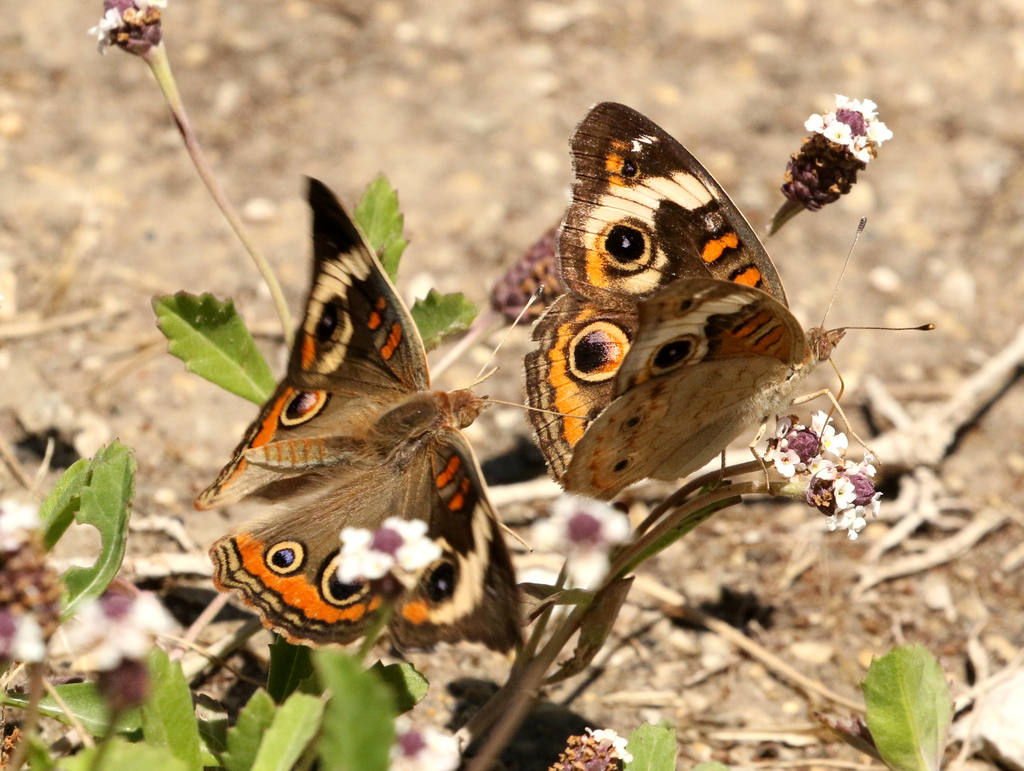
Junonia coenia, known as the common buckeye or buckeye, is a butterfly in the family Nymphalidae.
- Kingdom
- Animalia
- Phylum
- Arthropoda
- Class
- Insecta
- Order
- Lepidoptera
- Family
- Nymphalidae
- Genus
- Junonia
- Species
- Junonia coenia
Description
Junonia coenia, known as the common buckeye or buckeye, is a butterfly in the family Nymphalidae. It is found as a resident or vagrant across much of North America and Central America, as well as in parts of northern South America. This includes most of the eastern half of the US, the lower to middle Midwest, the Southwest (including most of California), southern Canada, and Mexico. Its habitat includes fields, dunes and scrub, typically in sunny environments up to 1,300 metres (4,300 ft) in altitude. It can be found in open areas with low vegetation and some bare ground. Its original ancestry has been traced to Africa, which then experienced divergence in Asia. The species Junonia grisea, the gray buckeye, is found west of the Rocky Mountains and was formerly a subspecies of Junonia coenia. Caterpillars of these butterflies appear to prefer plants that produce iridoid glycosides, which are bitter compounds that release a hormone called gastrin that activates the digestive system (i.e. hunger); therefore, iridoid glycoside producing plants stimulate and attract their appetites particularly when found in plants like Plantago lanceolata. In fact, the presence of these metabolites may trigger oviposition behaviors in female butterflies so that descendant larval bodies may better incorporate iridoid glycosides. Iridoid glycolyside metabolites appear to have a growth-stimulating effect on caterpillars but a growth-reducing effect on predators. Predators like ants, wasps, birds, and small animals prefer to feed on iridoid glycoside poor caterpillars rather than iridoid glycoside rich larvae, potentially due to these effects. Therefore, immunity of J. coenia larvae to predators like ants appears to be strongly related to the concentration of iridoid glycosides sequestered in their bodies. However, too much iridoid glycosides in the diet can negatively affect the immune response of these larvae and lead to increased susceptibility to parasitism. Adult butterflies feed on flowers with certain pollinator cues: yellow flowers that are "pre-change", or flowers whose color has not been changed due to insect visitation or other factors. Common buckeye caterpillars feed in isolation rather than relying upon grouping behaviors. Vulnerability to the Junonia coenia densovirus is another concern for survivorship of common buckeye larvae.
Gallery
Ajouter des photos
Partagez vos photos de cette espèce (jusqu'à 20 à la fois) : elles sont vérifiées automatiquement, puis publiées.
Répartition
Occurrences observées (données GBIF). Les zones hors aire d'origine peuvent indiquer une présence introduite ou invasive.
Sources et crédits
Informations provenant de plusieurs sources vérifiées. Dernière mise à jour : .
Crédits photos (7)
- Photo : Justin (@jwn) · CC BY-NC 4.0 · via iNaturalist
- Photo : Pauline Zinn (@pauline34) · CC BY-NC 4.0 · via iNaturalist
- Photo : Sharleen (@sharleen_j) · CC BY-NC 4.0 · via iNaturalist
- Photo : @kvjohnson · CC BY-NC 4.0 · via iNaturalist
- Photo : @bombusvos · CC BY-NC 4.0 · via iNaturalist
- Photo : Jennifer Linde (@jblinde) · CC BY-NC 4.0 · via iNaturalist
- Photo : Jared Gorrell (@wildlander) · CC BY-NC 4.0 · via iNaturalist
Mentions de licence
Texte disponible sous licence CC BY-SA 4.0. Il adapte notamment Wikipedia (CC BY-SA) : Junonia coenia (Wikipédia, auteurs dans l’historique de l’article).
- Taxonomie : GBIF Backbone Taxonomy (CC BY 4.0)
- Carte : occurrences GBIF, fond © contributeurs OpenStreetMap (ODbL)
- Statut de conservation : Liste rouge de l'UICN, via Wikidata (CC0)
Détail : Sources et licences.
Discussion (0)
Aucun message pour l’instant. Lancez la discussion sur cette fiche (sources, précisions, débats éditoriaux).
Connectez-vous pour participer à la discussion.