
Red wood ant
Formica rufa
Formica rufa, also known as the red wood ant, southern wood ant, or horse ant, is a boreal member of the Formica rufa group of ants, and is the type species for that group, being described by Linnaeus.
- Kingdom
- Animalia
- Phylum
- Arthropoda
- Class
- Insecta
- Order
- Hymenoptera
- Family
- Formicidae
- Genus
- Formica
- Species
- Formica rufa
Description
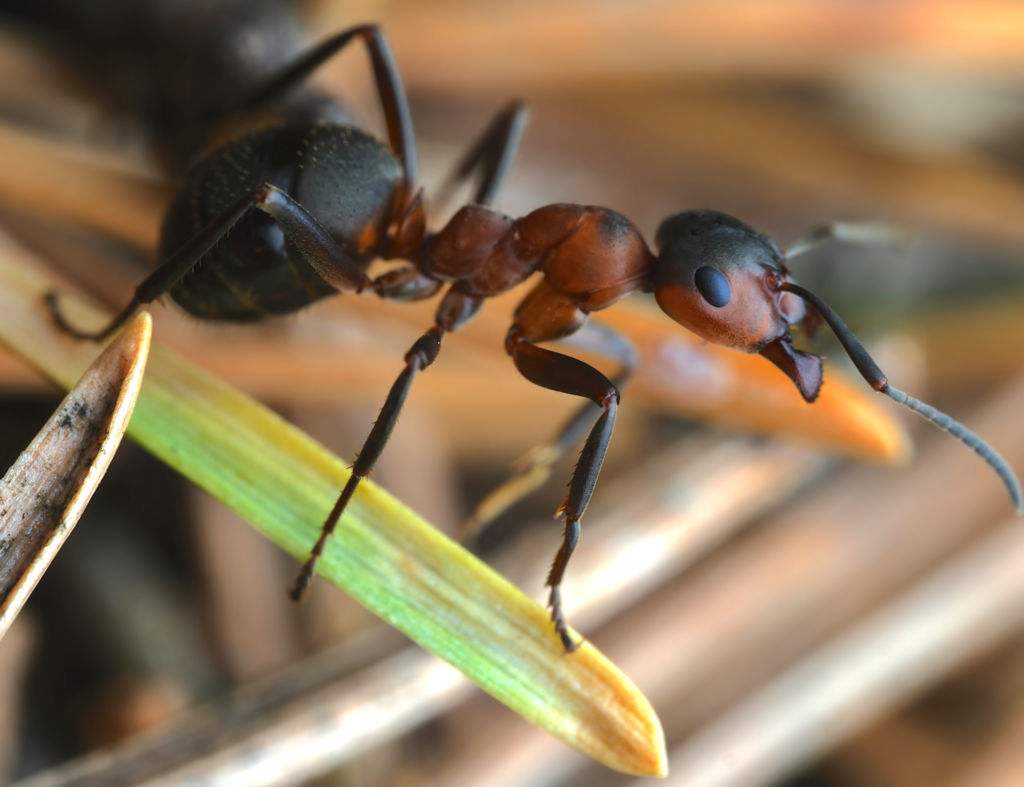
Formica rufa, also known as the red wood ant, southern wood ant, or horse ant, is a boreal member of the Formica rufa group of ants, and is the type species for that group, being described by Linnaeus. It is native to Eurasia, with a recorded distribution stretching from the middle of Scandinavia to northern Iberia and Anatolia, and from Great Britain to Lake Baikal, with unconfirmed reports of it in the Russian Far East. There are claims that it can be found in North America, but this is not confirmed in specialised literature: no recent publication where North American wood ants are listed mentions it as present and records from North America are listed as dubious or unconfirmed in a record compilation. The workers' heads and thoraces are colored red and the abdomen brownish-black, usually with dark patches on the head and promesonotum, although some individuals may be more uniformly reddish and even have some red on the part of the gaster facing the body. In order to separate them from closely related species, specimens needs to be inspected under magnification, where difference in hairiness is among the telling characteristics, with Formica rufa being hairier than, for example, Formica polyctena but less hairy than Formica lugubris. Workers are polymorphic, measuring 4.5–9 mm in length. They have large mandibles and, like many other ant species, are able to spray formic acid from their abdomens as a defence. Formic acid was first extracted in 1671 by the English naturalist John Ray, by distilling a large number of crushed ants of this species. Adult wood ants primarily feed on honeydew from aphids. Some F. rufa colonies are large networks of connected nests with multiple queens, while others have a single queen.
Gallery
Ajouter des photos
Partagez vos photos de cette espèce (jusqu'à 20 à la fois) : elles sont vérifiées automatiquement, puis publiées.
Sources et crédits
Informations provenant de plusieurs sources vérifiées. Dernière mise à jour : .
Crédits photos (5)
- Photo : @ameise23 · CC BY-NC 4.0 · via iNaturalist
- Photo : Захар Кононенко (@zakhar) · CC BY-NC 4.0 · via iNaturalist
- Photo : Philipp Hoenle (@myrmecophil) · CC0 (domaine public) · via iNaturalist
- Photo : Sergio Ibarra (@sergio_ibarra_mellado) · CC BY-NC 4.0 · via iNaturalist
- Photo : Bakos Ádám (@bakosadam_antsite) · CC BY-NC 4.0 · via iNaturalist
Mentions de licence
Texte disponible sous licence CC BY-SA 4.0. Il adapte notamment Formica, Wikipedia (CC BY-SA) : Formica rufa (Wikipédia, auteurs dans l’historique de l’article).
- Taxonomie : GBIF Backbone Taxonomy (CC BY 4.0)
- Statut de conservation : Liste rouge de l'UICN, via Wikidata (CC0)
Détail : Sources et licences.
Discussion (0)
Aucun message pour l’instant. Lancez la discussion sur cette fiche (sources, précisions, débats éditoriaux).
Connectez-vous pour participer à la discussion.