
Marsh pug
Eupithecia pygmaeata
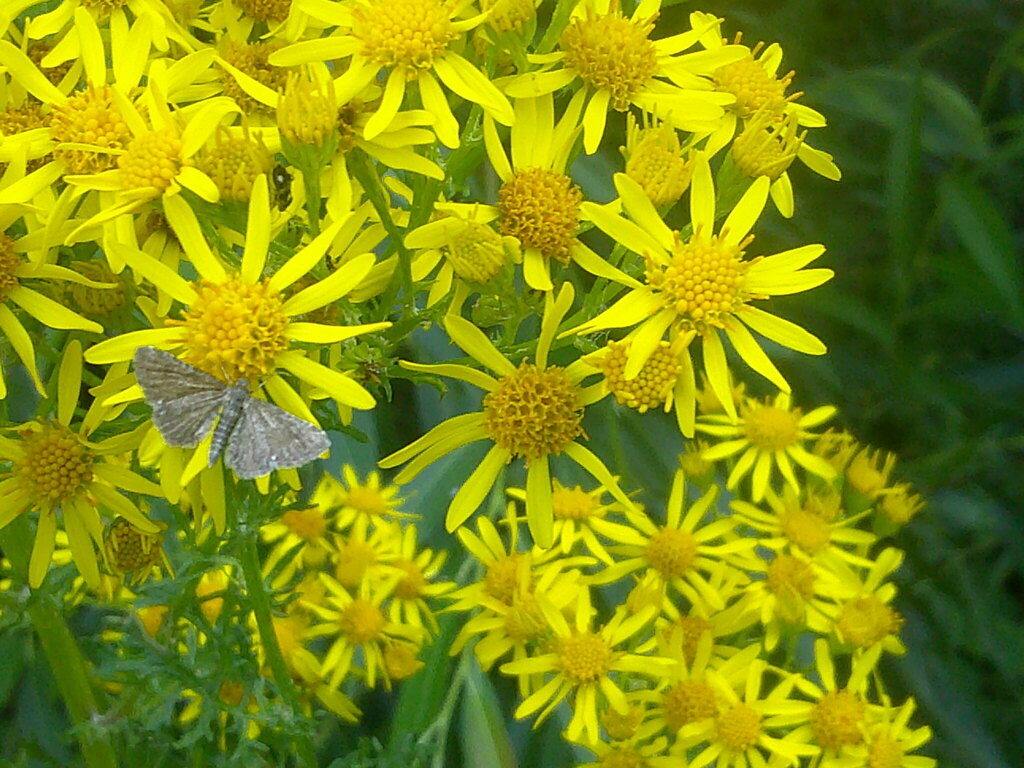
Eupithecia pygmaeata, the marsh pug, is a moth of the family Geometridae.
- Kingdom
- Animalia
- Phylum
- Arthropoda
- Class
- Insecta
- Order
- Lepidoptera
- Family
- Geometridae
- Genus
- Eupithecia
- Species
- Eupithecia pygmaeata
Description
Eupithecia pygmaeata, the marsh pug, is a moth of the family Geometridae. It is known from most of Europe, western and southern Siberia, the Russian Far East, northern Mongolia and North America (from Alaska to Newfoundland and Labrador and Quebec, south to Colorado).The species primarily colonizes floodplain and disused forests, bogs, river banks and marshy meadows. E. pygmaeata reaches up to 1800 meters in South Tyrol. The wingspan is 14–18 mm. The ground colour of the forewings is dark smoky brown. Newly emerged moths have a coppery sheen. It is generally very weakly marked. The forewings have a small white dot at the inner angle and two dark spots at the costal edge. They are pointed not rounded. The hindwings are similar in colour and have a pale dot at the tornal margin. ab. pseudozibellinata Dietze is more copiously sprinkled with light scales. The caterpillars are greenish or light brown and show dark brown dorsal and lateral lines as well as loose short hair. The dorsal line is sometimes extended onto the segments. The pupa is brownish, the wing sheaths often shimmer slightly greenish. The cremaster is equipped with a total of eight hook bristles, the middle pair of which is more powerfully formed. There are two generations per year with adults on wing from mid April to August. The larvae feed on Cerastium and Stellaria species. Larvae can be found from June to September. It overwinters as a pupa.
Gallery
Ajouter des photos
Partagez vos photos de cette espèce (jusqu'à 20 à la fois) : elles sont vérifiées automatiquement, puis publiées.
Répartition
Occurrences observées (données GBIF). Les zones hors aire d'origine peuvent indiquer une présence introduite ou invasive.
Sources et crédits
Informations provenant de plusieurs sources vérifiées. Dernière mise à jour : .
Crédits photos (8)
- Photo : @mothdragon · CC BY-NC 4.0 · via iNaturalist
- Photo : Jyrki Sahinoja (@ikryj) · CC BY-NC 4.0 · via iNaturalist
- Photo : Вадим Рыбаков (@vadimrybakov69) · CC BY-NC 4.0 · via iNaturalist
- Photo : Ross Laugher (@laugherross) · CC BY-NC 4.0 · via iNaturalist
- Photo : Sławomir Pietrzyk (@p_slawek) · CC BY-NC 4.0 · via iNaturalist
- Photo : Arūnas Juknevičius (@arunasjuknevicius) · CC BY-NC 4.0 · via iNaturalist
- Photo : Иван Матершев (@merlu) · CC BY-NC 4.0 · via iNaturalist
- Photo : @kevinkclausen · CC BY-NC 4.0 · via iNaturalist
Mentions de licence
Texte disponible sous licence CC BY-SA 4.0. Il adapte notamment Wikipedia (CC BY-SA) : Eupithecia pygmaeata (Wikipédia, auteurs dans l’historique de l’article).
- Taxonomie : GBIF Backbone Taxonomy (CC BY 4.0)
- Carte : occurrences GBIF, fond © contributeurs OpenStreetMap (ODbL)
Détail : Sources et licences.
Discussion (0)
Aucun message pour l’instant. Lancez la discussion sur cette fiche (sources, précisions, débats éditoriaux).
Connectez-vous pour participer à la discussion.