
Pimpinel pug
Eupithecia pimpinellata
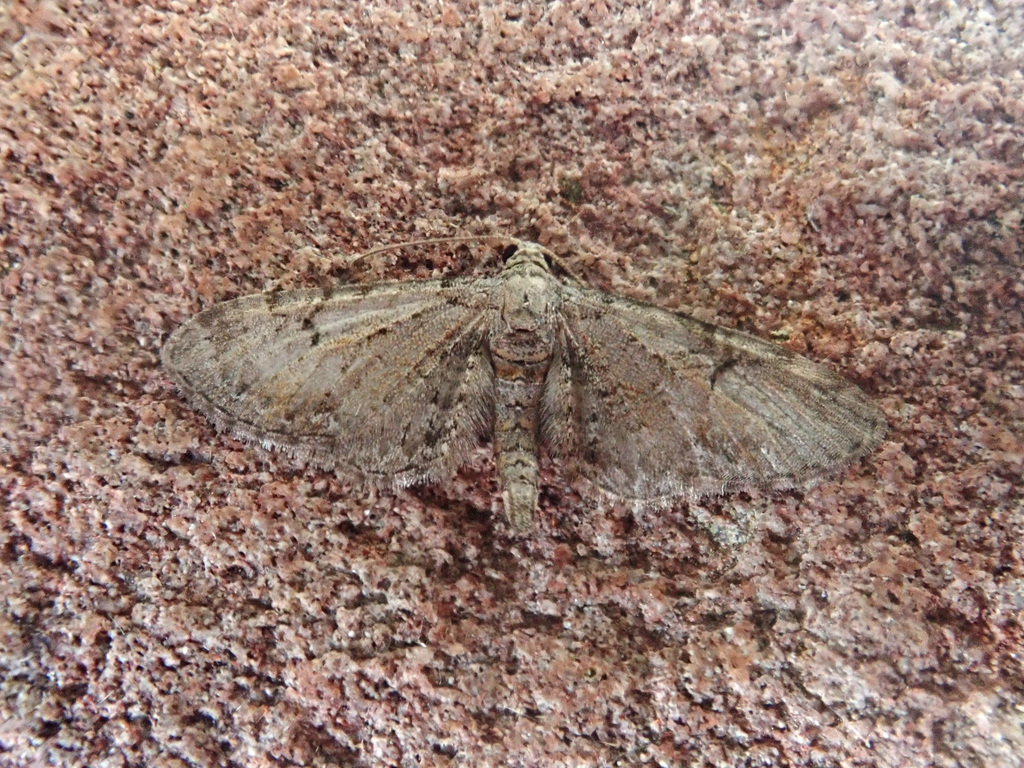
Eupithecia pimpinellata, the pimpinel pug, is a moth of the family Geometridae.
- Kingdom
- Animalia
- Phylum
- Arthropoda
- Class
- Insecta
- Order
- Lepidoptera
- Family
- Geometridae
- Genus
- Eupithecia
- Species
- Eupithecia pimpinellata
Description
Eupithecia pimpinellata, the pimpinel pug, is a moth of the family Geometridae. The species was first described by Jacob Hübner in 1813. It is known from most of Europe to Morocco (High Atlas), Siberia, Kyrgyzstan, Altai, Mongolia.It primarily colonizes bushy places, forest edges, clearings, hedges, mountain slopes, embankments, railway dams and parks as well as semi-dry grasslands. In the Alps it rises to heights of 1800 metres. The wingspan is 20–24 mm. Eupithecia pimpinellata has elongated wings. The forewing ground colour is ash-grey suffused rufous. The discal spot is large and elongated. Several crosslines, the median with a row of dark spots. Prout gives an account of the variations. There are forms of the long and slender larva which is either greenish with yellow segment incisions or almost monochrome red. The brownish pupa has green or yellow wing sheaths. On the dark brown cremaster there are eight hook bristles, the middle pair of which is strongly formed. There is one generation per year with adults on wing from the end of June to August. The larvae mainly feed on Pimpinella saxifraga and Pimpinella major, but also other Apiaceae species. They feed on the flowers and seeds of their host plant. Larvae can be found from July to October. It overwinters as a pupa.
Gallery
Ajouter des photos
Partagez vos photos de cette espèce (jusqu'à 20 à la fois) : elles sont vérifiées automatiquement, puis publiées.
Répartition
Occurrences observées (données GBIF). Les zones hors aire d'origine peuvent indiquer une présence introduite ou invasive.
Sources et crédits
Informations provenant de plusieurs sources vérifiées. Dernière mise à jour : .
Crédits photos (8)
- Photo : Paul Bowyer (@paulbowyer) · CC BY-NC 4.0 · via iNaturalist
- Photo : @stefanodirektor · CC BY-NC 4.0 · via iNaturalist
- Photo : Martin Wood-Weatherill (@martinww) · CC BY 4.0 · via iNaturalist
- Photo : Victor HOYEAU (@victor_85) · CC BY-NC 4.0 · via iNaturalist
- Photo : Nigel Voaden (@terathopius) · CC BY 4.0 · via iNaturalist
- Photo : Fernando de Juana (@fdejuana) · CC BY-NC 4.0 · via iNaturalist
- Photo : Gábor Keresztes (@xespok) · CC BY-NC 4.0 · via iNaturalist
- Photo : Andrea Piccinini (@apiccinini) · CC BY-NC 4.0 · via iNaturalist
Mentions de licence
Texte disponible sous licence CC BY-SA 4.0. Il adapte notamment Wikipedia (CC BY-SA) : Eupithecia pimpinellata (Wikipédia, auteurs dans l’historique de l’article).
- Taxonomie : GBIF Backbone Taxonomy (CC BY 4.0)
- Carte : occurrences GBIF, fond © contributeurs OpenStreetMap (ODbL)
Détail : Sources et licences.
Discussion (0)
Aucun message pour l’instant. Lancez la discussion sur cette fiche (sources, précisions, débats éditoriaux).
Connectez-vous pour participer à la discussion.