
Angle-barred pug
Eupithecia innotata
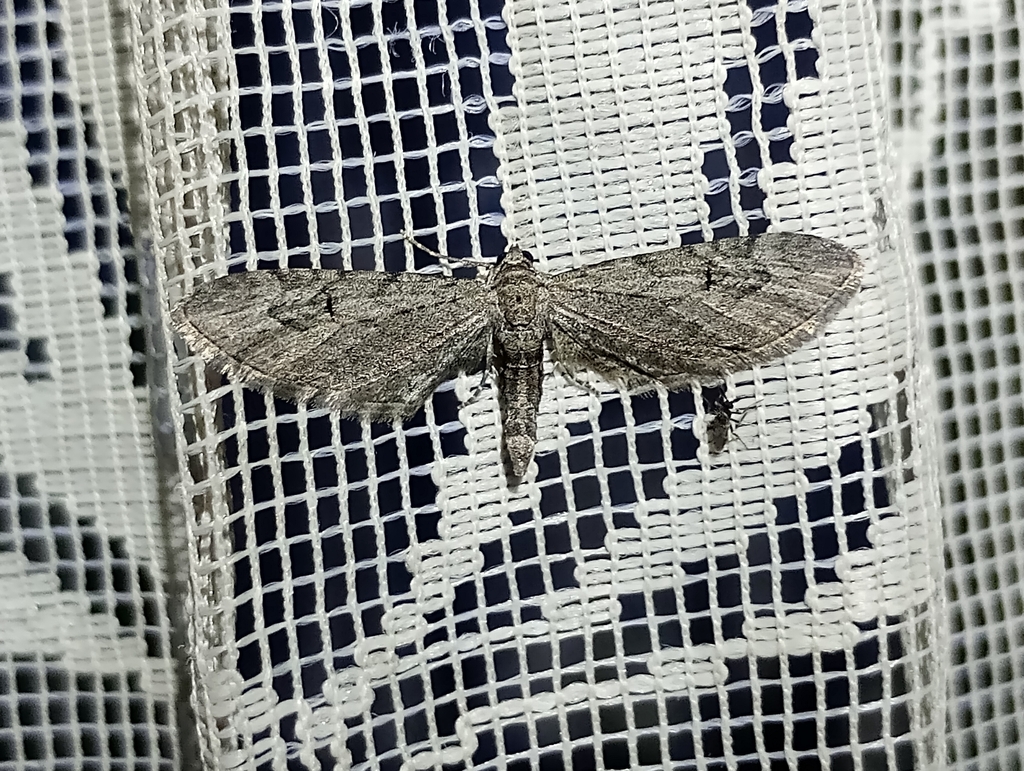
Eupithecia innotata, the angle-barred pug, is a moth of the family Geometridae.
- Kingdom
- Animalia
- Phylum
- Arthropoda
- Class
- Insecta
- Order
- Lepidoptera
- Family
- Geometridae
- Genus
- Eupithecia
- Species
- Eupithecia innotata
Description
Eupithecia innotata, the angle-barred pug, is a moth of the family Geometridae. The species was first described by Johann Siegfried Hufnagel in 1767. It ranges from Spain in the west to western Siberia and Central Asia in the east. There are three forms found in the British Isles: E. innotata sensu stricto (angle-barred pug) is found only on the east and south-east coasts f. fraxinata (ash pug) is widely distributed rare f. tamarisciata (tamarisk pug) The forewings are generally dark brown or grey with few distinguishing marks apart from a small white tornal spot which may not be present on the frequent melanic forms. They are crossed by darker oblique lines, which are angled on the front margin; the submarginal line is white and irregular, especially at each end. The wingspan is 18–24 mm. Two broods are produced each year with the adults flying in May and June and again in August. Moths of the spring brood are usually darker in colour than the later specimens. The larva is bright yellow-brown with brown and greenish markings, most strikingly a variety of large, brown-green spots along the back. It has numerous, small white warts all over the body. The caterpillars of the three races have different food plants: f. fraxinata feeding on ash E. innotata sensu stricto feeding on sea-buckthorn f. tamarisciata is found on the alien food plant tamarisk The species overwinters as a pupa.
Gallery
Ajouter des photos
Partagez vos photos de cette espèce (jusqu'à 20 à la fois) : elles sont vérifiées automatiquement, puis publiées.
Répartition
Occurrences observées (données GBIF). Les zones hors aire d'origine peuvent indiquer une présence introduite ou invasive.
Sources et crédits
Informations provenant de plusieurs sources vérifiées. Dernière mise à jour : .
Crédits photos (8)
- Photo : @mnauky · CC BY 4.0 · via iNaturalist
- Photo : Simon Oliver (@simon_oliver) · CC BY-NC 4.0 · via iNaturalist
- Photo : Герасимов Сергей Владимирович (@svg52) · CC BY-NC 4.0 · via iNaturalist
- Photo : Jaro Schacht (@jaroschacht) · CC BY-NC 4.0 · via iNaturalist
- Photo : kike Vergara (@kikevergara) · CC BY 4.0 · via iNaturalist
- Photo : Михаил Кривошеев / Mikhail Krivosheev (@krivosheev) · CC BY-NC 4.0 · via iNaturalist
- Photo : brian fisher (@supergan) · CC BY-NC 4.0 · via iNaturalist
- Photo : Andrey Ponomarev (@sskorpio) · CC BY-NC 4.0 · via iNaturalist
Mentions de licence
Texte disponible sous licence CC BY-SA 4.0. Il adapte notamment Wikipedia (CC BY-SA) : Eupithecia innotata (Wikipédia, auteurs dans l’historique de l’article).
- Taxonomie : GBIF Backbone Taxonomy (CC BY 4.0)
- Carte : occurrences GBIF, fond © contributeurs OpenStreetMap (ODbL)
Détail : Sources et licences.
Discussion (0)
Aucun message pour l’instant. Lancez la discussion sur cette fiche (sources, précisions, débats éditoriaux).
Connectez-vous pour participer à la discussion.