
Small phoenix
Ecliptopera silaceata
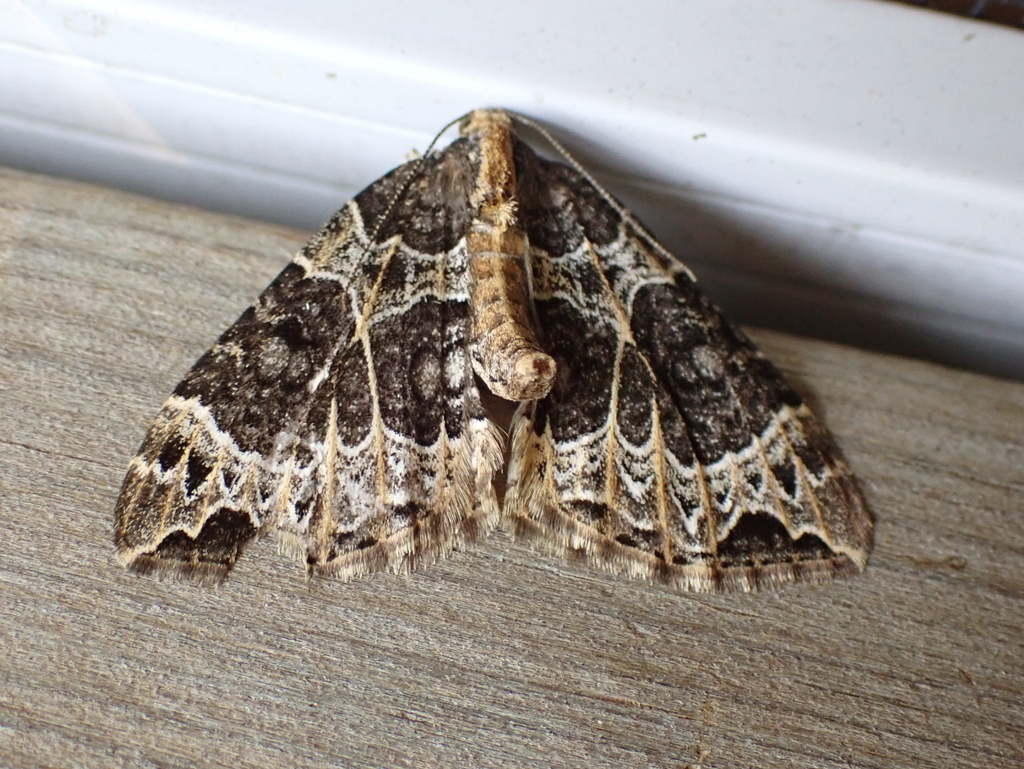
Ecliptopera silaceata, the small phoenix, is a species of moth in the family Geometridae.
- Kingdom
- Animalia
- Phylum
- Arthropoda
- Class
- Insecta
- Order
- Lepidoptera
- Family
- Geometridae
- Genus
- Ecliptopera
- Species
- Ecliptopera silaceata
Description
Ecliptopera silaceata, the small phoenix, is a species of moth in the family Geometridae. The species was first described by Michael Denis and Ignaz Schiffermüller in 1775. The distribution includes most of Europe including the British Isles and extends eastwards through Russia and the Altai and the Vyatskoye, as well as north into the Arctic Circle, and south to the Caucasus. It also occurs in North America. The wingspan is 23–27 mm. The length of the forewings is 13–17 mm. The basal region is dark grey, and is bordered by a light coloured band in which are mostly dark stains. The very wide discal region is black brown, and often shows a nearly elliptical white "drawing" in the middle. The marginal area is brown with several significant arrow patches. Two or three distally facing peaks continue as orange coloured strokes sometimes up to the outer edge. Below the apex, there are dark arch stains and a white wavy line located at the outer edge. The hind wings are white grey and have bright crosslines as well as a little black heart. The colour of head, thorax, and abdomen is brown. Prout describes some variants. The larva is long and thin, variable in colour, green or flesh-colour, the thoracic and last 4 abdominal segments with a red or blackish mediodorsal line, the middle segments with blackish dots. The venter has a white line, sometimes pink-edged. The main habitats of the species are semi-shady areas in deciduous, and mixed forests as well as young forest plantations and heaths. The moths fly in two generations from May to July and from August to September. [1]. The larvae feed mainly on willowherbs. The compact, brownish green pupa hibernates.
Gallery
Ajouter des photos
Partagez vos photos de cette espèce (jusqu'à 20 à la fois) : elles sont vérifiées automatiquement, puis publiées.
Répartition
Occurrences observées (données GBIF). Les zones hors aire d'origine peuvent indiquer une présence introduite ou invasive.
Sources et crédits
Informations provenant de plusieurs sources vérifiées. Dernière mise à jour : .
Crédits photos (8)
- Photo : Claire Moxon-Waltz (@scotiaspinner) · CC BY 4.0 · via iNaturalist
- Photo : Bryan Pfeiffer (@bryanpfeiffer) · CC BY-NC 4.0 · via iNaturalist
- Photo : Annika (@annetacea) · CC BY-NC 4.0 · via iNaturalist
- Photo : Susan Elliott (@susanelliott) · CC BY-NC 4.0 · via iNaturalist
- Photo : chris buelow (@cbuelow45) · CC BY-NC 4.0 · via iNaturalist
- Photo : Paul (@yellowbellyontour) · CC BY-NC 4.0 · via iNaturalist
- Photo : Ranscombe Lodge (@ranscombe_lodge) · CC BY-NC 4.0 · via iNaturalist
- Photo : @annagreilberger · CC BY-NC 4.0 · via iNaturalist
Mentions de licence
Texte disponible sous licence CC BY-SA 4.0. Il adapte notamment Wikipedia (CC BY-SA) : Ecliptopera silaceata (Wikipédia, auteurs dans l’historique de l’article).
- Taxonomie : GBIF Backbone Taxonomy (CC BY 4.0)
- Carte : occurrences GBIF, fond © contributeurs OpenStreetMap (ODbL)
Détail : Sources et licences.
Discussion (0)
Aucun message pour l’instant. Lancez la discussion sur cette fiche (sources, précisions, débats éditoriaux).
Connectez-vous pour participer à la discussion.