
Dark marbled carpet
Dysstroma citrata
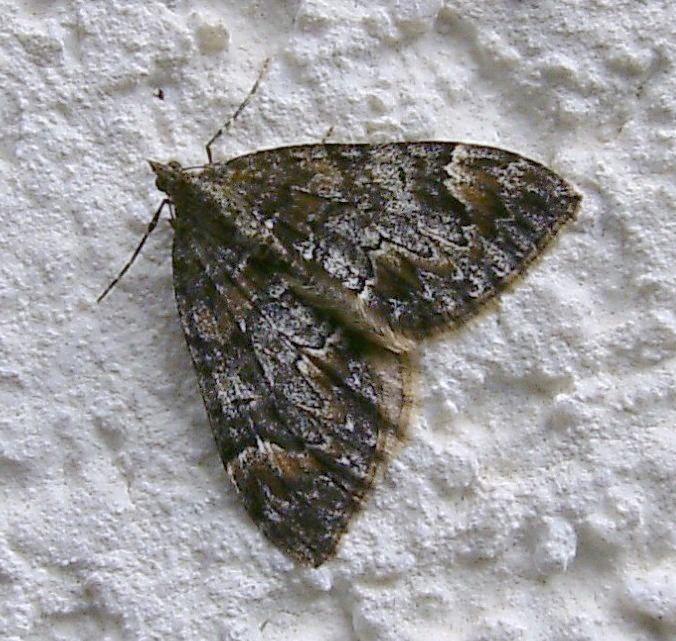
Dysstroma citrata, the dark marbled carpet or northern marbled carpet, is a moth of the family Geometridae.
- Kingdom
- Animalia
- Phylum
- Arthropoda
- Class
- Insecta
- Order
- Lepidoptera
- Family
- Geometridae
- Genus
- Dysstroma
- Species
- Dysstroma citrata
Description
Dysstroma citrata, the dark marbled carpet or northern marbled carpet, is a moth of the family Geometridae. The species was first described by Carl Linnaeus in 1761. It is found across the Holarctic ecozone and has been reported from India. The wingspan is 25–32 mm. The ground colour of the forewings may show whitish, grey, black or brown tints but the colour is extremely variable and there are strongly darkened forms. Prout describes some aberrations. Characteristic is the protruding post medial line on the front wings, which usually reaches the post discal wavy line or interrupts it. Very similar to Dysstroma truncata. Adult larvae are light green with two white dorsal lines. They have an approximately cylindrical shape as well as a blunt anus flap. The pupa is of green with whitish wing sheaths and has a brown, blunt rounded cremaster. Adults are on wing from July to August. It is found from Europe through the temperate zone of Asia through northwest China, Mongolia to the Russian Far East and Japan. It is absent in Portugal, on the Mediterranean islands and Greece. In the north, it occurs in Scandinavia up to Lapland and Iceland and the Faroe Islands. In North America it is found from Alaska and Newfoundland to New England and California. It is also reported in India. It has been found at a height of about 2,400 metres in the Alps. It prefers mountainous areas, wetlands, mountain forests and bushy slopes. The larvae feed on various shrubs and herbaceous plants, including Vaccinium species such as V. myrtillus and V. uliginosum as well as Aster tripolium, Alnus and Salix.
Gallery
Ajouter des photos
Partagez vos photos de cette espèce (jusqu'à 20 à la fois) : elles sont vérifiées automatiquement, puis publiées.
Répartition
Occurrences observées (données GBIF). Les zones hors aire d'origine peuvent indiquer une présence introduite ou invasive.
Sources et crédits
Informations provenant de plusieurs sources vérifiées. Dernière mise à jour : .
Crédits photos (6)
- Photo : Dumi · CC BY-SA 3.0
- Photo : Denis Doucet (@nbdragonflyguy) · CC BY-NC 4.0 · via iNaturalist
- Photo : Louis Imbeau (@imbeaul) · CC BY 4.0 · via iNaturalist
- Photo : @bakkasv · CC BY-NC 4.0 · via iNaturalist
- Photo : @leewarren · CC BY-NC 4.0 · via iNaturalist
- Photo : Lupoli Roland (@roland_lupoli) · CC BY-NC 4.0 · via iNaturalist
Mentions de licence
Texte disponible sous licence CC BY-SA 4.0. Il adapte notamment Wikipedia (CC BY-SA) : Dysstroma citrata (Wikipédia, auteurs dans l’historique de l’article).
- Taxonomie : GBIF Backbone Taxonomy (CC BY 4.0)
- Carte : occurrences GBIF, fond © contributeurs OpenStreetMap (ODbL)
Détail : Sources et licences.
Discussion (0)
Aucun message pour l’instant. Lancez la discussion sur cette fiche (sources, précisions, débats éditoriaux).
Connectez-vous pour participer à la discussion.