
Julia butterfly
Dryas iulia
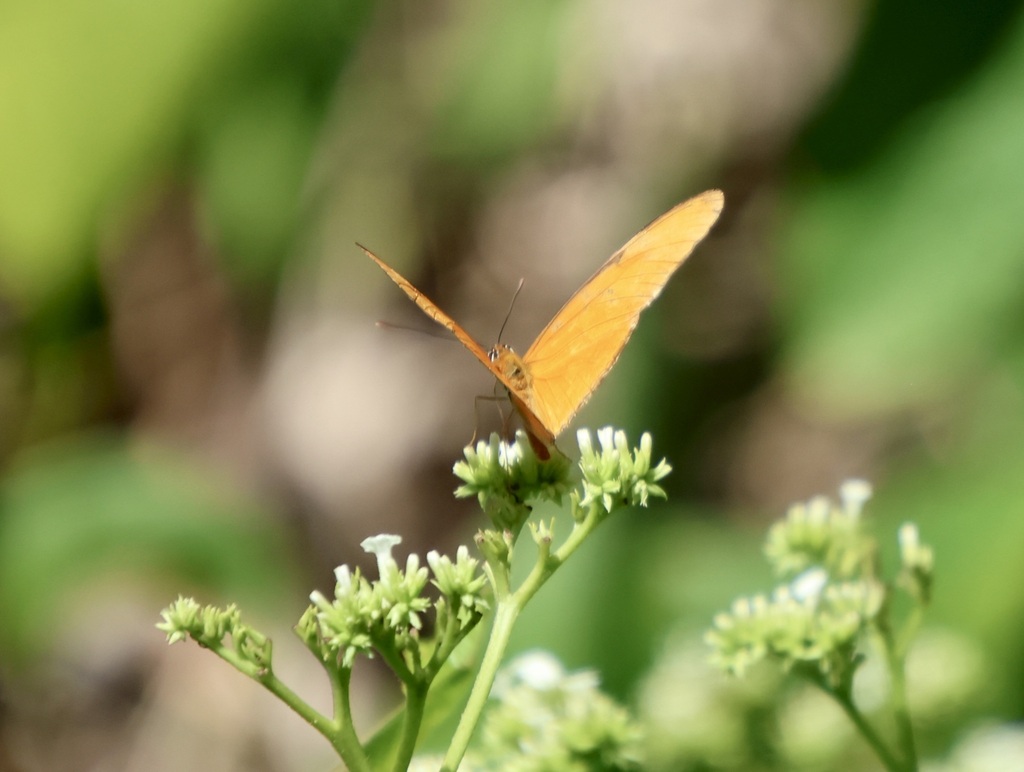
Dryas iulia (often incorrectly spelled julia), commonly called the Julia butterfly, Julia heliconian, the flame, or flambeau, is a species of brush-footed (or nymphalid) butterfly.
- Kingdom
- Animalia
- Phylum
- Arthropoda
- Class
- Insecta
- Order
- Lepidoptera
- Family
- Nymphalidae
- Genus
- Dryas
- Species
- Dryas iulia
Description
Dryas iulia (often incorrectly spelled julia), commonly called the Julia butterfly, Julia heliconian, the flame, or flambeau, is a species of brush-footed (or nymphalid) butterfly. The sole representative of its genus Dryas, it is native from Brazil to southern Texas and Florida, and in summer can sometimes be found as far north as eastern Nebraska. Over 15 subspecies have been described. Its wingspan ranges from 82 to 92 mm, and it is colored orange (brighter in male specimens) with black markings; this species is somewhat unpalatable to birds and belongs to the "orange" Müllerian mimicry complex. This butterfly is a fast flier and frequents clearings, paths, and margins of forests and woodlands. It feeds on the nectar of flowers, such as lantanas (Lantana) and shepherd's-needle (Scandix pecten-veneris), and drinks the tears of caiman, the eye of which the butterfly irritates to produce tears. Its caterpillar feeds on leaves of passion vines, including Passiflora affinis and yellow passionflower (P. lutea) in Texas. Its mating behavior is complex and involves a prolonged courtship whose outcome appears to be controlled by the female. This raises questions pertaining to the occurrence of the evolution of sexual conflict. The species is popular in butterfly houses because it is long-lived and active throughout the day. However, the caterpillars are spiky and may cause a skin rash.
Gallery
Ajouter des photos
Partagez vos photos de cette espèce (jusqu'à 20 à la fois) : elles sont vérifiées automatiquement, puis publiées.
Répartition
Occurrences observées (données GBIF). Les zones hors aire d'origine peuvent indiquer une présence introduite ou invasive.
Sources et crédits
Informations provenant de plusieurs sources vérifiées. Dernière mise à jour : .
Crédits photos (8)
- Photo : @djholland2022 · CC BY-NC 4.0 · via iNaturalist
- Photo : Jeremy Barker (@jeremybarker) · CC BY-NC 4.0 · via iNaturalist
- Photo : Santi MD (@smejiadu) · CC BY-NC 4.0 · via iNaturalist
- Photo : @lisa_cs · CC BY-NC 4.0 · via iNaturalist
- Photo : Cheongweei Gan (@gancw1) · CC BY 4.0 · via iNaturalist
- Photo : @inshaallah · CC BY-NC 4.0 · via iNaturalist
- Photo : Brian McNinch (@brian_mcninch) · CC BY-NC 4.0 · via iNaturalist
- Photo : Audrey Whitlock (@ajwhitlock) · CC BY-NC 4.0 · via iNaturalist
Mentions de licence
Texte disponible sous licence CC BY-SA 4.0. Il adapte notamment Wikipedia (CC BY-SA) : Dryas iulia (Wikipédia, auteurs dans l’historique de l’article).
- Taxonomie : GBIF Backbone Taxonomy (CC BY 4.0)
- Carte : occurrences GBIF, fond © contributeurs OpenStreetMap (ODbL)
Détail : Sources et licences.
Discussion (0)
Aucun message pour l’instant. Lancez la discussion sur cette fiche (sources, précisions, débats éditoriaux).
Connectez-vous pour participer à la discussion.