
Elephant hawk-moth
Deilephila elpenor
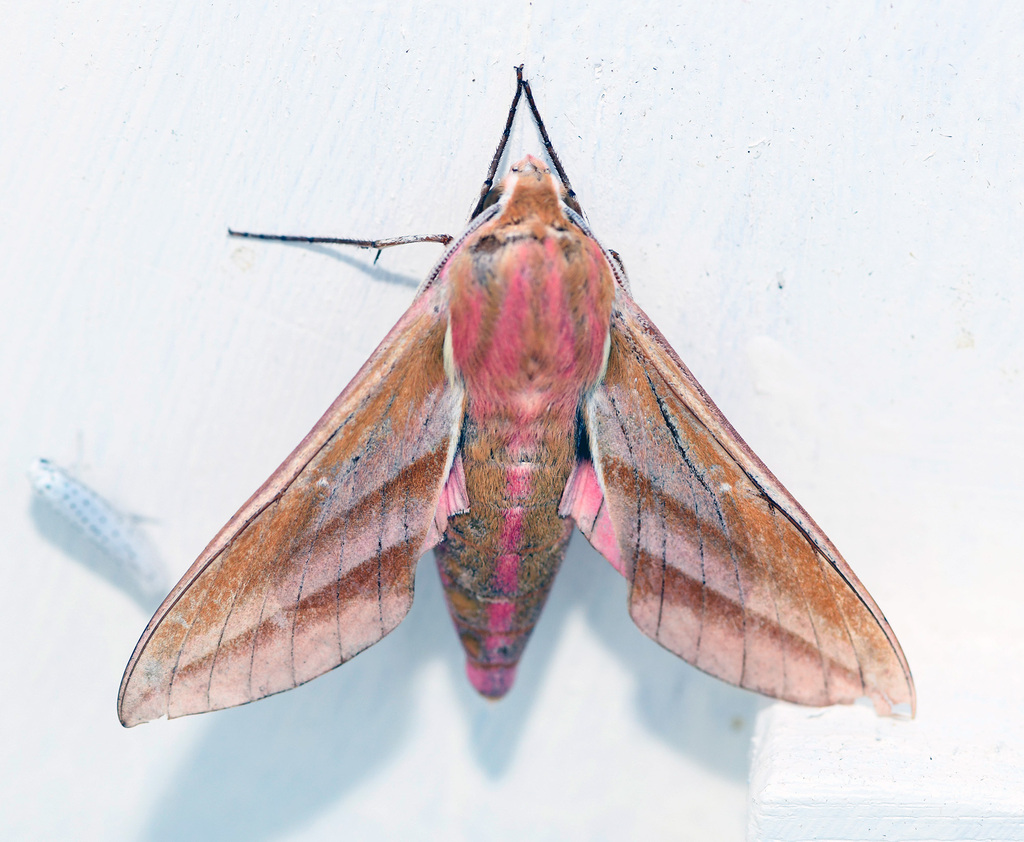
Deilephila elpenor, the elephant hawk moth or large elephant hawk moth, is a moth in the family Sphingidae.
- Kingdom
- Animalia
- Phylum
- Arthropoda
- Class
- Insecta
- Order
- Lepidoptera
- Family
- Sphingidae
- Genus
- Deilephila
- Species
- Deilephila elpenor
Description
Deilephila elpenor, the elephant hawk moth or large elephant hawk moth, is a moth in the family Sphingidae. Its common name is derived from the caterpillar's resemblance to an elephant's trunk. It is most common in Central Europe and is distributed throughout the Palearctic region. It has also been introduced in British Columbia, Canada. Its distinct olive and pink colouring makes it one of the most recognisable moths in its range, but confusing the elephant hawk moth with the small elephant hawk moth, a closely related species that also shares the characteristic colours, is quite common. These moths are nocturnal, so feed on flowers that open or produce nectar at night. The elephant hawk moth has very sensitive eyes that allow it to see colour even at low light, and it was one of the first species in which nocturnal colour vision was documented in animals. The moth is also known for its hovering capability, which it uses when feeding on nectar from flowers. This behaviour is costly in terms of energy and can help explain why the moth has evolved such enhanced visual capabilities for efficient feeding. The moths also have an important role as pollinators throughout their habitat.
Gallery
Ajouter des photos
Partagez vos photos de cette espèce (jusqu'à 20 à la fois) : elles sont vérifiées automatiquement, puis publiées.
Répartition
Occurrences observées (données GBIF). Les zones hors aire d'origine peuvent indiquer une présence introduite ou invasive.
Sources et crédits
Informations provenant de plusieurs sources vérifiées. Dernière mise à jour : .
Crédits photos (8)
- Photo : Philippe Moniotte (@pgmoni) · CC BY-NC 4.0 · via iNaturalist
- Photo : @motheaten · CC BY-NC 4.0 · via iNaturalist
- Photo : Donald Hobern (@dhobern) · CC BY 4.0 · via iNaturalist
- Photo : Philip Mark Osso (@philipmarkosso) · CC BY-NC 4.0 · via iNaturalist
- Photo : Aleks Lund. (@lund) · CC BY-NC 4.0 · via iNaturalist
- Photo : Mathias (@butor) · CC BY-NC 4.0 · via iNaturalist
- Photo : @ttso · CC BY-NC 4.0 · via iNaturalist
- Photo : Катя Калагина (@durashka) · CC BY-NC 4.0 · via iNaturalist
Mentions de licence
Texte disponible sous licence CC BY-SA 4.0. Il adapte notamment Wikipedia (CC BY-SA) : Deilephila elpenor (Wikipédia, auteurs dans l’historique de l’article).
- Taxonomie : GBIF Backbone Taxonomy (CC BY 4.0)
- Carte : occurrences GBIF, fond © contributeurs OpenStreetMap (ODbL)
Détail : Sources et licences.
Discussion (0)
Aucun message pour l’instant. Lancez la discussion sur cette fiche (sources, précisions, débats éditoriaux).
Connectez-vous pour participer à la discussion.