
Streak
Chesias legatella
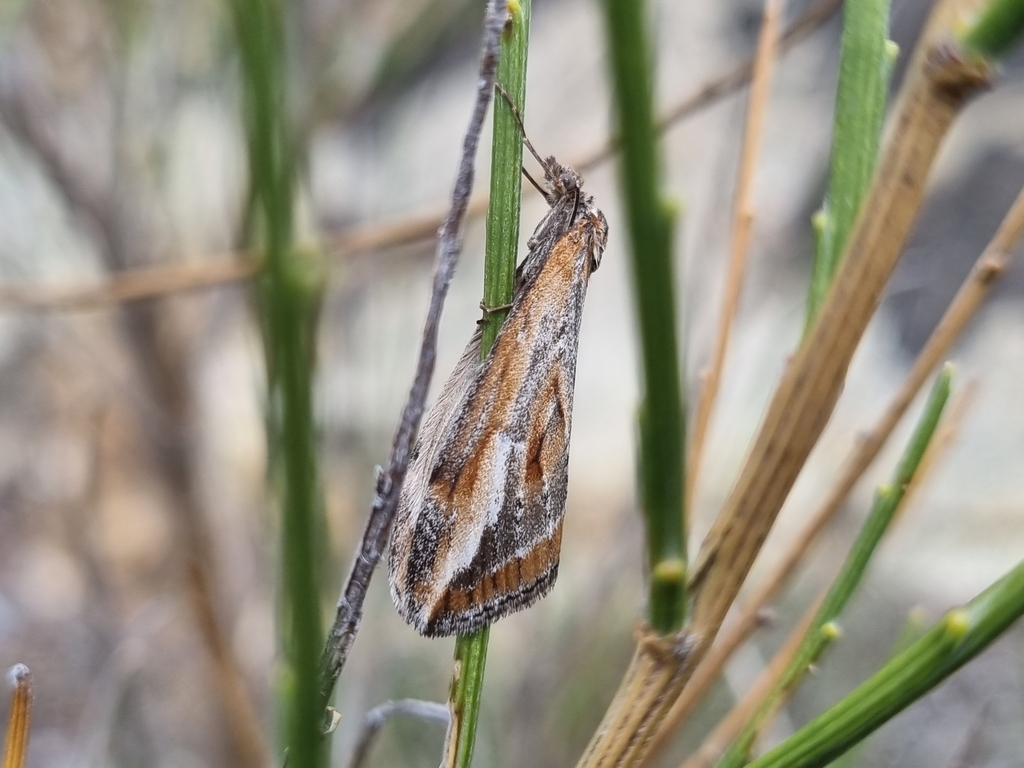
The streak (Chesias legatella) is a moth of the family Geometridae.
- Kingdom
- Animalia
- Phylum
- Arthropoda
- Class
- Insecta
- Order
- Lepidoptera
- Family
- Geometridae
- Genus
- Chesias
- Species
- Chesias legatella
Description
The streak (Chesias legatella) is a moth of the family Geometridae. It is found in northern and western Europe and north Africa. It is common in Britain, but local and confined to the north in Ireland. The species was first described by Michael Denis and Ignaz Schiffermüller in 1775. The species is quite variable, the forewings being buff or brown, but is always easily identified by the bold whitish apical streak which gives it its common name. The hindwings are pale grey or buff. The wingspan is 35–38 millimetres (1.4–1.5 in). See Prout for a full description. The larva is usually dark green with darker, paler-edged dorsal line, a broad whitish or yellowish subdorsal. It has a conspicuous white lateral stripe and 3 white lines ventrally. The spiracles are red, ringed with black. It is adaptive to its environment, a yellow form being frequent on plants on which there is much bloom, while a much blackened form has been recorded from dry, stunted plants. The pupa is red-brown, dorsally rather darker, wings tinged with green. The moth flies, usually at dusk, in September and October [1] and is sometimes attracted to light. The larva usually feeds on broom but has been recorded on yellow bush lupin. The species overwinters as an egg. The pupa is buried deeply in the ground without a cocoon. ^The flight season refers to the British Isles. This may vary in other parts of the range.
Gallery
Ajouter des photos
Partagez vos photos de cette espèce (jusqu'à 20 à la fois) : elles sont vérifiées automatiquement, puis publiées.
Répartition
Occurrences observées (données GBIF). Les zones hors aire d'origine peuvent indiquer une présence introduite ou invasive.
Sources et crédits
Informations provenant de plusieurs sources vérifiées. Dernière mise à jour : .
Crédits photos (8)
- Photo : François-Xavier Taxil (@geum) · CC BY-NC 4.0 · via iNaturalist
- Photo : Hanelie S. (@hanelies) · CC BY-NC 4.0 · via iNaturalist
- Photo : Joey Bom (@joeybom) · CC BY 4.0 · via iNaturalist
- Photo : Bogdan Mazur (@boguo) · CC BY-NC 4.0 · via iNaturalist
- Photo : @ancalagontheblack · CC BY-NC 4.0 · via iNaturalist
- Photo : @carrierlolo · CC BY-NC 4.0 · via iNaturalist
- Photo : Marcel Nadal (@marcelnc) · CC BY-NC 4.0 · via iNaturalist
- Photo : @keith681 · CC BY-NC 4.0 · via iNaturalist
Mentions de licence
Texte disponible sous licence CC BY-SA 4.0. Il adapte notamment Wikipedia (CC BY-SA) : Streak (moth) (Wikipédia, auteurs dans l’historique de l’article).
- Taxonomie : GBIF Backbone Taxonomy (CC BY 4.0)
- Carte : occurrences GBIF, fond © contributeurs OpenStreetMap (ODbL)
Détail : Sources et licences.
Discussion (0)
Aucun message pour l’instant. Lancez la discussion sur cette fiche (sources, précisions, débats éditoriaux).
Connectez-vous pour participer à la discussion.