
Royal mantle
Catarhoe cuculata
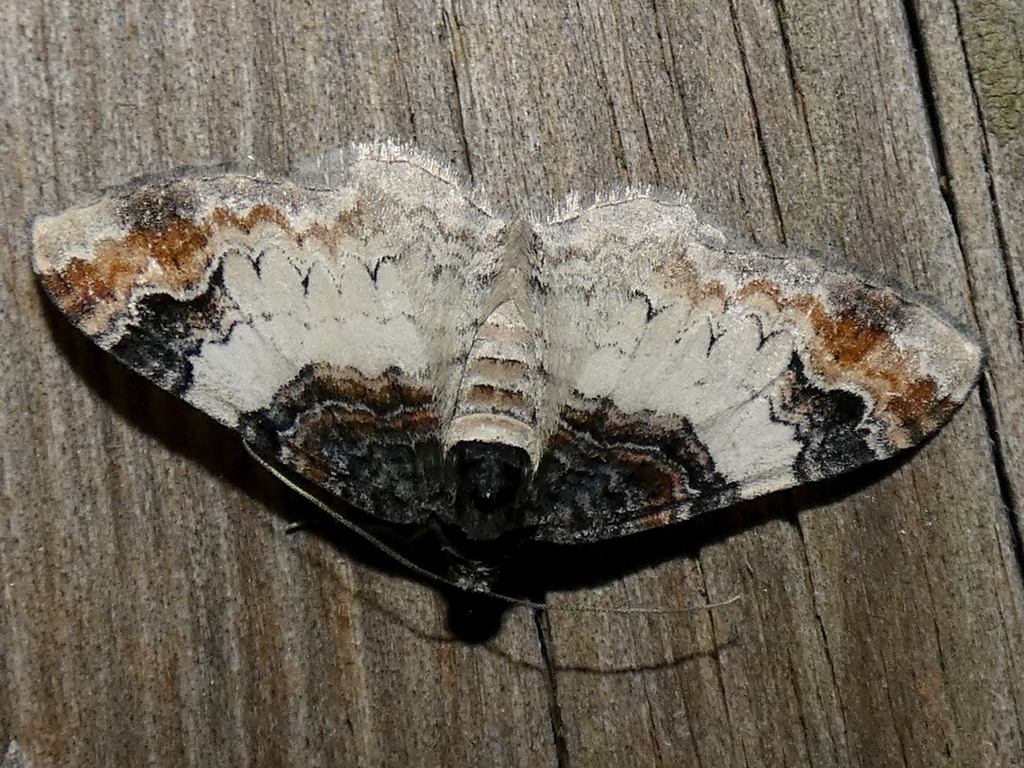
Catarhoe cuculata, the royal mantle, is a moth of the family Geometridae.
- Kingdom
- Animalia
- Phylum
- Arthropoda
- Class
- Insecta
- Order
- Lepidoptera
- Family
- Geometridae
- Genus
- Catarhoe
- Species
- Catarhoe cuculata
Description
Catarhoe cuculata, the royal mantle, is a moth of the family Geometridae. The species was first described by Johann Siegfried Hufnagel in 1767. It is found from Europe to western Central Asia and east Siberia. The species prefers to live in light forests and forest edges, but also occurs on meadows. The wingspan is 22–27 mm. The basic or ground colour of the wings is whitish. The base of the forewing is black with a red-brown band, and at the apex are two reddish-brown stains that pass into a red-brown crossline and a dark brown and black spot (separated by a thin black crossline). The first crossline near the base of the forewing is red with a thick black border. It is characterized by the alternate bands of chestnut and blackish brown in the proximal area, the white median area and the form of the postmedian band- ab. circulata Rbl. is a remarkable and perhaps unique aberration in which the dark bands of the central area are connected on the subcostal and median veins, enclosing a roundish white patch. The larva is green or yellowish with conspicuous blackish or dark purple subdorsal stripes. The pupa is reddish, with browner wings. Adults are on wing from April to August in one generation. The larvae feed on Galium species. Larvae can be found in July to September. It overwinters as a pupa.
Gallery
Ajouter des photos
Partagez vos photos de cette espèce (jusqu'à 20 à la fois) : elles sont vérifiées automatiquement, puis publiées.
Répartition
Occurrences observées (données GBIF). Les zones hors aire d'origine peuvent indiquer une présence introduite ou invasive.
Sources et crédits
Informations provenant de plusieurs sources vérifiées. Dernière mise à jour : .
Crédits photos (8)
- Photo : @adinie · CC BY-NC 4.0 · via iNaturalist
- Photo : Samuel Büttler (@ornisamu) · CC BY-NC 4.0 · via iNaturalist
- Photo : @adinie · CC BY-NC 4.0 · via iNaturalist
- Photo : @mnauky · CC BY 4.0 · via iNaturalist
- Photo : Jukka Santala (@junuli) · CC BY-NC 4.0 · via iNaturalist
- Photo : @krezga · CC BY-NC 4.0 · via iNaturalist
- Photo : Илья Уколов (@iiukolov) · CC BY-NC 4.0 · via iNaturalist
- Photo : Bruno Durand (@brunodurand) · CC BY-NC 4.0 · via iNaturalist
Mentions de licence
Texte disponible sous licence CC BY-SA 4.0. Il adapte notamment Wikipedia (CC BY-SA) : Catarhoe cuculata (Wikipédia, auteurs dans l’historique de l’article).
- Taxonomie : GBIF Backbone Taxonomy (CC BY 4.0)
- Carte : occurrences GBIF, fond © contributeurs OpenStreetMap (ODbL)
Détail : Sources et licences.
Discussion (0)
Aucun message pour l’instant. Lancez la discussion sur cette fiche (sources, précisions, débats éditoriaux).
Connectez-vous pour participer à la discussion.