
Owl Butterfly
Caligo eurilochus
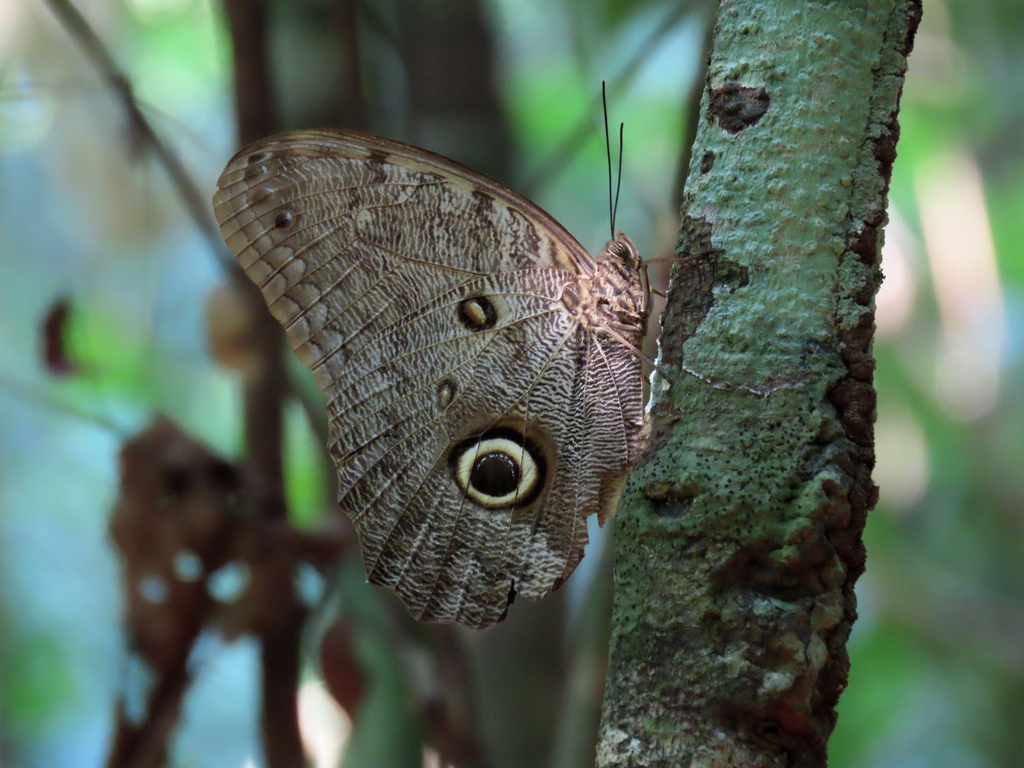
Caligo eurilochus, the forest giant owl, is an owl butterfly (tribe Brassolini of nymphalid subfamily Morphinae) ranging from Mexico, through Central America, to the Amazon River basin in South America.
- Kingdom
- Animalia
- Phylum
- Arthropoda
- Class
- Insecta
- Order
- Lepidoptera
- Family
- Nymphalidae
- Genus
- Caligo
- Species
- Caligo eurilochus
Description
Caligo eurilochus, the forest giant owl, is an owl butterfly (tribe Brassolini of nymphalid subfamily Morphinae) ranging from Mexico, through Central America, to the Amazon River basin in South America. It is a very large butterfly, among the largest in its family, with a wingspan up to 17 centimetres. The type locality is Suriname. Several subspecies are recognized, but many more have been proposed. The larvae feed on several host plants, including Calathea latifolia (Marantaceae), Heychium sp. (Zingiberaceae), Heliconia latispatha (Heliconiaceae), and Musa spp. (Musaceae). The larva also feed on the fruit of most Musa species. The female lays a large number of eggs of one of the host plants and the small larvae hatch after about 3 to 5 days. Fertile eggs develop a grey ring just above the center. Infertile eggs collapse. The first instar of the larvae are white with two orange/brown stripes down the length of their body leading to two little spindles at the end. Later on in life the larvae develop hairs mimicking spines and a crown made of four horns at the back of their head. The larvae then find a high enough spot to pupate and begin the change of metamorphosis. The large owl butterfly emerges and begins to pump out its wings, later searching for food. the butterflies drink the juices of fermenting fruits and a wide variety of nectar plants.
Gallery
Ajouter des photos
Partagez vos photos de cette espèce (jusqu'à 20 à la fois) : elles sont vérifiées automatiquement, puis publiées.
Répartition
Occurrences observées (données GBIF). Les zones hors aire d'origine peuvent indiquer une présence introduite ou invasive.
Sources et crédits
Informations provenant de plusieurs sources vérifiées. Dernière mise à jour : .
Crédits photos (8)
- Photo : Bruno R. Möller (@brunomoller_brm) · CC BY-NC 4.0 · via iNaturalist
- Photo : Bernard Foy (@cotingidae) · CC BY-NC 4.0 · via iNaturalist
- Photo : @johnharshman · CC BY-NC 4.0 · via iNaturalist
- Photo : Jill Warwick (@jill_warwick) · CC BY-NC 4.0 · via iNaturalist
- Photo : Bruno R. Möller (@brunomoller_brm) · CC BY-NC 4.0 · via iNaturalist
- Photo : Holger Beck (@holgerbeck) · CC BY-NC 4.0 · via iNaturalist
- Photo : Henry González (@henrygocol) · CC BY-NC 4.0 · via iNaturalist
- Photo : David Caloren (@mrdingo) · CC BY-NC 4.0 · via iNaturalist
Mentions de licence
Texte disponible sous licence CC BY-SA 4.0. Il adapte notamment Wikipedia (CC BY-SA) : Caligo eurilochus (Wikipédia, auteurs dans l’historique de l’article).
- Taxonomie : GBIF Backbone Taxonomy (CC BY 4.0)
- Carte : occurrences GBIF, fond © contributeurs OpenStreetMap (ODbL)
Détail : Sources et licences.
Discussion (0)
Aucun message pour l’instant. Lancez la discussion sur cette fiche (sources, précisions, débats éditoriaux).
Connectez-vous pour participer à la discussion.