
Sweet potato whitefly
Bemisia tabaci
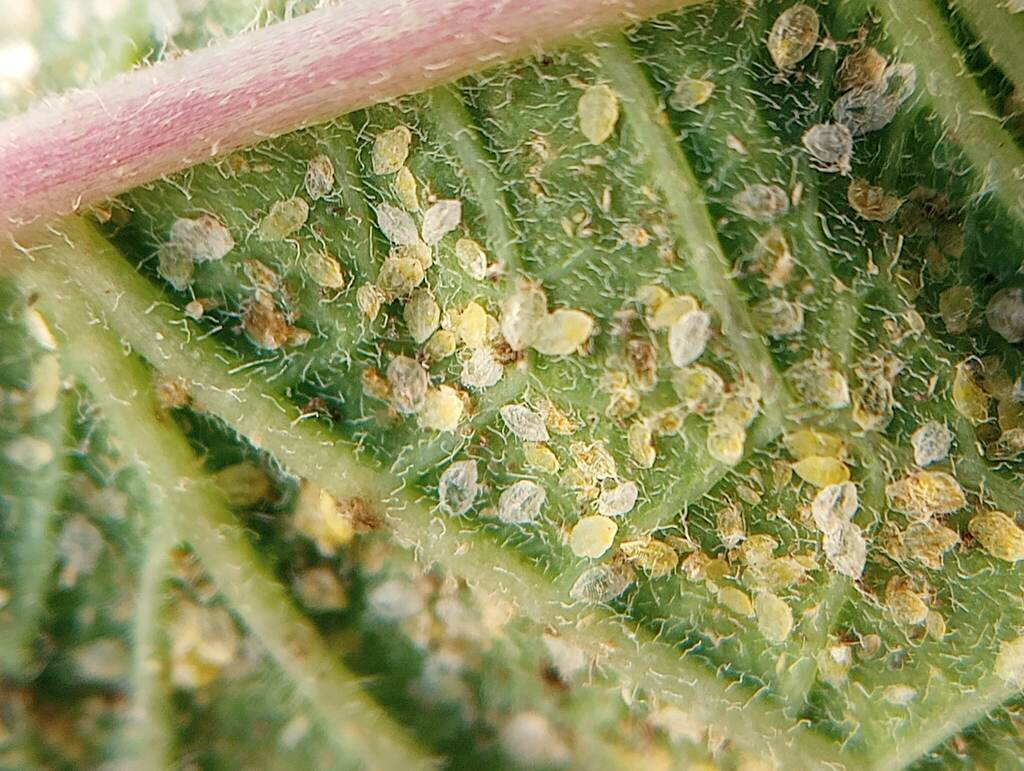
The silverleaf whitefly (Bemisia tabaci, also informally referred to as the sweet potato whitefly and cotton whitefly) is one of several species of whitefly that are currently important agricultural pests.
- Kingdom
- Animalia
- Phylum
- Arthropoda
- Class
- Insecta
- Order
- Hemiptera
- Family
- Aleyrodidae
- Genus
- Bemisia
- Species
- Bemisia tabaci
Description
The silverleaf whitefly (Bemisia tabaci, also informally referred to as the sweet potato whitefly and cotton whitefly) is one of several species of whitefly that are currently important agricultural pests. A review in 2011 concluded that the silverleaf whitefly is actually a species complex containing at least 40 morphologically indistinguishable species. The silverleaf whitefly thrives worldwide in tropical, subtropical, and less predominately in temperate habitats. Cold temperatures kill both the adults and the nymphs of the species. The silverleaf whitefly can be confused with other insects such as the common fruitfly, but with close inspection, the whitefly is slightly smaller and has a distinct wing color that helps to differentiate it from other insects. While the silverleaf whitefly had been known in the United States since 1896, in the mid-1980s an aggressive strain appeared in poinsettia crops in Florida. For convenience that strain was referred to as strain B (biotype B), to distinguish it from the milder infestation of the earlier known strain A. Less than a year after its identification, strain B was found to have moved to tomatoes, and other fruit and vegetable crops. Within five years, the silverleaf whitefly had caused over $100 million in damage to agriculture in Texas and in California.
Gallery
Ajouter des photos
Partagez vos photos de cette espèce (jusqu'à 20 à la fois) : elles sont vérifiées automatiquement, puis publiées.
Répartition
Occurrences observées (données GBIF). Les zones hors aire d'origine peuvent indiquer une présence introduite ou invasive.
Sources et crédits
Informations provenant de plusieurs sources vérifiées. Dernière mise à jour : .
Crédits photos (8)
- Photo : Michele Jones (@beetle_mch) · CC BY 4.0 · via iNaturalist
- Photo : Sequoia Janirella Wrens (@astrobirder) · CC BY-NC 4.0 · via iNaturalist
- Photo : Oscar Angel Sánchez Flores (@oscarangel) · CC BY-NC 4.0 · via iNaturalist
- Photo : Jean-Jacques Durand (@elcapricho) · CC BY-NC 4.0 · via iNaturalist
- Photo : Cherre Bezerra Da Silva (@entomologista) · CC BY-NC 4.0 · via iNaturalist
- Photo : Mihajlo Tomić (@mihajlo2) · CC BY 4.0 · via iNaturalist
- Photo : Oswaldo Rodriguez-Flores (@roswaldo) · CC BY-NC 4.0 · via iNaturalist
- Photo : @jblas209112 · CC BY-NC 4.0 · via iNaturalist
Mentions de licence
Texte disponible sous licence CC BY-SA 4.0. Il adapte notamment Wikipedia (CC BY-SA) : Silverleaf whitefly (Wikipédia, auteurs dans l’historique de l’article).
- Taxonomie : GBIF Backbone Taxonomy (CC BY 4.0)
- Carte : occurrences GBIF, fond © contributeurs OpenStreetMap (ODbL)
Détail : Sources et licences.
Discussion (0)
Aucun message pour l’instant. Lancez la discussion sur cette fiche (sources, précisions, débats éditoriaux).
Connectez-vous pour participer à la discussion.