
Argyresthia curvella
Argyresthia curvella
Argyresthia curvella is a species of ermine moth (family Yponomeutidae).
- Kingdom
- Animalia
- Phylum
- Arthropoda
- Class
- Insecta
- Order
- Lepidoptera
- Family
- Argyresthiidae
- Genus
- Argyresthia
- Species
- Argyresthia curvella
Description
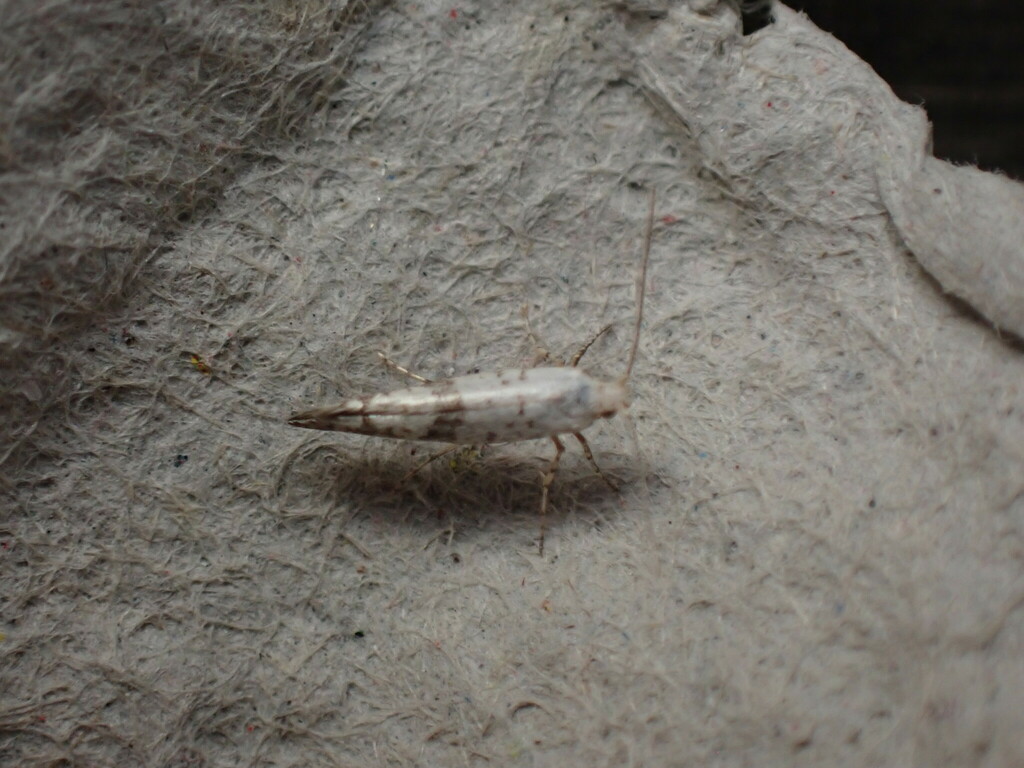
Argyresthia curvella is a species of ermine moth (family Yponomeutidae). It belongs to subfamily Argyresthiinae, which is sometimes elevated to full family rank in the superfamily Yponomeutoidea. It is commonly called apple blossom tineid, reflecting the fact that it was originally believed to be a tineid moth (family Tinieidae). This small moth is widespread in northwestern Eurasia. It is absent from Iberia and probably the entire Balkans, and generally ranges southwards only to the northern Mediterranean region; a possibly isolated population occurs in the Caucasus region. Where it occurs, it is usually not rare and may be abundant. The nocturnal adults are attracted to light sources; they are on the wing around June/July or somewhat later, depending on the location. The wingspan of adults is 10–12 mm. As usual for Yponomeutidae, the forewings have a bold black-and-white pattern, which fades easily in museum specimens though. The pattern consists of a thick oblique black line running from the center of the forewings' dorsal margin to somewhat nearer the apex on the costal margin. From the apex, a thinner and often somewhat irregular black band extends to meet the first one. The remaining areas of the forewings are generously sprinkled with small black blotches. The hindwings are pale greyish, as is the body. The caterpillars feed on Malus (apple) trees, where they eat the blossoms; it has also been suspected that they eat rotting apple wood at least occasionally. They may become a pest in apple orchards, if they occur in abundance.
Gallery
Ajouter des photos
Partagez vos photos de cette espèce (jusqu'à 20 à la fois) : elles sont vérifiées automatiquement, puis publiées.
Répartition
Occurrences observées (données GBIF). Les zones hors aire d'origine peuvent indiquer une présence introduite ou invasive.
Sources et crédits
Informations provenant de plusieurs sources vérifiées. Dernière mise à jour : .
Crédits photos (8)
- Photo : @father_of_purpose · CC BY-NC 4.0 · via iNaturalist
- Photo : Марина Горбунова-Ëлкина (@marina_gorbunova) · CC BY-NC 4.0 · via iNaturalist
- Photo : @cpu · CC BY-NC 4.0 · via iNaturalist
- Photo : @flisar · CC BY-NC 4.0 · via iNaturalist
- Photo : @bakkasv · CC BY-NC 4.0 · via iNaturalist
- Photo : @ingridaltmann · CC BY-NC 4.0 · via iNaturalist
- Photo : Daniel Eskildsen (@dpeskildsen) · CC BY-NC 4.0 · via iNaturalist
- Photo : @arskas · CC BY-NC 4.0 · via iNaturalist
Mentions de licence
Texte disponible sous licence CC BY-SA 4.0. Il adapte notamment Wikipedia (CC BY-SA) : Argyresthia curvella (Wikipédia, auteurs dans l’historique de l’article).
- Taxonomie : GBIF Backbone Taxonomy (CC BY 4.0)
- Carte : occurrences GBIF, fond © contributeurs OpenStreetMap (ODbL)
Détail : Sources et licences.
Discussion (0)
Aucun message pour l’instant. Lancez la discussion sur cette fiche (sources, précisions, débats éditoriaux).
Connectez-vous pour participer à la discussion.