
Aproceros leucopoda
Aproceros leucopoda
Aproceros leucopoda, the elm zigzag sawfly, is a species of sawfly in the family Argidae native to eastern Asia in China and Japan.
- Kingdom
- Animalia
- Phylum
- Arthropoda
- Class
- Insecta
- Order
- Hymenoptera
- Family
- Argidae
- Genus
- Aproceros
- Species
- Aproceros leucopoda
Description
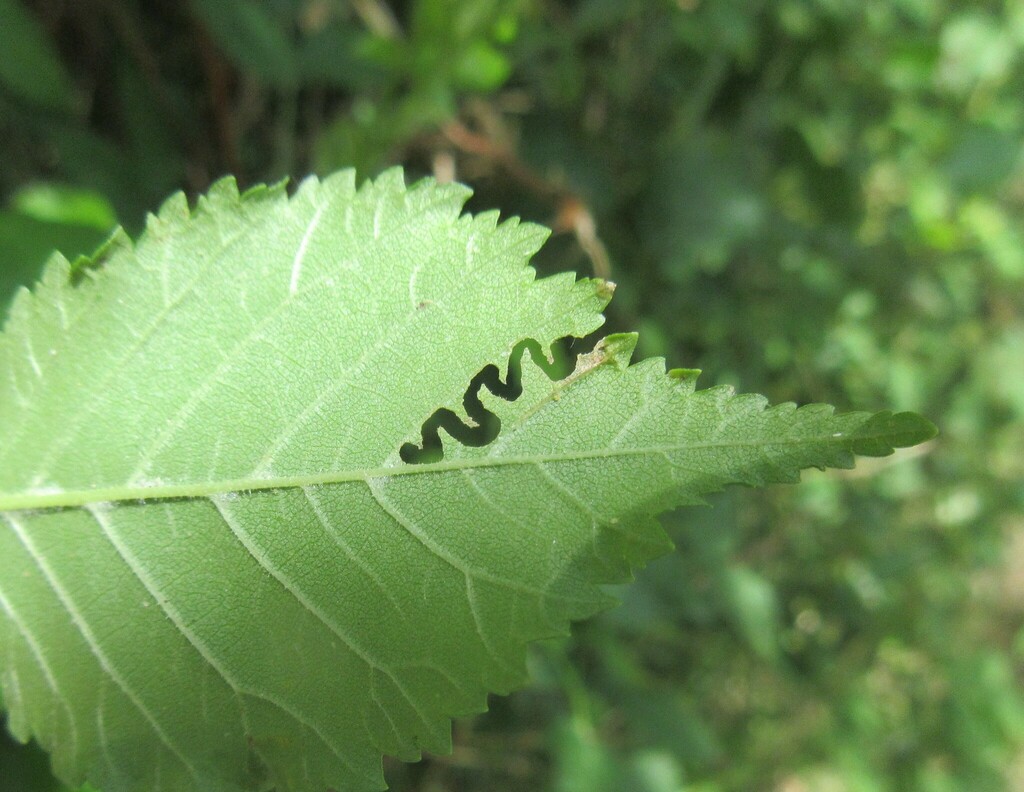
Aproceros leucopoda, the elm zigzag sawfly, is a species of sawfly in the family Argidae native to eastern Asia in China and Japan. It is an invasive species in Europe since 2003, and North America since 2020. The larva is green, around 4 mm long at first, growing to 10 mm long when full grown, and feeds on elm (Ulmus) leaves. At first it eats a very distinctive zig-zag shaped cut into the leaves, from which the species' English name derives. As the larva grows over its 4–7 instars, the feeding trace becomes less regular and less easily distinguished from other elm leaf feeding insects. The larva completes its growth in 2–3 weeks, then produces a transparent lattice-like cocoon on the underside of an elm leaf, in which it pupates. The pupa is also green, around 8 mm long. The adult hatches out after 4–7 days; it is a small black sawfly, 6–10 mm long, with pale legs. There are several generations in a year; the final generation of the autumn produces a thicker, more solid cocoon; this falls with the autumn leaves, with the insect overwintering as a pupa in the leaf litter to emerge as adults the following spring. As an invasive species, it was first found in Europe in 2003, with the first records in Poland and Hungary; it spread westwards from there, reaching southeastern England in 2017. The first record in North America was in Quebec in 2020, and it has subsequently spread to several states in the United States. It can cause severe defoliation of elms, which can lead to their decline and death, particularly if other diseases are enabled to attack due to the tree's weakened status.
Gallery
Ajouter des photos
Partagez vos photos de cette espèce (jusqu'à 20 à la fois) : elles sont vérifiées automatiquement, puis publiées.
Répartition
Occurrences observées (données GBIF). Les zones hors aire d'origine peuvent indiquer une présence introduite ou invasive.
Sources et crédits
Informations provenant de plusieurs sources vérifiées. Dernière mise à jour : .
Crédits photos (8)
- Photo : @ahls · CC BY-NC 4.0 · via iNaturalist
- Photo : Owen Clarkin (@owenclarkin) · CC BY-NC 4.0 · via iNaturalist
- Photo : Erika Mitchell (@erikamitchell) · CC BY-NC 4.0 · via iNaturalist
- Photo : Owen Clarkin (@owenclarkin) · CC BY-NC 4.0 · via iNaturalist
- Photo : Josh Emm (@apistopanchax) · CC BY-NC 4.0 · via iNaturalist
- Photo : @jonathan_mack · CC BY-NC 4.0 · via iNaturalist
- Photo : @jamie-aa · CC BY 4.0 · via iNaturalist
- Photo : Al Quinsey (@alquinsey) · CC BY-NC 4.0 · via iNaturalist
Mentions de licence
Texte disponible sous licence CC BY-SA 4.0. Il adapte notamment Wikipedia (CC BY-SA) : Aproceros leucopoda (Wikipédia, auteurs dans l’historique de l’article).
- Taxonomie : GBIF Backbone Taxonomy (CC BY 4.0)
- Carte : occurrences GBIF, fond © contributeurs OpenStreetMap (ODbL)
Détail : Sources et licences.
Discussion (0)
Aucun message pour l’instant. Lancez la discussion sur cette fiche (sources, précisions, débats éditoriaux).
Connectez-vous pour participer à la discussion.