
Honey bee
Apis mellifera
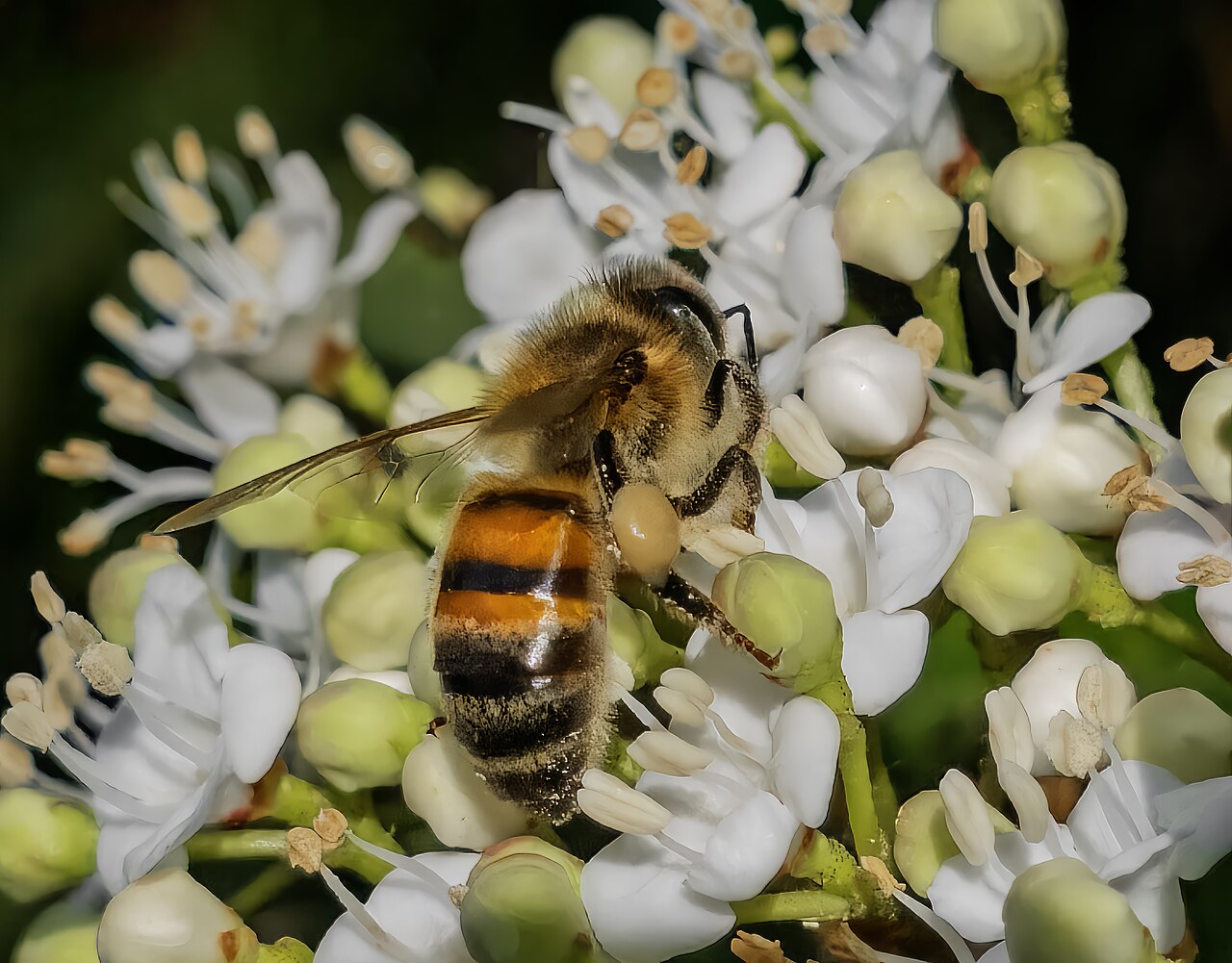
The western honey bee (Apis mellifera) is the most common of the 7–12 species of honey bees worldwide.
- Kingdom
- Animalia
- Phylum
- Arthropoda
- Class
- Insecta
- Order
- Hymenoptera
- Family
- Apidae
- Genus
- Apis
- Species
- Apis mellifera
Description
The western honey bee (Apis mellifera) is the most common of the 7–12 species of honey bees worldwide. The genus name Apis is Latin for 'bee', and mellifera is the Latin for 'honey-bearing' or 'honey-carrying', referring to the species' production of honey. Like all honey bee species, the western honey bee is eusocial, creating colonies with a single fertile female (or "queen"), many normally non-reproductive females or "workers", and a small proportion of fertile males or "drones". Individual colonies can house tens of thousands of bees. Colony activities are organized by complex communication between individuals, through both pheromones and the waggle dance. The western honey bee was one of the first domesticated insects, and it is the primary species maintained by beekeepers to this day for both its honey production and pollination activities. With human assistance, the western honey bee now occupies every continent except Antarctica. Western honey bees are threatened by pests and diseases, especially the Varroa mite and colony collapse disorder. As of 2025, the western honey bee was assessed as "Data Deficient" on the IUCN Red List. Western honey bees are an important model organism in scientific studies, particularly in the fields of social evolution, learning, and memory; they are also used in studies of pesticide toxicity, especially via pollen, to assess non-target impacts of commercial pesticides.
Gallery
Ajouter des photos
Partagez vos photos de cette espèce (jusqu'à 20 à la fois) : elles sont vérifiées automatiquement, puis publiées.
Répartition
Occurrences observées (données GBIF). Les zones hors aire d'origine peuvent indiquer une présence introduite ou invasive.
Sources et crédits
Informations provenant de plusieurs sources vérifiées. Dernière mise à jour : .
Crédits photos (7)
- Photo : Didier Descouens · CC BY-SA 4.0 · via Wikimedia Commons
- Photo : Didier Descouens · CC BY-SA 4.0 · via Wikimedia Commons
- Photo : Isaac Eastland (@isaaceastland) · CC BY-NC 4.0 · via iNaturalist
- Photo : Chris Bentley (@christopherbentley04) · CC BY-NC 4.0 · via iNaturalist
- Photo : 蔡问 (@stevesheepliu) · CC BY-NC 4.0 · via iNaturalist
- Photo : Fernanda Proaño Salazar (@fernyproas) · CC BY-NC 4.0 · via iNaturalist
- Photo : @wsellers · CC BY-NC 4.0 · via iNaturalist
Mentions de licence
Texte disponible sous licence CC BY-SA 4.0. Il adapte notamment Wikipedia (CC BY-SA) : Western honey bee (Wikipédia, auteurs dans l’historique de l’article).
- Taxonomie : GBIF Backbone Taxonomy (CC BY 4.0)
- Carte : occurrences GBIF, fond © contributeurs OpenStreetMap (ODbL)
- Statut de conservation : Liste rouge de l'UICN, via Wikidata (CC0)
Détail : Sources et licences.
Discussion (0)
Aucun message pour l’instant. Lancez la discussion sur cette fiche (sources, précisions, débats éditoriaux).
Connectez-vous pour participer à la discussion.