
Lilac beauty
Apeira syringaria
Apeira syringaria, the lilac beauty, is a moth of the family Geometridae.
- Kingdom
- Animalia
- Phylum
- Arthropoda
- Class
- Insecta
- Order
- Lepidoptera
- Family
- Geometridae
- Genus
- Apeira
- Species
- Apeira syringaria
Description
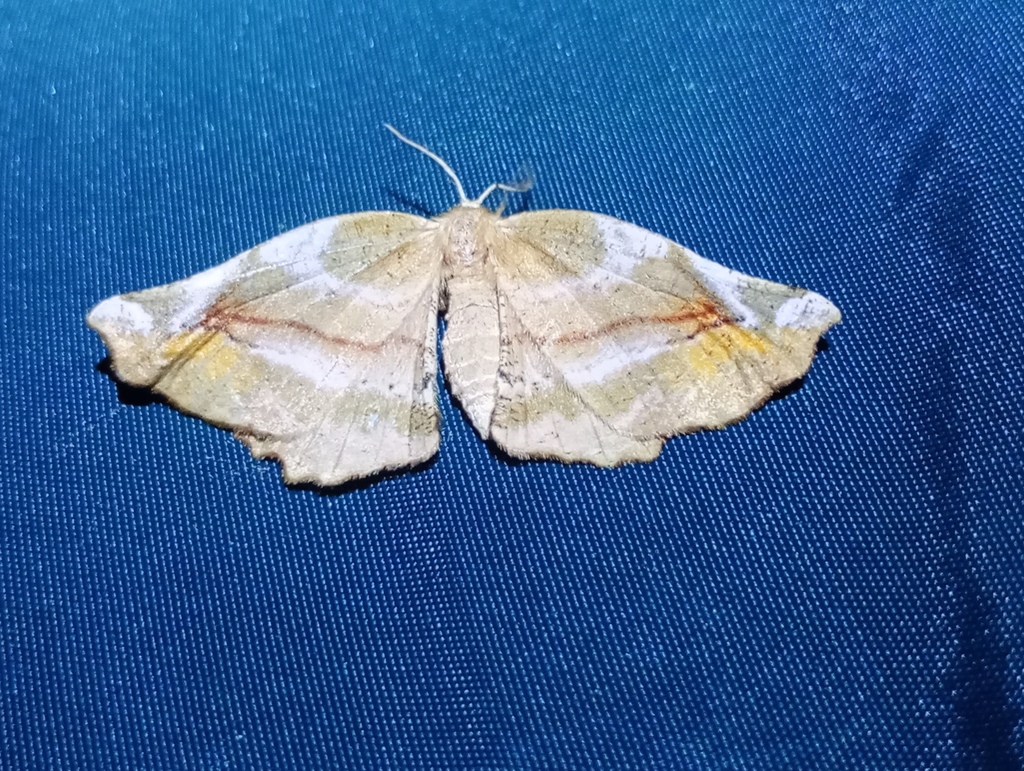
Apeira syringaria, the lilac beauty, is a moth of the family Geometridae. It is found throughout Europe and east across the Palearctic to the Russian Far East and Japan. The wingspan is 38–42 mm. The length of the forewings is 19–22 mm. The front wings are coloured violet-grey to bright reddish brown and yellowish in the marginal field. There are white marks along the costa. The interior cross line is pinkish white and broken under the costa (toward the basal field). The narrow central band is red-brown and continues on the hindwings. The outer cross line is dark on the front edge becoming pink white adjoining on the hind wings a dark row of dots. A pink-white spot is located off the apex of the wing. In rest, the front margins of the wings are curiously folded. This, in combination with the colour and pattern give a crumpled leaf-like appearance. The caterpillars reach a length of up to 30 millimeters. . On the seventh segment there is an eye-catching pair of curved extensions; smaller dorsal humps are located on segments five and six. They are pale ochre-coloured with dark olive-brown or purple-brown markings . The head capsule is grey-brown. In a resting position, the caterpillars do not sit stretched out like most other looper caterpillars, but remain curved to resemble the dried fruit capsules of the lilac. The moth flies from June to July [1]. The caterpillars feed on lilac, honeysuckle and privet. This species overwinters as a larva. Ecology: found in woodland, heaths and occasionally fens.
Gallery
Ajouter des photos
Partagez vos photos de cette espèce (jusqu'à 20 à la fois) : elles sont vérifiées automatiquement, puis publiées.
Répartition
Occurrences observées (données GBIF). Les zones hors aire d'origine peuvent indiquer une présence introduite ou invasive.
Sources et crédits
Informations provenant de plusieurs sources vérifiées. Dernière mise à jour : .
Crédits photos (8)
- Photo : @mnauky · CC BY 4.0 · via iNaturalist
- Photo : @angelrat · CC BY-NC 4.0 · via iNaturalist
- Photo : M. A. Miranda (@mamiranda10) · CC BY-NC 4.0 · via iNaturalist
- Photo : @sarah-hall · CC BY-NC 4.0 · via iNaturalist
- Photo : @nijuralu · CC BY-NC 4.0 · via iNaturalist
- Photo : Marina Privalova (@marina-privalova) · CC BY-NC 4.0 · via iNaturalist
- Photo : Lola Smirnova (@lola73) · CC BY-NC 4.0 · via iNaturalist
- Photo : Marek Michalski (@marcus_lodzensis) · CC BY-NC 4.0 · via iNaturalist
Mentions de licence
Texte disponible sous licence CC BY-SA 4.0. Il adapte notamment Wikipedia (CC BY-SA) : Apeira syringaria (Wikipédia, auteurs dans l’historique de l’article).
- Taxonomie : GBIF Backbone Taxonomy (CC BY 4.0)
- Carte : occurrences GBIF, fond © contributeurs OpenStreetMap (ODbL)
Détail : Sources et licences.
Discussion (0)
Aucun message pour l’instant. Lancez la discussion sur cette fiche (sources, précisions, débats éditoriaux).
Connectez-vous pour participer à la discussion.