
Confused
Apamea furva
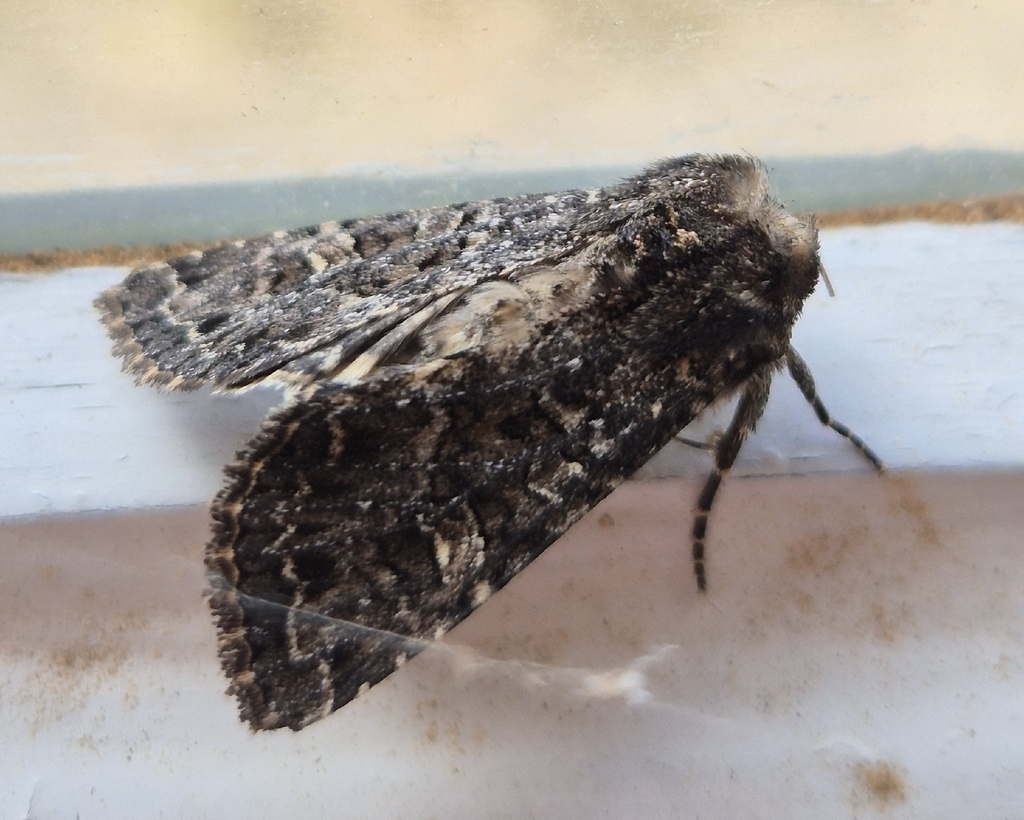
Apamea furva, the confused, is a moth of the family Noctuidae.
- Kingdom
- Animalia
- Phylum
- Arthropoda
- Class
- Insecta
- Order
- Lepidoptera
- Family
- Noctuidae
- Genus
- Apamea
- Species
- Apamea furva
Description
Apamea furva, the confused, is a moth of the family Noctuidae. The species was first described by Michael Denis and Ignaz Schiffermüller in 1775. It is found throughout Europe. In southwestern Europe it is primarily montane. It is found as far north as the Arctic Circle. From Europe its range extends to Siberia, Turkey, Iran, Kyrgyzstan, Mongolia and Xinjiang in China. The population in Great Britain and Ireland is sometimes treated as a subspecies, Apamea furva britannica. The wingspan is 34–42 mm. Forewing varying from brownish to blackish fuscous, more or less dusted with grey or whitish scales, especially along the costa and inner margin and along the veins; lines conversely edged with pale; claviform stigma black-edged, or filled in with black; orbicular grey, with pale ring and black outline, often obscure; reniform always whiter, especially on outer edge; submarginal line whitish, waved, always preceded by distinct black wedge-shaped marks; the brown fringe finely cut by pale dashes; hindwing smoky grey, the terminal half smoky fuscous; veins and cellspot darker; the blackish fuscous forms, still with paler dusting, are ab. freyeri [Boie] and infernalis Ev. the latter being the darker. Apamea furva is difficult to certainly distinguish from its congener Apamea remissa (Hübner, 1809). See Townsend et al. Adults are on wing from July to August. The larvae feed on the roots and stem bases of various grasses, including meadowgrasses, fescues, slimstem reedgrass, and wavy hairgrass.
Gallery
Ajouter des photos
Partagez vos photos de cette espèce (jusqu'à 20 à la fois) : elles sont vérifiées automatiquement, puis publiées.
Répartition
Occurrences observées (données GBIF). Les zones hors aire d'origine peuvent indiquer une présence introduite ou invasive.
Sources et crédits
Informations provenant de plusieurs sources vérifiées. Dernière mise à jour : .
Crédits photos (8)
- Photo : Ahti Ihonen (@ihoah) · CC BY-NC 4.0 · via iNaturalist
- Photo : Mirko Tomasi (@mirko_tomasi) · CC BY-NC 4.0 · via iNaturalist
- Photo : Phil Benstead (@philbenstead) · CC BY-NC 4.0 · via iNaturalist
- Photo : Mirko Tomasi (@mirko_tomasi) · CC BY-NC 4.0 · via iNaturalist
- Photo : Samuel Büttler (@ornisamu) · CC BY-NC 4.0 · via iNaturalist
- Photo : Jaro Schacht (@jaroschacht) · CC BY-NC 4.0 · via iNaturalist
- Photo : Tero Linjama (@terolinjama) · CC0 (domaine public) · via iNaturalist
- Photo : Valentinus T (@valentinus-tikhonov) · CC BY-NC 4.0 · via iNaturalist
Mentions de licence
Texte disponible sous licence CC BY-SA 4.0. Il adapte notamment Wikipedia (CC BY-SA) : Apamea furva (Wikipédia, auteurs dans l’historique de l’article).
- Taxonomie : GBIF Backbone Taxonomy (CC BY 4.0)
- Carte : occurrences GBIF, fond © contributeurs OpenStreetMap (ODbL)
Détail : Sources et licences.
Discussion (0)
Aucun message pour l’instant. Lancez la discussion sur cette fiche (sources, précisions, débats éditoriaux).
Connectez-vous pour participer à la discussion.