
Anthocomus rufus
Anthocomus rufus
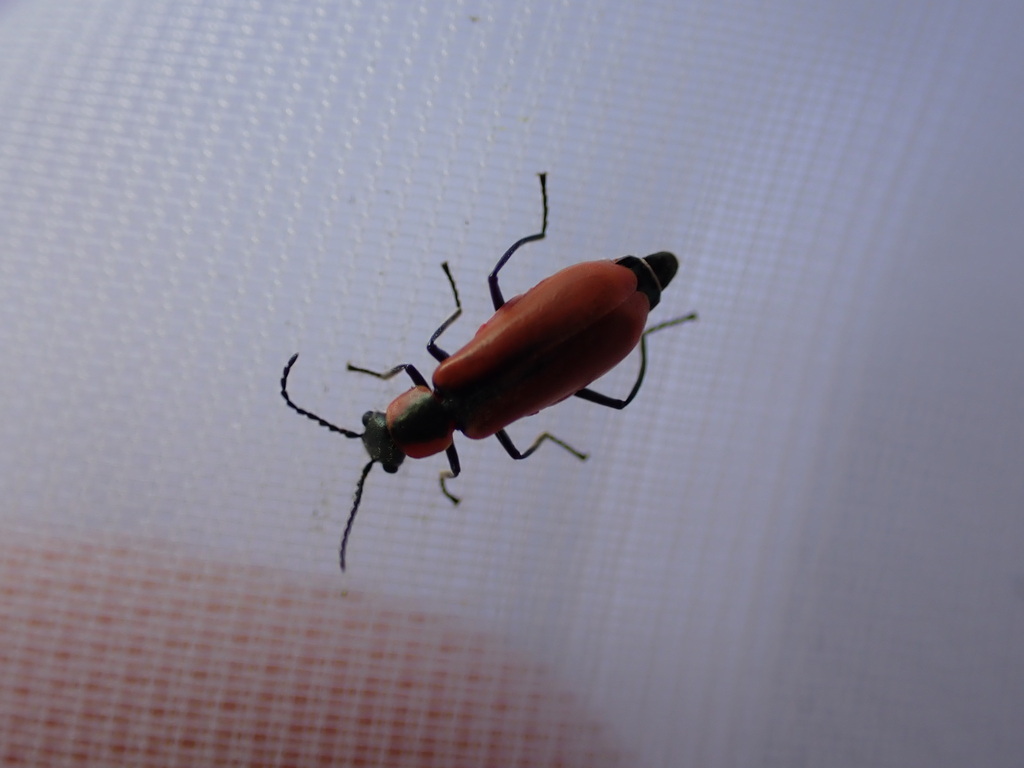
Anthocomus rufus is a species of beetle belonging to the family Melyridae.
- Kingdom
- Animalia
- Phylum
- Arthropoda
- Class
- Insecta
- Order
- Coleoptera
- Family
- Melyridae
- Genus
- Anthocomus
- Species
- Anthocomus rufus
Description
Anthocomus rufus is a species of beetle belonging to the family Melyridae. It is commonly known as the red malachite beetle. It is native to Europe. The elongated body has a lightly sclerotized outer skeleton. It is sparsely hairy and reaches an average length of just under five millimeters. The elongate black head is slightly tilted downward. The mouthparts point forward. The mandibles have a two-toothed tip. The thread-like maxillary palps have three segments, with the terminal segment spindle-shaped and ending in a point. The labial palps are short, with the second and third segments being the same length. The eleven-segmented antennae are thread-like, originating in front of the eyes, not between them. The pronotum is wider than it is long. The base has a fine edge and tapers to a rounded shape. It is black with red on the sides, or red with a broad black middle stripe. The red and black colours are not sharply defined but flow smoothly into each other. The elytra only partially cover the abdomen in females. They are only slightly wider than the pronotum. The frequently occurring double hair within the family is absent: the elytra are only softly hairy in a downy way. They are the same red as the edges of the pronotum. Around the scutellum, there is usually a blurry black spot. In females, the elytra are slightly widened at the back, while in males, they are almost parallel. At the tip of the elytra in males, there is a striking structure called the excitator. It consists of a black, intricately curved chitin ridge that resembles a musical note. The animals are active during the day and love the sun and warmth. The beetles eat pollen from the reed (Phragmites communis). They also consume dead insects, preferably prey of the reed spider. The beetles are often found in large numbers on their host plant and mate there as well. Mating is usually preceded by a so-called tasting courtship (gustatory courtship), as is only seen in the longhorn beetles.
Gallery
Ajouter des photos
Partagez vos photos de cette espèce (jusqu'à 20 à la fois) : elles sont vérifiées automatiquement, puis publiées.
Répartition
Occurrences observées (données GBIF). Les zones hors aire d'origine peuvent indiquer une présence introduite ou invasive.
Sources et crédits
Informations provenant de plusieurs sources vérifiées. Dernière mise à jour : .
Crédits photos (8)
- Photo : Louis Aureglia (@louis_aureglia) · CC BY 4.0 · via iNaturalist
- Photo : @dawid_stencel · CC BY-NC 4.0 · via iNaturalist
- Photo : @jonash · CC BY-NC 4.0 · via iNaturalist
- Photo : @sandjar · CC BY-NC 4.0 · via iNaturalist
- Photo : Jamie O'Neill (@swimjamie) · CC BY 4.0 · via iNaturalist
- Photo : Pavlo Kovalenko (@pavlok-97) · CC BY-NC 4.0 · via iNaturalist
- Photo : Jean-Paul Boerekamps (@jeanpaulboerekamps) · CC0 (domaine public) · via iNaturalist
- Photo : @iwo2022 · CC BY-NC 4.0 · via iNaturalist
Mentions de licence
Texte disponible sous licence CC BY-SA 4.0. Il adapte notamment Wikipedia (CC BY-SA) : Anthocomus rufus (Wikipédia, auteurs dans l’historique de l’article).
- Taxonomie : GBIF Backbone Taxonomy (CC BY 4.0)
- Carte : occurrences GBIF, fond © contributeurs OpenStreetMap (ODbL)
Détail : Sources et licences.
Discussion (0)
Aucun message pour l’instant. Lancez la discussion sur cette fiche (sources, précisions, débats éditoriaux).
Connectez-vous pour participer à la discussion.