
Yellow crazy ant
Anoplolepis gracilipes
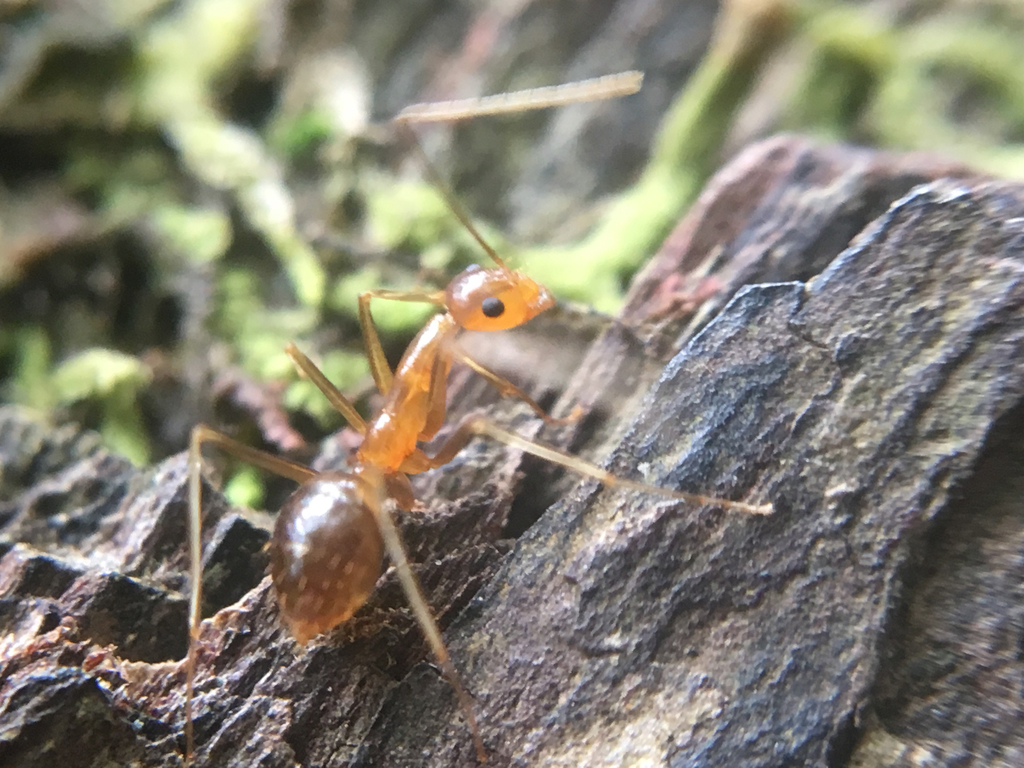
The yellow crazy ant (Anoplolepis gracilipes), also known as the long-legged ant or Maldive ant, is a species of ant, thought to be native to Asia.
- Kingdom
- Animalia
- Phylum
- Arthropoda
- Class
- Insecta
- Order
- Hymenoptera
- Family
- Formicidae
- Genus
- Anoplolepis
- Species
- Anoplolepis gracilipes
Description
The yellow crazy ant (Anoplolepis gracilipes), also known as the long-legged ant or Maldive ant, is a species of ant, thought to be native to Asia. They have been accidentally introduced to numerous places in the world's tropics. The yellow crazy ant has colloquially been given the modifier "crazy" on account of the ant's erratic movements when disturbed. Its long legs and antennae make it one of the largest invasive ant species in the world. Like several other invasive ants, such as the red imported fire ant (Solenopsis invicta), the big-headed ant (Pheidole megacephala), the little fire ant (Wasmannia auropunctata), and the Argentine ant (Linepithema humile), the yellow crazy ant is a "tramp ant", a species that easily becomes established and dominant in new habitat due to traits such as aggression toward other ant species, little aggression toward members of its own species, efficient recruitment, and large colony size. It is on a list of "one hundred of the world's worst invasive species" formulated by the International Union for Conservation of Nature (IUCN), having invaded ecosystems from Hawaii to the Seychelles, and formed supercolonies on Christmas Island in the Indian Ocean. In 2023, a scientific article postulated a unique reproductive cycle for A. gracilipes, suggesting that males are obligate chimeras.
Gallery
Ajouter des photos
Partagez vos photos de cette espèce (jusqu'à 20 à la fois) : elles sont vérifiées automatiquement, puis publiées.
Répartition
Occurrences observées (données GBIF). Les zones hors aire d'origine peuvent indiquer une présence introduite ou invasive.
Sources et crédits
Informations provenant de plusieurs sources vérifiées. Dernière mise à jour : .
Crédits photos (8)
- Photo : Damon Tighe (@damontighe) · CC BY-NC 4.0 · via iNaturalist
- Photo : Max Hsieh(雁子) (@maxhsieh) · CC BY-NC 4.0 · via iNaturalist
- Photo : Damien Wallace (@damienxw) · CC0 (domaine public) · via iNaturalist
- Photo : 逸愷 (@kate9999) · CC BY-NC 4.0 · via iNaturalist
- Photo : @zoezac · CC BY-NC 4.0 · via iNaturalist
- Photo : Dominik Maximilián Ramík (@dominik_ramik) · CC BY 4.0 · via iNaturalist
- Photo : @maggie_wong · CC BY-NC 4.0 · via iNaturalist
- Photo : @saraptor · CC BY-NC 4.0 · via iNaturalist
Mentions de licence
Texte disponible sous licence CC BY-SA 4.0. Il adapte notamment Wikipedia (CC BY-SA) : Yellow crazy ant (Wikipédia, auteurs dans l’historique de l’article).
- Taxonomie : GBIF Backbone Taxonomy (CC BY 4.0)
- Carte : occurrences GBIF, fond © contributeurs OpenStreetMap (ODbL)
Détail : Sources et licences.
Discussion (0)
Aucun message pour l’instant. Lancez la discussion sur cette fiche (sources, précisions, débats éditoriaux).
Connectez-vous pour participer à la discussion.