
Clark's Andrena
Andrena clarkella
The Clark's miner bee (Andrena clarkella) is a species of miner bee in the family Andrenidae.
- Kingdom
- Animalia
- Phylum
- Arthropoda
- Class
- Insecta
- Order
- Hymenoptera
- Family
- Andrenidae
- Genus
- Andrena
- Species
- Andrena clarkella
Description
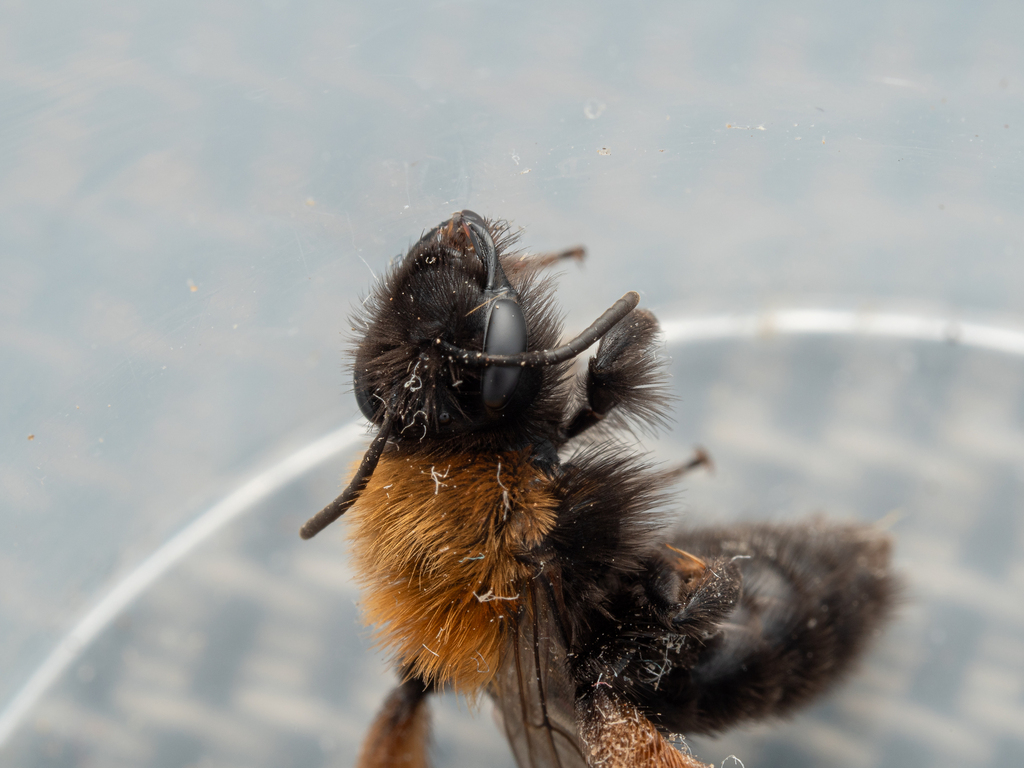
The Clark's miner bee (Andrena clarkella) is a species of miner bee in the family Andrenidae. Other common names include Clark's andrena and Clarke's mining bee. It is found in Europe and Northern Asia (excluding China) and North America. Etymology: KIRBY named the species in honor of Bracy Clark, an English entomologist. Identification: 10-13 mm. Male with brown hair with loose tergite bands. Rarely on flowers, more on tree bark basking. In the field not to distinguish from similar Andrena species. Female easy to determine in the field: very densely hairy, with black hairs on the abdomen and reddish brown hair on the mesonotum. Hind legs fox red with equally colored rail brush. Small specimens resemble Andrena bicolor. Terminal fringe dark brown. Pollen sources: Oligolectic on willows (Salix, Salicaceae). Nest building: Bare to sparsely overgrown areas in sparse forests Forest fringes or clearings, preferably in sandy soil, but also nests in humus soils, mostly in smaller aggregations with low nest density. The nest entrance is locked before each food supply flight. One to four brood cells are created per nest, often only 5 cm, a maximum of 30 cm below the surface. Habitat: Affinity to forests; forest fringes, forest clearings, clear cuts, preferred on sandy soil. From the lowlands to the subalpine altitude. Parasites: cuckoo bee is Nomada leucophthalma. As another nest parasite Bombylius major was observed. Adults are sometimes infested with Stylops melittae. Flight period: In one generation from early March to mid-May.
Gallery
Ajouter des photos
Partagez vos photos de cette espèce (jusqu'à 20 à la fois) : elles sont vérifiées automatiquement, puis publiées.
Répartition
Occurrences observées (données GBIF). Les zones hors aire d'origine peuvent indiquer une présence introduite ou invasive.
Sources et crédits
Informations provenant de plusieurs sources vérifiées. Dernière mise à jour : .
Crédits photos (6)
- Photo : Fyodor Churochkin (@nowoji) · CC BY-NC 4.0 · via iNaturalist
- Photo : Sebi99883 (@sebi99993) · CC BY-NC 4.0 · via iNaturalist
- Photo : Hjalte Kjærby (@hjallevad) · CC BY-NC 4.0 · via iNaturalist
- Photo : Arūnas Juknevičius (@arunasjuknevicius) · CC BY-NC 4.0 · via iNaturalist
- Photo : София Р. (@sofya_hm) · CC BY-NC 4.0 · via iNaturalist
- Photo : @vyatka · CC BY-NC 4.0 · via iNaturalist
Mentions de licence
Texte disponible sous licence CC BY-SA 4.0. Il adapte notamment Wikipedia (CC BY-SA) : Andrena clarkella (Wikipédia, auteurs dans l’historique de l’article).
- Taxonomie : GBIF Backbone Taxonomy (CC BY 4.0)
- Carte : occurrences GBIF, fond © contributeurs OpenStreetMap (ODbL)
Détail : Sources et licences.
Discussion (0)
Aucun message pour l’instant. Lancez la discussion sur cette fiche (sources, précisions, débats éditoriaux).
Connectez-vous pour participer à la discussion.