
Agriphila inquinatella
Agriphila inquinatella
The name Agriphila inquinatella has been misapplied to some related species in the past; see below for details.
- Kingdom
- Animalia
- Phylum
- Arthropoda
- Class
- Insecta
- Order
- Lepidoptera
- Family
- Crambidae
- Genus
- Agriphila
- Species
- Agriphila inquinatella
Description
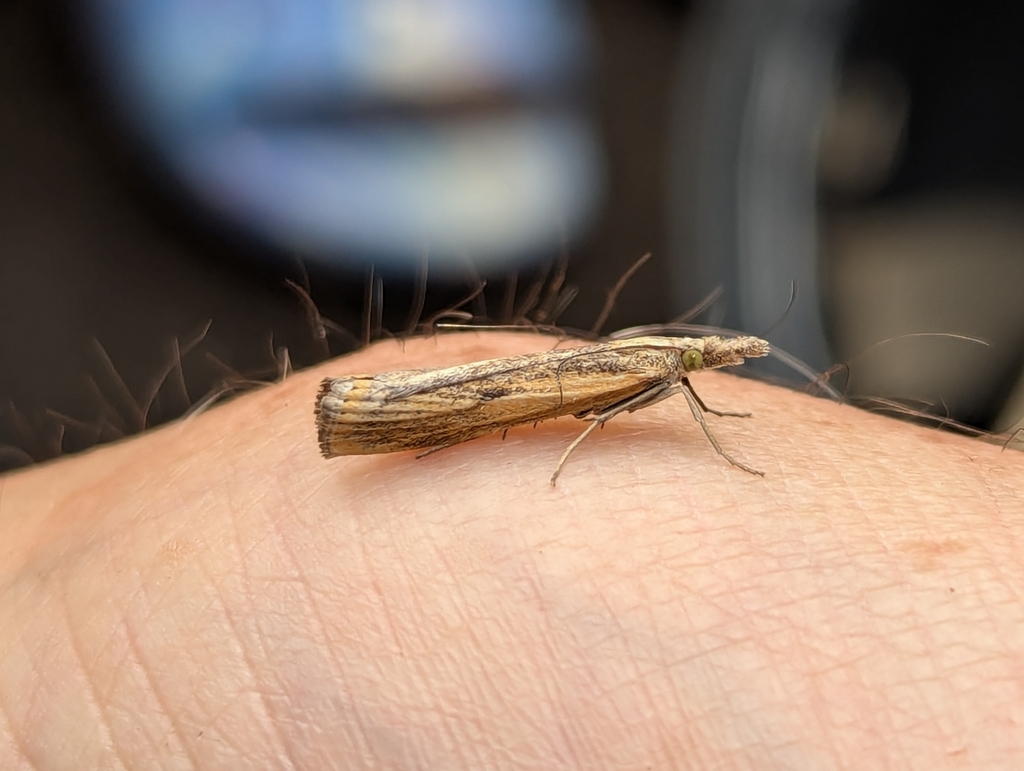
The name Agriphila inquinatella has been misapplied to some related species in the past; see below for details. Agriphila inquinatella is a small moth species of the family Crambidae. It is found in Europe, around the Caucasus area to Turkestan, and in the Near East to Jordan. The type locality is in Austria. Three subspecies are accepted today: Agriphila inquinatella inquinatella (Denis & Schiffermüller, 1775) – most of the range Agriphila inquinatella nevadensis (Caradja, 1910) – Sierra Nevada and presumably elsewhere in Spain Agriphila inquinatella elbursella (Zerny, 1939) – Alborz mountains and presumably elsewhere in the Caucasus region Their wingspan is 23–29 mm. Similar to Agriphila geniculea and Agriphila tolli. The forewing ground colour is cream to straw brown.The forewing has scattered black scales and the veins are widely marked whitish.There is a distinctive dark stain on dorsal side of the discal cell (and on the upper edge of the angled median streak).The outer cross-line is broken by projections of the median streak. There is a single row of black sub-terminal dots. The cilia are grey. In the similar A. geniculea the lines are strongly angled and the cilia glossy or metallic. Meyrick - Face with sharp cone. Forewings light yellow-ochreous, somewhat mixed with pale brownish, with scattered dark fuscous scales, sometimes more or less wholly suffused with rather dark brown; veins suffusedly paler or whitish-ochreous, especially median; angulated median and second lines indistinct, brownish, marked with dark fuscous below middle; a terminal series of black dots; cilia rather dark shining fuscous, in female paler. Hindwings grey. Larva dull grey-greenish to purplish-brown; spots large, darker; head dark brown or blackish. The caterpillars feed mainly on Poaceae grasses, such as meadow-grass species (Poa) or sheep's fescue (Festuca ovina) in silken galleries. They can be found under pebbles adjacent to their food plants, suggesting that they feed on the plants' roots. A more unusual food plant is the Pottiales moss Tortula muralis.
Gallery
Ajouter des photos
Partagez vos photos de cette espèce (jusqu'à 20 à la fois) : elles sont vérifiées automatiquement, puis publiées.
Répartition
Occurrences observées (données GBIF). Les zones hors aire d'origine peuvent indiquer une présence introduite ou invasive.
Sources et crédits
Informations provenant de plusieurs sources vérifiées. Dernière mise à jour : .
Crédits photos (8)
- Photo : Mariya (@muky) · CC BY-NC 4.0 · via iNaturalist
- Photo : Jaro Schacht (@jaroschacht) · CC BY-NC 4.0 · via iNaturalist
- Photo : @mothdragon · CC BY-NC 4.0 · via iNaturalist
- Photo : @carrierlolo · CC BY-NC 4.0 · via iNaturalist
- Photo : Zachi Mihai (@zmihai) · CC BY-NC 4.0 · via iNaturalist
- Photo : Michael Grundner (@migru) · CC BY 4.0 · via iNaturalist
- Photo : Bo Sundqvist (@bogao) · CC BY-NC 4.0 · via iNaturalist
- Photo : @halinaa · CC BY-NC 4.0 · via iNaturalist
Mentions de licence
Texte disponible sous licence CC BY-SA 4.0. Il adapte notamment Wikipedia (CC BY-SA) : Agriphila inquinatella (Wikipédia, auteurs dans l’historique de l’article).
- Taxonomie : GBIF Backbone Taxonomy (CC BY 4.0)
- Carte : occurrences GBIF, fond © contributeurs OpenStreetMap (ODbL)
Détail : Sources et licences.
Discussion (0)
Aucun message pour l’instant. Lancez la discussion sur cette fiche (sources, précisions, débats éditoriaux).
Connectez-vous pour participer à la discussion.