
Luna Moth
Actias luna
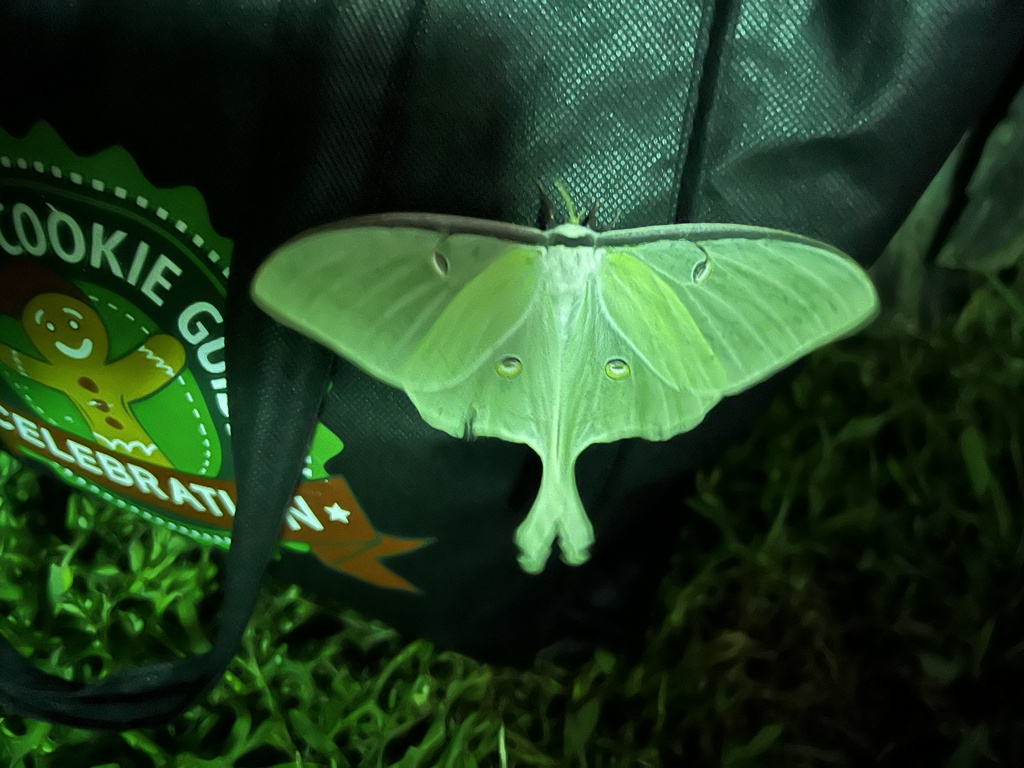
The luna moth (Actias luna), also called the American moon moth, is a Nearctic moth in the family Saturniidae, subfamily Saturniinae, a group commonly named the giant silk moths.
- Kingdom
- Animalia
- Phylum
- Arthropoda
- Class
- Insecta
- Order
- Lepidoptera
- Family
- Saturniidae
- Genus
- Actias
- Species
- Actias luna
Description
The luna moth (Actias luna), also called the American moon moth, is a Nearctic moth in the family Saturniidae, subfamily Saturniinae, a group commonly named the giant silk moths. The moth has lime-green wings and a white body. Its caterpillars are also green. Its typical wingspan is roughly 114 mm (4.5 in), but wingspans can exceed 178 mm (7.0 in), ranking the species as one of the larger moths found in North America. Across Canada, it has one generation per year, with the winged adults appearing in late May or early June, whereas farther south it will have two or even three generations per year, the first appearance as early as March in southern parts of the United States. As defense mechanisms, larvae emit clicks as a warning and can also regurgitate intestinal contents, confirmed as having a deterrent effect on a variety of predators. The elongated tails of the hindwings are thought to confuse the echolocation detection used by predatory bats. A parasitoid fly deliberately introduced to North America as a biological pest control for the invasive species spongy moth (also known as gypsy moth) appears to have had a negative impact on luna moths and other native moths.
Gallery
Ajouter des photos
Partagez vos photos de cette espèce (jusqu'à 20 à la fois) : elles sont vérifiées automatiquement, puis publiées.
Répartition
Occurrences observées (données GBIF). Les zones hors aire d'origine peuvent indiquer une présence introduite ou invasive.
Sources et crédits
Informations provenant de plusieurs sources vérifiées. Dernière mise à jour : .
Crédits photos (8)
- Photo : Barb Snyder (@traveler3) · CC BY-NC 4.0 · via iNaturalist
- Photo : @ericlopresti · CC BY-NC 4.0 · via iNaturalist
- Photo : @leealloway · CC BY-NC 4.0 · via iNaturalist
- Photo : Paul Manning (@paulypod) · CC0 (domaine public) · via iNaturalist
- Photo : Peter Wilson (@pwilson96) · CC BY-NC 4.0 · via iNaturalist
- Photo : Maria Dunlavey (@mdunlavey) · CC BY-NC 4.0 · via iNaturalist
- Photo : Robert Eberhardt (@robert_alabama) · CC0 (domaine public) · via iNaturalist
- Photo : Samuel Paul Galick (@sgalick) · CC0 (domaine public) · via iNaturalist
Mentions de licence
Texte disponible sous licence CC BY-SA 4.0. Il adapte notamment Wikipedia (CC BY-SA) : Luna moth (Wikipédia, auteurs dans l’historique de l’article).
- Taxonomie : GBIF Backbone Taxonomy (CC BY 4.0)
- Carte : occurrences GBIF, fond © contributeurs OpenStreetMap (ODbL)
Détail : Sources et licences.
Discussion (0)
Aucun message pour l’instant. Lancez la discussion sur cette fiche (sources, précisions, débats éditoriaux).
Connectez-vous pour participer à la discussion.